
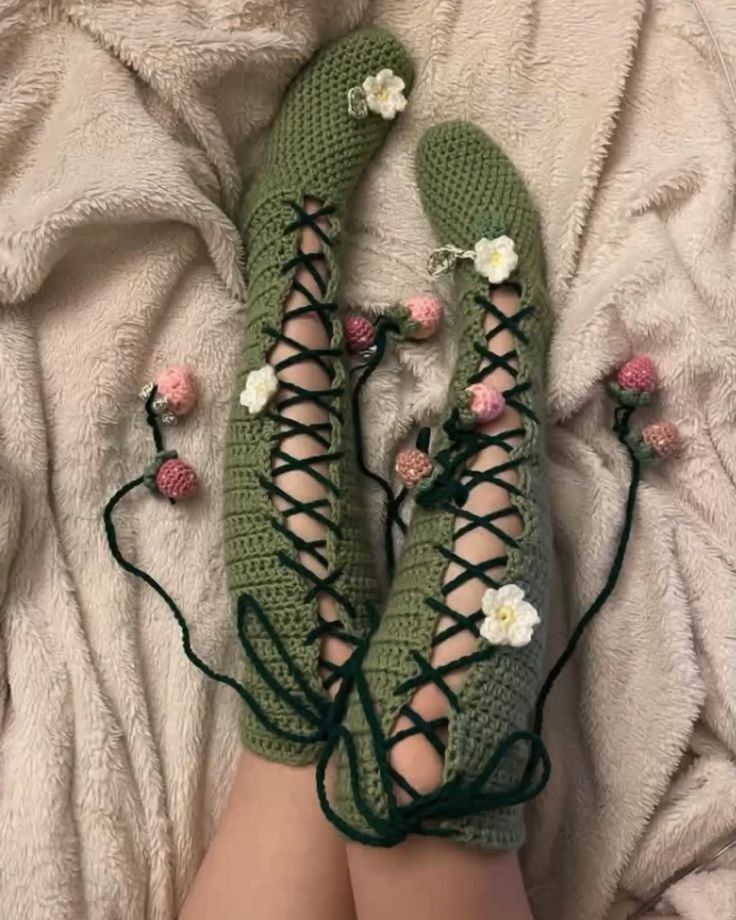
Overknee Socks Crochet Pattern is a beautiful wearable crochet project that combines cozy handmade footwear with an elegant lace-up design and delicate floral details. Inspired by the long sage-green crochet socks in the reference image, this style features a fitted foot, an extended leg section, an open front panel, and contrasting crochet laces woven in a crisscross pattern. Small flowers, leaves, and berry-like embellishments can be added afterward to transform an ordinary pair of crochet socks into a romantic botanical accessory.
One of the most appealing aspects of this Overknee Socks Crochet Pattern is the opportunity to customize the fit. Unlike a basic decorative sock, an over-the-knee design needs to follow several areas of the leg, including the ankle, calf, knee, and lower thigh. Careful measurements and regular fitting are therefore more important than simply following a fixed stitch count. Once the basic construction is understood, however, the pattern can be adapted to different sizes without changing its overall appearance.
The project is best suited to an intermediate crocheter, although an adventurous beginner who understands increases, decreases, and basic garment shaping can also work through it gradually. The instructions below use U.S. crochet terminology and explain a practical method for recreating the appearance of the photographed socks rather than claiming exact stitch counts from the image. Because feet and legs vary considerably, the most reliable approach is to combine a gauge swatch with your own measurements.
Materials, Measurements, and Crochet Stitches You Will Need
For this Overknee Socks Crochet Pattern, choose a soft yarn with good stitch definition and some resilience. A lightweight category 2 or category 3 yarn works particularly well. Wool blends, cotton blends, and soft acrylic blends can all be suitable depending on the season and desired warmth.
DISCOVER MORE FREE PATTERNS HERE!
Approximately 700–1,000 yards (640–915 m) of the main sage or olive-green yarn is a reasonable starting range for an adult pair, although the actual quantity varies significantly according to leg length, size, gauge, and yarn weight. Keep additional dark-green yarn for the lacing, leaves, and stems, plus small amounts of pink, cream, and white for the flowers and berries.
A crochet hook between approximately 3.0 and 4.0 mm can work well with lighter yarns. Select the hook that produces a firm yet flexible fabric. The sock should stretch comfortably around the foot and leg without becoming stiff.
You will also need a tapestry needle, scissors, stitch markers, flexible measuring tape, and optional blocking supplies. Because this is fitted clothing, measure the foot length, ball of foot, ankle, widest calf, knee, lower thigh, and desired total height before beginning.
Useful abbreviations include ch (chain), sl st (slip stitch), sc (single crochet), hdc (half double crochet), dc (double crochet), sc2tog (single crochet two together), and dc2tog (double crochet two together). Depending on your preferred texture, the primary fabric can be made predominantly with sc or hdc.
Before beginning the actual socks, make a gauge swatch measuring at least 4 x 4 inches (10 x 10 cm). Wash and dry the swatch according to the yarn instructions before measuring it. This gives you a much more dependable basis for calculating the fitted circumference of the socks.
Crocheting the Foot, Toe, Heel, and Ankle
Begin the crochet overknee socks at the toe. One convenient construction method starts with an oval. Chain enough stitches to create a foundation slightly shorter than the desired toe width, then work around both sides of the chain.
Place several stitches into each end of the foundation chain so the crochet begins forming a rounded oval. Continue working in rounds while increasing evenly at both sides until the piece comfortably covers the toes and reaches approximately the ball of the foot.
Once the required circumference has been established, stop increasing and crochet evenly toward the heel. Use single crochet for a dense fabric or half double crochet for slightly more stretch and quicker progress. Keep the beginning-of-round marker in place throughout.
Try the sock on regularly. The fabric should fit closely without pulling the toes inward. Remember that crochet generally has less natural stretch than knitted sock fabric, so a little comfortable ease is important.
When you reach the heel, work only across the stitches covering the back half of the foot. Crochet back and forth to create a heel flap approximately long enough to reach the natural back of the heel. Shape the heel with gradual decreases near the center or sides.
After shaping, resume working around the complete ankle. Pick up stitches neatly along the edges of the heel section. If the ankle feels too loose, make several evenly distributed decreases during the first few rounds until the sock sits comfortably.
Building the Lace-Up Leg and Shaping the Overknee Section
The distinctive feature of this Overknee Socks Crochet Pattern is the open lace-up front. Instead of continuing in closed rounds for the entire leg, begin working back and forth once the ankle section has reached the desired height.
Leave a vertical opening approximately 1½–2½ inches (4–6 cm) wide along the front of the leg. Crochet from one side of this opening around the back of the leg and finish at the opposite side. Turn and repeat.
Create reinforced edges beside the opening by working the first and last few stitches in single crochet. These borders support the laces and help prevent the opening from stretching excessively.
Add small eyelets at regular intervals. A simple eyelet can be formed by working ch 1, skip 1 stitch near the edge and continuing the row. On the following row, work into the chain space. Repeat the eyelets approximately every 1–1½ inches (2.5–4 cm).
As the sock approaches the calf, gradually increase the stitch count. Rather than adding many stitches at once, add one stitch near each side every several rows. Try the sock on frequently because calf shaping varies greatly between wearers.
Continue upward through the knee and toward the lower thigh. Above the calf, additional increases may be necessary. The top should remain secure without restricting movement or circulation. Finish with several rows of firmer single crochet or a subtle ribbed edging.
Making the Crochet Laces, Flowers, Leaves, and Berry Details
For the dramatic lacing seen in the inspiration, use dark-green yarn and create a long crochet cord. A simple chain works, but a slip-stitch cord or crochet Romanian-style cord provides greater strength and a more finished appearance.
Thread the cord through the eyelets from the ankle upward, crossing it alternately from one side to the other. The resulting X-shaped pattern should remain loose enough to allow comfortable movement. Leave generous ends near the ankle or upper leg for tying into decorative bows.
To make a small flower, begin with a magic ring. Work five groups such as (sc, hdc, dc, hdc, sc) into the ring, repeating the sequence five times to form rounded petals. Close the ring firmly and weave in the ends.
For the small pink berry decorations, crochet 6 sc into a magic ring. Increase around the next round, then work one or two even rounds. Add a small amount of fiberfill if desired, decrease until closed, and leave a yarn tail for attachment.
Small leaves can be crocheted by chaining approximately 5–7 stitches, then working sc, hdc, dc, hdc, sc along the chain. Work around the opposite side if you want a fuller leaf. Dark forest green provides attractive contrast against a muted sage sock.
Arrange the flowers, leaves, and berries only after both socks are complete. Sew them firmly with matching yarn, keeping embellishments away from high-friction areas under the foot. Long decorative stems can be created from crochet chains and lightly secured at selected points so they maintain the trailing botanical appearance.
FAQ About the Overknee Socks Crochet Pattern
Is the Overknee Socks Crochet Pattern suitable for beginners?
It is better suited to intermediate crocheters because it involves garment fitting, heel construction, increases, decreases, eyelets, and decorative elements. A confident beginner can still attempt it by working slowly and trying the sock on frequently.
What yarn should I use for crochet overknee socks?
A soft lightweight yarn with good durability is preferable. Wool blends provide warmth and resilience, while cotton blends can create a lighter version.
What crochet hook size works best?
Approximately 3.0–4.0 mm is a useful range for many lightweight yarns, but gauge and the yarn manufacturer’s recommendation should determine the final hook size.
How much yarn will I need?
An adult pair may require approximately 700–1,000 yards (640–915 m), but tall socks can vary greatly in yarn consumption according to size, gauge, stitch density, and leg length.
How do I make the socks stay above the knee?
Accurate thigh measurements are essential. A fitted upper edge, appropriate negative ease for the specific yarn, and adjustable lacing can improve stability. Some crocheters may also choose to incorporate elastic thread into the upper edging.
Can I make them shorter?
Yes. Stop the leg section at mid-calf or just below the knee and finish the upper border there.
Can I make the front completely closed?
Certainly. Continue crocheting in rounds instead of turning back and forth. The lace-up section is decorative as well as functional, but it is not required for the basic sock construction.
How should I measure my foot?
Measure from heel to longest toe, around the widest part of the foot, around the ankle, and around the calf. For an overknee version, also measure the knee, lower thigh, and vertical distance from the floor to the desired upper edge.
Can I use chunky yarn?
It is possible, but chunky yarn will create substantially thicker socks and may make shoes uncomfortable. Lightweight yarn provides better definition and a more flexible fit.
How do I make two socks the same size?
Write down the number of rows between every increase and decrease. Count stitches frequently and measure the first sock at several points before beginning the second.
Can the flowers be removed?
Yes. The Overknee Socks Crochet Pattern works beautifully without embellishments. You can also replace the flowers with leaves, bows, stars, hearts, or other small motifs.
Can I use different colors?
Absolutely. Cream and brown create a cottage-inspired look, black and burgundy can produce a dramatic style, while lavender, dusty rose, forest green, or neutral beige can give the socks a softer appearance.
Should I block the finished socks?
Light blocking can improve stitch definition, but avoid stretching the garment beyond its intended measurements. Always follow the care instructions for your specific yarn.
Are crocheted overknee socks suitable for wearing inside shoes?
That depends on yarn thickness and shoe fit. This decorative style is particularly suitable as cozy indoor legwear or worn with roomy footwear rather than tightly fitted shoes.
Conclusion
The Overknee Socks Crochet Pattern combines practical crochet construction with a beautiful romantic design. From the shaped toe and fitted foot to the heel, calf increases, over-the-knee length, open front, and dramatic crisscross lacing, every stage provides an opportunity to develop useful garment-making skills.
In this tutorial, we covered how to select yarn and determine gauge, measure the foot and leg, crochet the toe and foot, shape the heel, build the ankle, gradually increase around the calf and thigh, create reinforced eyelets, and finish the design with long crochet laces. We also explored how simple crochet flowers, leaves, berries, and vines can transform the finished socks into a distinctive botanical accessory.
The most important element when making fitted crochet socks is measurement. Use the stitch counts required by your own gauge rather than relying on a universal number, and try the work on regularly as you progress. This approach produces a much more comfortable and personalized Overknee Socks Crochet Pattern.
Once you understand the construction, experiment with different colors, yarn textures, lace styles, and floral arrangements to create your own version. If you make these crochet overknee socks, leave your sincere opinion about the pattern and share your suggestions for future crochet tutorials.