
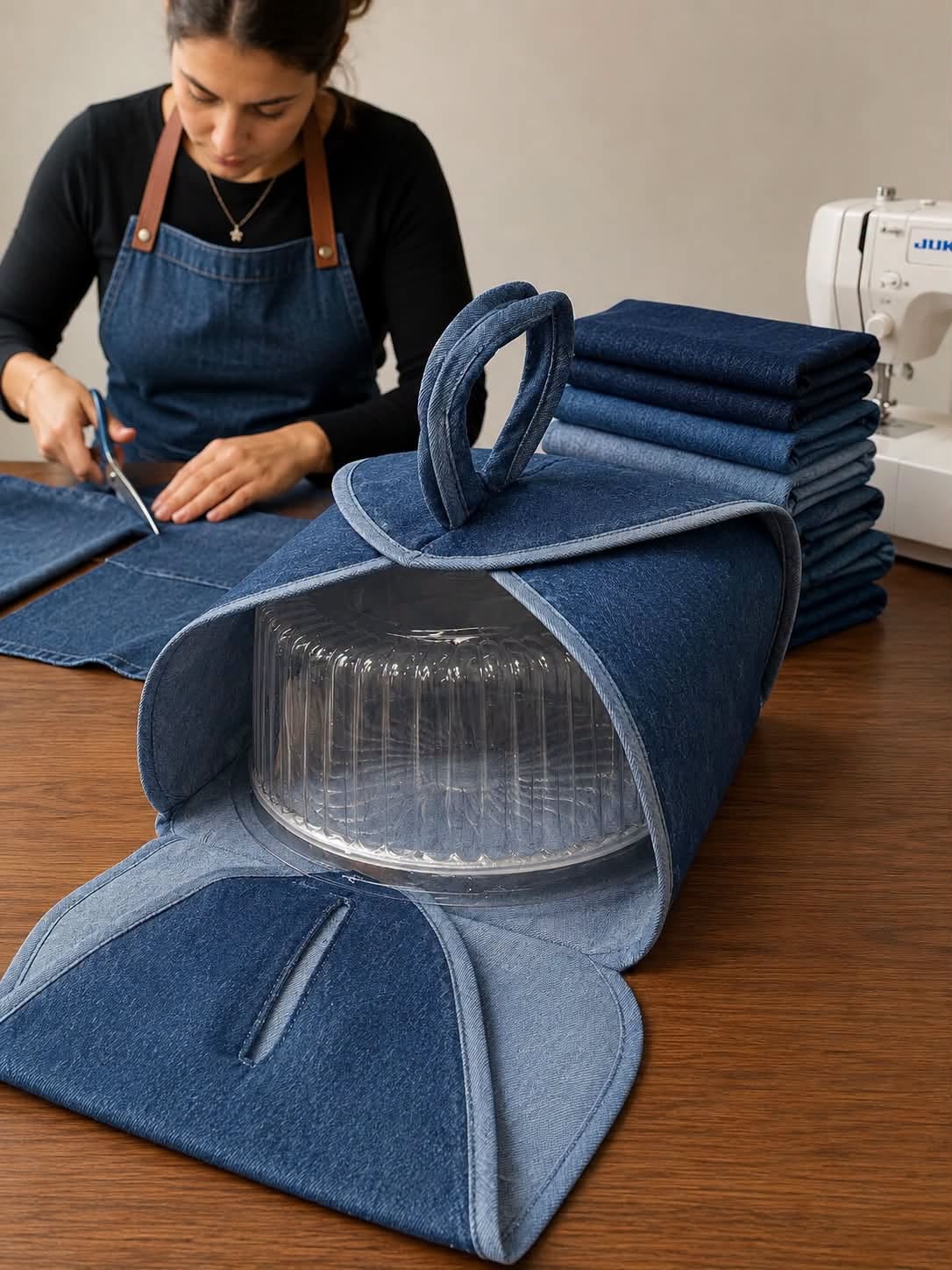
Saucepan Holder Pattern is a practical quilted sewing project designed to create a padded fabric carrier that helps protect and transport covered cookware, casserole dishes, serving bowls, and similar kitchen containers. Inspired by the denim-style holder shown in the reference image, this project combines a structured quilted body, protective padding, bound edges, overlapping flaps, and sturdy fabric handles. The result is a useful handmade kitchen accessory that can also make an attractive housewarming or holiday gift.
One of the most appealing features of this quilted saucepan holder is its simple construction. Instead of requiring complicated bag hardware or a zipper, the design relies on shaped padded panels that wrap around the cookware. When opened, the holder lies relatively flat, making it easier to position the dish inside. Once the flaps are folded into place, the handles come together at the top and create a convenient carrying point. The contrasting binding visible around the edges also gives the project a neat, professional finish.
This tutorial uses the photograph as inspiration rather than presenting an exact commercial template. Because saucepans, casserole dishes, and serving containers vary greatly in size and shape, the most reliable method is to measure the container you intend to carry and customize the pattern accordingly. The instructions below explain how to draft the pieces, select suitable fabrics, add thermal padding, quilt the layers, construct the handles, bind the curved edges, and assemble a finished Saucepan Holder Pattern that is both attractive and functional.
Materials, Measurements, and Preparing the Saucepan Holder Pattern
Begin by choosing a durable exterior fabric. The reference project has a beautiful denim appearance, and cotton denim, canvas, cotton duck, or heavyweight quilting cotton are excellent options. If using actual denim, a medium-weight variety is easier to sew than very heavy jeans denim, especially because several layers will eventually meet along the bound edges.
DISCOVER MORE FREE PATTERNS HERE!
For the lining, choose a tightly woven cotton fabric that coordinates with the exterior. You can use lighter blue cotton to reproduce the two-tone effect shown in the photograph, or create contrast with gingham, florals, stripes, or kitchen-themed prints. Prewash cotton fabrics before cutting if you expect the completed holder to be washed.
You will also need cotton batting or appropriate heat-resistant insulated batting, coordinating thread, bias binding, fabric clips, scissors or a rotary cutter, ruler, marking tool, sewing machine, and iron. If the holder may be used around warm cookware, select materials specifically rated for the temperatures and use you expect. Ordinary polyester batting should not automatically be assumed to provide heat protection.
To determine your dimensions, measure the cookware across its widest point. Then measure its height. A useful starting principle is to create a central supporting area slightly larger than the bottom of the container and extend the surrounding flaps far enough to overlap comfortably around the sides and top.
For example, if your container is approximately 12 inches (30.5 cm) across, you might begin experimenting with a central section approximately 13–14 inches (33–35.5 cm) across, then add generous side extensions. These are drafting suggestions rather than universal finished dimensions. Make a paper prototype before cutting valuable fabric.
The characteristic appearance of this fabric saucepan carrier comes from its rounded overlapping panels. Draw the first full-size template on paper, add smooth curves to the corners, and mark the center lines. Place the paper around the intended cookware to confirm that the panels provide sufficient coverage and that the handles can meet comfortably above the container.
Cutting, Layering, and Quilting the Main Fabric Panels
Once you are satisfied with your paper template, cut the exterior fabric, batting, and lining. If your design uses multiple overlapping sections, label every piece before sewing. Accurate labeling is particularly helpful when exterior fabrics are similar in color but individual panels have different orientations.
Create a traditional quilt sandwich with the lining wrong side up, batting in the middle, and exterior fabric right side up. Smooth all three layers carefully. Baste them with quilting pins, temporary basting methods, or clips around the perimeter.
Quilt the layers before completing the final assembly. Straight-line quilting is ideal for this project because it strengthens the carrier without distracting from the clean design. You can quilt parallel lines, a grid, diagonal diamonds, or gentle geometric shapes.
Keep the quilting density reasonably consistent across every panel. This matters because heavily quilted sections can shrink slightly compared with less-quilted areas. After quilting, place the original template over each piece again and trim the edges to restore the intended shape.
If you want the structured denim appearance shown in the photograph, use enough batting to provide body without making the carrier difficult to fold. Excessively thick batting can create bulky intersections, particularly around the handles and binding.
Before proceeding, place your cookware on the quilted section and perform another fitting test. Bring the sides upward without forcing them. At this stage you can still adjust the curves or reduce unnecessary bulk before binding the edges.
Making the Handles and Assembling the Saucepan Holder
The handles are an important structural feature of the Saucepan Holder Pattern. They should be comfortable to hold and securely attached to the quilted body. Cut two identical fabric strips according to the scale of your carrier.
For a medium carrier, you could test strips approximately 4–5 inches (10–12.5 cm) wide before folding, with the length determined by how high you want the handles to rise. These dimensions are customizable. A larger container generally benefits from wider, stronger handles.
Fold each handle strip lengthwise and press. Fold the raw long edges toward the center, then fold the entire strip again. Add a narrow strip of batting or sturdy interfacing inside if additional structure is desired. Stitch along both long edges.
Alternatively, create padded handles using exterior fabric, lining, and thin batting. Sew right sides together, turn the tube, press it flat, and topstitch along both edges. This technique creates the rounded padded handles seen in many quilted casserole carriers.
Position the handles symmetrically on opposite sections of the carrier. Measure carefully rather than relying only on visual placement. Sew each handle securely using reinforced rectangular stitching. Keep the attachment areas away from locations where they might interfere with the final binding.
Now test the complete arrangement. Put an empty, cool container in the center, fold the first pair of flaps around it, bring the remaining panels into position, and lift the handles together. Adjust the overlap until the carrier sits evenly.
Binding, Finishing, and Using the Quilted Saucepan Holder
Binding is one of the details that makes this project look professionally finished. Because the carrier contains rounded edges, bias binding is particularly useful. Bias-cut fabric stretches gently around curves and is less likely to wrinkle than straight-grain binding.
You can purchase ready-made binding or make your own from coordinating cotton. The reference design uses a lighter blue binding against the dark denim exterior, creating a subtle but attractive outline. Contrasting binding is also an excellent way to introduce another color into the project.
Attach the binding gradually around the perimeter. Work slowly around the curves, allowing the bias strip to follow the shape naturally. Avoid stretching it aggressively because excessive tension can cause the finished edge to curl.
Fold the binding over the raw edge and secure the second side with machine stitching or neat hand stitching. Inspect the entire perimeter afterward to make sure no raw edges have escaped the binding. Reinforce areas that will experience frequent handling.
Give the completed quilted saucepan holder a final press according to the fabric and batting manufacturers’ care instructions. Do not flatten padded handles excessively. Remove loose threads and check every structural seam.
For actual use, remember that a fabric carrier is not automatically an oven mitt. Unless every material and layer has been specifically selected and rated for heat-handling applications, allow cookware to cool to a safe temperature before placing it inside. Never assume ordinary cotton fabric and batting will protect hands from a hot pan.
FAQ About the Saucepan Holder Pattern
What is a Saucepan Holder Pattern?
A Saucepan Holder Pattern is a sewing template used to create a padded fabric carrier or wrap for cookware. Depending on its dimensions, it can accommodate casserole dishes, bowls, pans, or other covered kitchen containers.
Is this project suitable for beginners?
Yes. A confident beginner can complete it, particularly if the design uses straightforward quilted panels. Binding curved edges is probably the most technique-sensitive part.
What is the best exterior fabric?
Cotton denim, canvas, cotton duck, and quality quilting cotton are good choices. The fabric should be durable enough to withstand repeated handling.
Can I make it from old jeans?
Yes. Upcycled denim can be an excellent material. Avoid sections containing very bulky seams unless you specifically incorporate them into the design.
What batting should I use?
Cotton batting works well for general padding. If thermal performance is required, use an insulating material specifically manufactured and rated for that purpose.
Does regular batting make the holder heatproof?
No. Regular batting should not be treated as guaranteed heat protection. Always follow the specifications of the materials you use.
Can I place a pan directly from the oven into the carrier?
Only if the complete construction and all materials are specifically designed and rated for that temperature and application. For a general fabric carrier, the safer approach is to let the cookware cool appropriately first.
How do I determine the correct size?
Measure the intended container across its widest point and measure its height. Draft the center and flaps with additional room for wrapping and overlap.
Should I include seam allowance?
Yes. If your template represents the finished dimensions, add your chosen seam allowance before cutting. If the edges will be completely enclosed with binding after quilting, account for that construction method during drafting.
Why should I make a paper prototype?
Cookware varies considerably in shape. A paper prototype lets you test whether the flaps overlap correctly without wasting fabric and batting.
Can the carrier be made larger for a casserole dish?
Absolutely. The same construction principles can be adapted into a quilted casserole carrier by increasing the central area and surrounding panels.
Can I use patchwork for the exterior?
Yes. Sew your patchwork panel first, press it carefully, and then cut the carrier pieces from the completed patchwork fabric.
Should I quilt the fabric before cutting the final shape?
You can rough-cut the layers slightly oversized, quilt them, and then trim them with your final template. This method helps compensate for minor shrinkage caused by quilting.
How wide should the handles be?
There is no universal measurement, but finished handles around 1–1.5 inches (2.5–3.8 cm) wide can provide a comfortable starting point for a medium carrier. Adjust according to the carrier’s size.
Can I add a closure?
Yes. Depending on your design, you can incorporate fabric ties, securely attached hook-and-loop tape, or another suitable closure. However, the overlapping construction may already provide sufficient containment for careful transport.
What type of binding works best around curves?
Bias binding is generally preferable because its diagonal grain allows it to conform more smoothly to rounded edges.
Can the holder be machine washed?
That depends on your materials. Prewashed cotton exterior, cotton lining, and washable batting can generally make care easier, but always follow the care requirements of every material used.
How can I make the project look professional?
Accurate cutting, consistent quilting, symmetrical handle placement, smooth curves, reinforced handle stitching, and evenly applied binding make the biggest visual difference.
Can I make several carriers in different sizes?
Yes. Creating small, medium, and large templates can give you a useful collection for different bowls and cookware.
Is this a good handmade gift project?
Definitely. A handmade quilted cookware carrier can be a practical gift for someone who enjoys cooking, entertaining, potlucks, family gatherings, or handmade kitchen accessories.
Conclusion
The Saucepan Holder Pattern combines quilting and practical sewing in a project that can be customized for the cookware you already own. Its padded construction protects the container during appropriate transport, while the overlapping panels and integrated handles create a convenient carrier-style design.
The most important step is accurate sizing. Rather than relying on one universal measurement, measure your saucepan, bowl, or casserole dish and create a paper prototype. This allows you to adjust the central support area, flap length, curves, and handle position before cutting your final fabrics.
Fabric selection provides plenty of room for creativity. Dark and light denim fabric can recreate the sophisticated appearance of the reference project, while floral cotton, gingham, patchwork scraps, canvas, or coordinated quilting prints can produce completely different styles.
Take particular care when quilting the layers and attaching the handles. Even quilting helps the carrier maintain its shape, while reinforced handle stitching improves durability. Finishing the perimeter with bias binding gives the curved edges a clean appearance and adds another opportunity for color contrast.
This project is also an excellent way to practice useful quilting skills on a manageable scale: making a quilt sandwich, straight-line quilting, trimming padded pieces, constructing handles, sewing curved edges, and applying binding. Those same techniques can later be used for bags, placemats, casserole carriers, organizers, and many other fabric projects.
With careful measurements and thoughtful finishing, your Saucepan Holder Pattern can become an attractive handmade kitchen accessory that is useful for family meals, gatherings, and appropriate transport of covered dishes. Choose your favorite fabrics, customize the dimensions for your cookware, and enjoy turning simple quilted layers into a functional project made entirely by hand.