
Sheep Pillows Pattern is a charming quilt-inspired sewing project that combines soft curves, simple appliqué pieces, and playful facial details to create an adorable decorative cushion. Inspired by the sheep pillows shown in the reference image, this project features a scalloped wool-shaped body, an oval face, floppy ears, oversized eyes, and gentle dimensional shaping. The finished pillow can be customized with traditional cream fabrics, colorful quilting cotton, gingham, solids, or coordinated scraps from your fabric collection.
One of the most enjoyable features of this sheep pillow sewing pattern is how easily the design can be personalized. A classic sheep can be made with ivory or white fabric, while a more whimsical version might use burgundy, red gingham, pastel blue, sage green, pink, or patchwork prints. The face can remain neutral in gray or taupe so that the expressive eyes and ears become the focal point. Because the body consists mainly of one large shaped piece, the project is approachable even if you have limited experience sewing curved stuffed projects.
The quilted sheep pillow can work beautifully as seasonal décor, farmhouse-inspired decoration, or a handmade accent for a craft room or family space. The construction also introduces useful sewing skills, including working with templates, sewing curves, clipping seam allowances, making appliqué features, stuffing evenly, and closing an opening by hand. The instructions below use suggested measurements that can be adjusted depending on the size of pillow you would like to make.
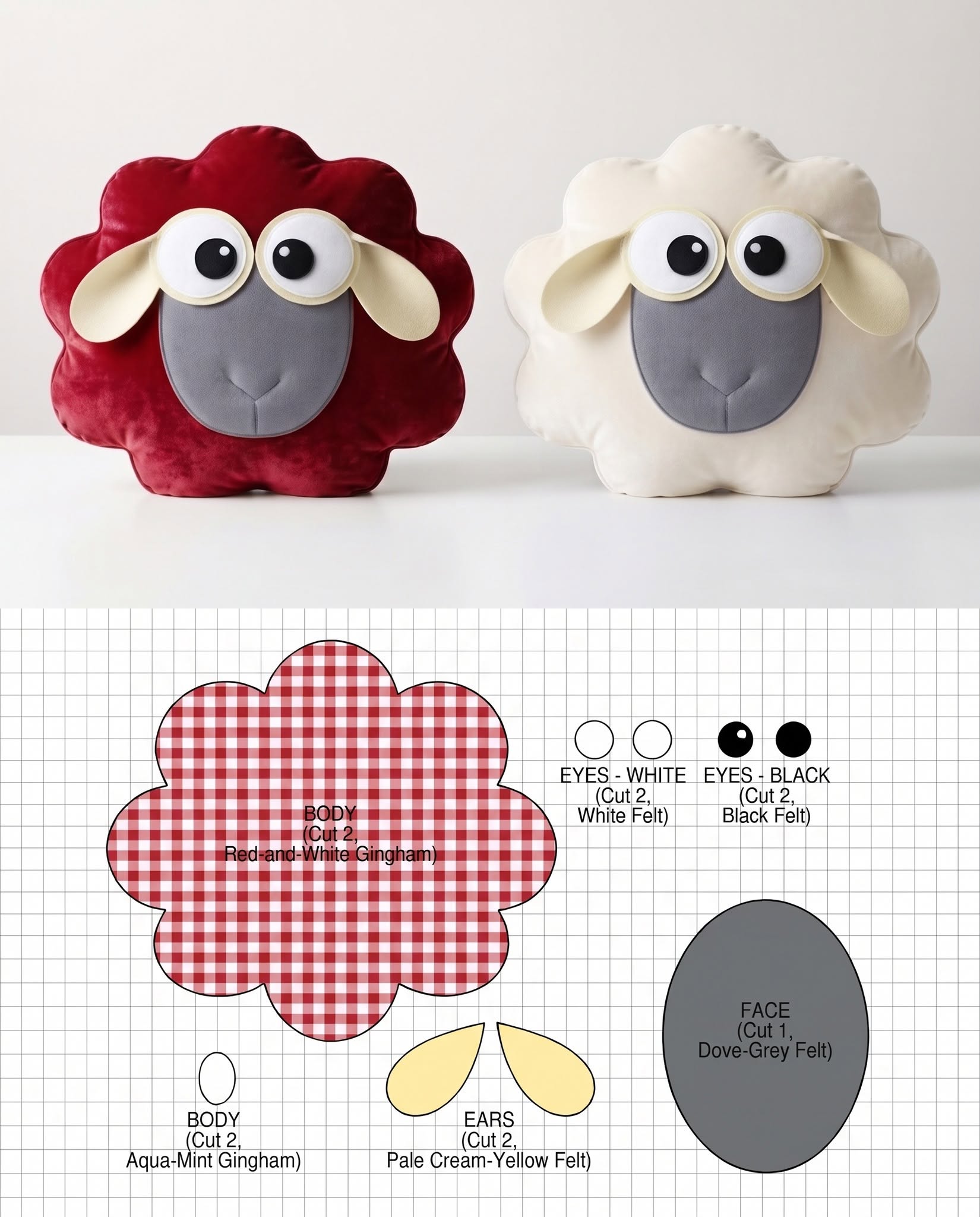
Materials, Measurements, and Pieces for the Sheep Pillows Pattern
For the main body, choose a medium-weight quilting cotton, cotton-linen blend, soft canvas, or similar woven fabric. For a pillow approximately 16 inches (40.5 cm) wide, around ½ yard (46 cm) of exterior fabric should provide comfortable cutting room for the front and back pieces.
DISCOVER MORE FREE PATTERNS HERE!
The sheep’s main body is shaped like a soft cloud or stylized wool fleece. Draft an approximately 16 x 15 inch (40.5 x 38 cm) shape with rounded scallops around the perimeter. Seven to ten broad curves create the fluffy appearance without making the seams unnecessarily difficult.
Cut two identical body pieces: one for the front and one for the back. If you want a quilted version, cut matching pieces of thin batting and quilt them to the exterior fabric before assembling the pillow. Lightweight batting provides structure while keeping the cushion soft.
For the face, cut one oval approximately 6 x 8 inches (15 x 20 cm) from gray, charcoal, taupe, or another contrasting fabric. Felt is particularly convenient because its edges do not fray, but quilting cotton backed with lightweight fusible web can also work.
Cut two long teardrop-shaped ears measuring approximately 5 x 2½ inches (12.5 x 6.5 cm). Cream, beige, or pale yellow works beautifully against a gray face. You can use felt for simple flat ears or sew two layers of fabric together if you prefer softly dimensional ears.
For the eyes, prepare two white circles approximately 2½ inches (6.5 cm) across and two smaller black circles approximately 1¼ inches (3 cm) across. You will also need polyester fiberfill, coordinating thread, pins or clips, fabric scissors, a marking tool, hand-sewing needle, iron, and sewing machine.
Preparing the Sheep Face, Ears, and Appliqué Details
Begin the Sheep Pillows Pattern with the face rather than sewing the pillow body immediately. Place one body panel right side up and identify its center. Position the oval face vertically, leaving enough fleece visible above and around it to create the recognizable sheep silhouette.
Temporarily position the ears behind the upper sides of the face. The ears should extend outward and slightly downward. Experiment with their angle before sewing because even a small change can dramatically alter the sheep’s expression.
If you are using felt, the face can be appliquéd directly onto the body. Pin or temporarily secure the oval and stitch approximately ⅛ inch (3 mm) from its edge. A straight stitch provides a clean modern finish, while a blanket stitch creates a traditional handmade appearance.
Place the two white eye circles near the upper portion of the face. Positioning them relatively close together creates the wide-eyed expression visible in the inspiration. Stitch around each circle carefully, then center or slightly offset the smaller black pupils.
Small white felt circles can be added over the black pupils to create highlights. These tiny highlights make a surprisingly large visual difference and give the finished sheep cushion a lively expression. Secure all appliqué pieces thoroughly.
For the mouth and nose area, use dark embroidery thread to create a subtle Y-shaped detail. Keep the stitching simple. The oversized eyes already provide plenty of personality, so minimal facial embroidery helps preserve the clean, charming appearance of the design.
Sewing and Stuffing the Sheep Pillow
Once the appliqué is finished, inspect the front panel carefully. Trim loose threads and make sure every decorative piece is securely attached before proceeding with the main construction.
Place the second fleece-shaped body panel over the decorated front panel with right sides together. Carefully match every scallop around the perimeter. Curved sections benefit from additional pins or sewing clips because the layers can shift as they pass under the presser foot.
Using approximately a ⅜-inch (1 cm) seam allowance, stitch around the entire sheep shape. Leave a 4–5 inch (10–12.5 cm) opening along one of the lower, relatively straight curves for turning and stuffing.
The scalloped edges are the most important technical element in this sheep pillow pattern. After stitching, carefully clip into the concave curves without cutting through the seam. Trim small amounts of excess fabric from convex curves. These adjustments allow the fleece outline to expand properly when turned right side out.
Turn the pillow through the opening. Use your fingers or a blunt turning tool to gently shape every scallop. Avoid using sharp scissors or pointed objects because they can puncture the seam or fabric.
Begin adding polyester fiberfill in small portions. Push stuffing into the outer scallops first and gradually work toward the center. Continue until the pillow feels comfortably full while remaining soft. Fold the opening’s seam allowances inward and close it using a ladder stitch for an almost invisible finish.
Customizing and Finishing Your Quilted Sheep Pillow
The simplest way to customize a Sheep Pillows Pattern is through fabric selection. Cream and gray create a classic sheep, while burgundy, gingham, floral prints, or colorful quilting cotton transform the same template into playful decorative pillows.
For a genuine quilted effect, piece the front fleece from fabric scraps before cutting the body shape. Small squares, strips, or irregular patchwork sections can be joined into a panel large enough for the template. Add thin batting and quilt the panel before cutting the final silhouette.
Another option is decorative quilting. Instead of leaving the fleece completely smooth, stitch gentle swirls, loops, waves, or echo lines across the body before adding the facial appliqué. These textures can visually suggest curly wool.
The back of the pillow does not necessarily need to match the front. A coordinating solid, gingham, or subtle print can conserve your feature fabric while creating an attractive reversible finish. Just make sure both fabrics have reasonably similar weights.
You can also enlarge or reduce the entire sheep cushion pattern. When resizing, scale every piece proportionally—including the face, ears, and eyes—rather than changing only the body. This preserves the playful proportions of the original design.
Finally, press only where appropriate before stuffing. Once the pillow is filled, shape it gently by hand. Redistribute the fiberfill until the scallops are even, the face lies smoothly, and the pillow has a balanced silhouette.
FAQ About the Sheep Pillows Pattern
What is a Sheep Pillows Pattern?
A Sheep Pillows Pattern is a sewing template used to create a decorative stuffed cushion shaped and decorated like a sheep, usually featuring a fleece-shaped body, contrasting face, ears, and appliqué eyes.
Is this project suitable for beginners?
Yes. A confident beginner can complete it successfully. The most challenging part is sewing and clipping the curved scalloped edges.
What is the recommended finished size?
Approximately 16 x 15 inches (40.5 x 38 cm) is a useful decorative size, although the pattern can easily be scaled.
What fabric should I use for the body?
Quilting cotton, cotton-linen blends, lightweight canvas, gingham, and other stable woven fabrics work well.
Can I use fleece or plush fabric?
Yes, but stretchy or very fluffy fabrics can be slightly more difficult for beginners. Stabilizing the material may make sewing easier.
Can I make the sheep from quilting scraps?
Absolutely. A patchwork fleece body is an excellent way to turn small fabric leftovers into a useful decorative project.
Should the face be felt or fabric?
Either works. Felt appliqué is especially beginner-friendly because the edges do not require turning under.
How much stuffing will I need?
The amount depends on the finished dimensions and desired firmness. Add fiberfill gradually rather than attempting to fill the pillow all at once.
How do I make smooth scalloped edges?
Clip the inner curves carefully and trim excess seam allowance from the outer curves before turning the pillow.
Can the sheep body be quilted?
Yes. Adding thin batting behind the front panel and quilting it before assembly creates additional texture.
How should the appliqué pieces be attached?
They can be secured with a straight stitch, narrow zigzag, or decorative blanket stitch.
Can I embroider the eyes instead of using felt?
Yes. Embroidery provides another attractive option, especially on smaller pillows.
Can I add dimensional ears?
Certainly. Sew two pieces of fabric together for each ear, turn them right side out, and attach them beneath the face appliqué.
Can I make the pillow in different colors?
Yes. Red, cream, pink, blue, green, gingham, floral prints, and patchwork combinations can all create unique versions.
Is interfacing required?
Usually not for standard quilting cotton, although lightweight interfacing can help stabilize particularly thin fabric.
What seam allowance should I use?
A consistent ⅜ inch (1 cm) is convenient for this project.
Can I install a zipper?
Yes. An experienced sewer can modify the back panel to include a zipper and use a removable pillow insert instead of permanent stuffing.
How can I make a farmhouse-style version?
Try cream linen-look fabric for the fleece, warm gray for the face, beige ears, and simple black-and-white eyes.
Can several sheep pillows be made as a matching collection?
Definitely. Using the same facial fabrics with different fleece colors creates a coordinated handmade set.
Are buttons recommended for the eyes?
For purely decorative pillows they can be used with appropriate care, but appliquéd or embroidered details avoid detachable pieces and are preferable when the item may be accessible to young children.
Conclusion
The Sheep Pillows Pattern combines the cozy character of a handmade cushion with the creative possibilities of quilting and appliqué. Its distinctive scalloped body creates the appearance of fluffy wool, while the large eyes, floppy ears, and simple embroidered mouth give the sheep an instantly recognizable personality.
The construction is straightforward: prepare two matching fleece-shaped body panels, create the facial appliqué, attach the ears and eyes, sew the front and back together, carefully clip the curves, turn the project, and fill it evenly with polyester fiberfill.
Fabric choice can completely change the personality of the finished sheep pillow. Neutral cream and gray produce a classic look, while rich red, gingham, florals, pastels, or scrap fabrics create more whimsical versions. Making two or three sheep in coordinating colors can create an especially attractive decorative collection.
Quilters can take the project further by piecing the fleece from scraps or adding decorative quilting over thin batting. This turns a simple stuffed cushion into a true patchwork sheep pillow and provides an excellent opportunity to use smaller pieces from previous projects.
Accurate clipping and patient stuffing are the secrets to a polished result. Take extra time around the inward curves of the fleece, shape every scallop after turning, and distribute the filling gradually so that the finished outline remains smooth and balanced.
With its approachable construction and endless possibilities for color and fabric combinations, the Sheep Pillows Pattern is a delightful project for turning ordinary quilting fabrics into cheerful handmade décor.