
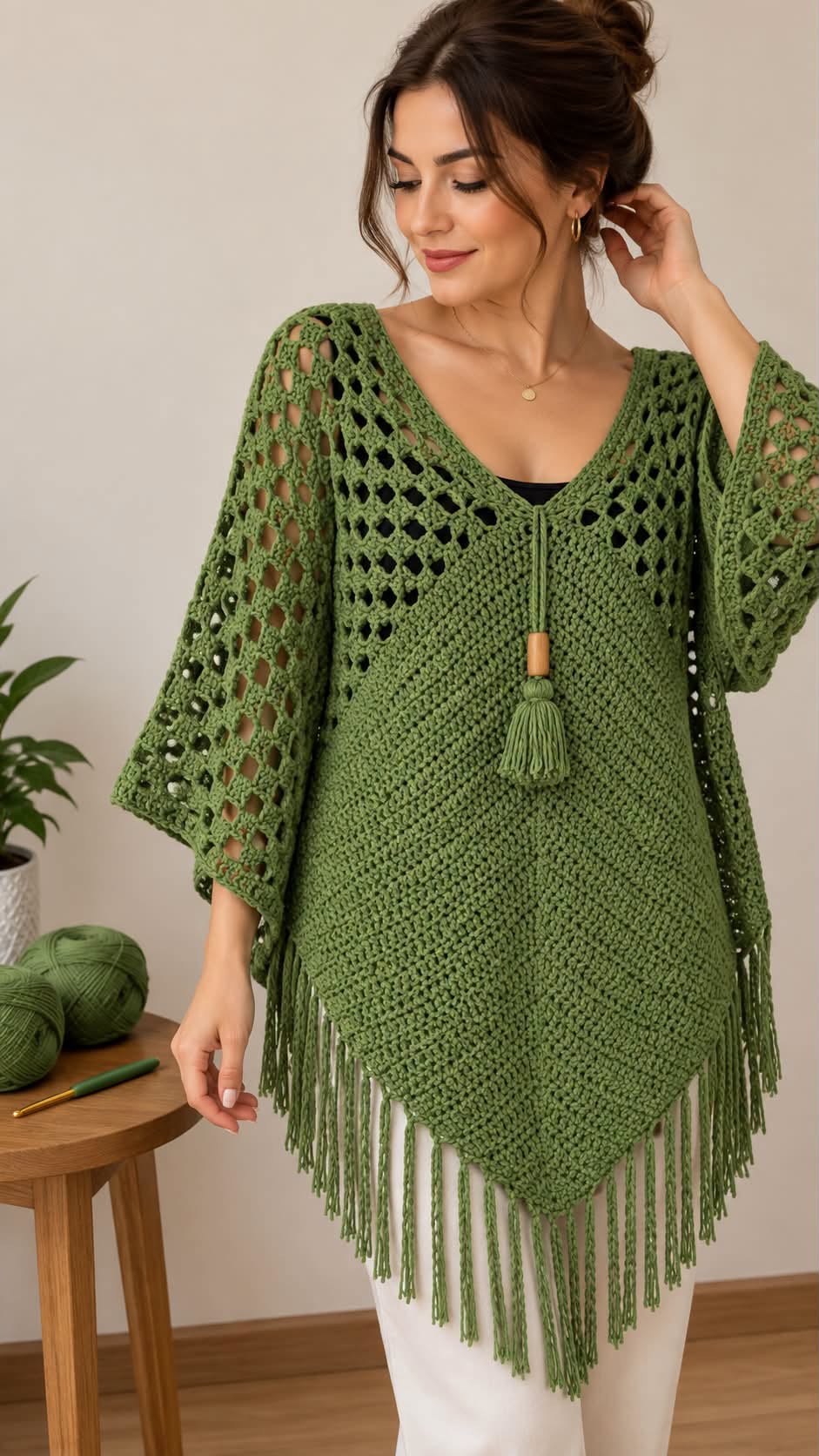
The Crochet Boho Poncho Top Pattern is a beautiful way to combine relaxed bohemian fashion with the handmade texture that makes crochet garments so special. Inspired by flowing poncho silhouettes, openwork shoulders, a textured central body, and long decorative fringe, this project creates a comfortable garment that can become a favorite layering piece for spring, summer evenings, and early fall. The loose construction also makes it more forgiving than many fitted crochet garments, which is especially helpful for crocheters who are beginning to explore wearable projects.
One of the most attractive features of this crochet boho poncho is the contrast between solid crochet and airy lace. The central section provides coverage, while the open mesh around the shoulders and sleeves keeps the garment light and gives it the unmistakable bohemian appearance. A V-shaped lower edge visually lengthens the design, and fringe adds movement whenever the wearer walks. A simple neck tie with tassels can provide the final decorative touch without requiring complicated shaping.
Although the finished piece looks elaborate, the construction can be approached as a sequence of manageable sections. The key is to establish the correct width first, maintain an even crochet gauge, create symmetrical front and back panels, and then add decorative details after assembly. The following tutorial uses U.S. crochet terminology and is designed as an adaptable guide rather than an exact reproduction of a commercial pattern. Always make a gauge swatch and adjust the foundation count to your own measurements before beginning.
Materials, Measurements, Gauge, and Crochet Stitches
For a soft garment with good drape, choose a DK/light worsted (#3) or lightweight worsted (#4) yarn. Cotton, cotton-acrylic blends, bamboo blends, or other smooth fibers are particularly suitable because they allow the lace stitches to remain visible while helping the poncho hang naturally. For an average adult size, approximately 1,000–1,500 yards (915–1,370 m) may be required, including fringe. Larger sizes and longer versions will require additional yarn.
DISCOVER MORE FREE PATTERNS HERE!
A 4.5 mm to 5.5 mm crochet hook is a practical starting range, depending on the yarn. You will also need scissors, a yarn needle, removable stitch markers, and a measuring tape. A slightly larger hook can be used for the openwork sections if you want softer, more relaxed lace.
The finished Crochet Boho Poncho Top Pattern can be customized extensively. For a medium relaxed fit, aim for approximately 30–34 inches (76–86 cm) across the garment when laid flat, measured from one outer sleeve edge to the other. A finished center-front length of approximately 27–31 inches (69–79 cm) before fringe creates the long bohemian silhouette shown in the inspiration.
For sizing, measure across the shoulders and decide how far you want the sides to extend down the arms. Because a poncho is intentionally loose, positive ease is desirable. Add approximately 6–12 inches (15–30 cm) of total ease compared with a fitted top. Petite versions can be shortened at both the body and fringe, while longer versions can approach tunic length.
Make a 4 x 4 inch (10 x 10 cm) gauge swatch using the main body stitch. A useful target with medium-light yarn is approximately 14–17 stitches and 9–12 rows per 4 inches, although your exact gauge is less important than achieving the desired dimensions. Wash and dry the swatch as you intend to treat the finished garment before measuring it.
The main abbreviations used throughout this crochet poncho pattern are: ch = chain, sl st = slip stitch, sc = single crochet, hdc = half double crochet, dc = double crochet, tr = treble crochet, sp = space, sk = skip, and st/sts = stitch/stitches. The lace areas primarily use chains and double crochet stitches.
Crocheting the Main Body and Creating the V Shape
Begin with the front panel. Instead of relying on one fixed stitch count, make a foundation chain corresponding to approximately 18–22 inches (46–56 cm) for the solid central body. This adaptable approach makes the project easier to resize. Keep the foundation relaxed so the lower section does not pull inward.
For a simple textured fabric, work hdc or dc across the foundation. Turn with the appropriate turning chain and continue in rows. If using double crochet, a basic row can be written as: Ch 3, dc in each st across, turn. For more texture, alternate rows of regular double crochet with rows worked into the back loop.
Continue until the rectangular portion reaches approximately 15–18 inches (38–46 cm). This creates the central coverage area. Check the piece against your torso occasionally rather than relying exclusively on measurements. Handmade garments are easier to customize when fitting is checked during construction.
To create the pointed lower edge, begin decreasing gradually at both ends. One simple method is to work dc2tog near each edge on every second row. Continue decreasing until the remaining stitches form the desired point. The result should resemble a long, shallow triangle attached to the bottom of the rectangular body.
Alternatively, the lower point can be crocheted separately from the center outward. Mark the center stitch, then work decreasing rows toward the point. This approach can produce especially clean symmetry. Whichever technique you choose, count the stitches carefully so both sides of the V-shaped crochet hem remain balanced.
Create the back panel using the same measurements. It may be slightly shorter if desired, although matching front and back lengths produces the most traditional poncho shape. Place the pieces together periodically and verify that the shoulder edges, body widths, and lower points correspond before proceeding.
Once both central panels are completed, lightly block them. Pin the pieces to their intended dimensions and allow them to dry completely. Blocking at this stage makes the later crochet lace panels considerably easier to measure and attach.
Creating the Openwork Shoulders, Sleeves, and Neckline
The dramatic openwork section is what transforms the basic body into a true boho crochet poncho. Attach yarn near an upper corner of the central front panel. Work evenly across the shoulder area using a simple mesh pattern such as dc, ch 2, sk 2 sts, dc in next st. Maintain consistent spacing.
On subsequent rows, work the double crochet stitches into the corresponding stitches or chain spaces. A basic mesh repeat can be written as: *Ch 3, ch 2, dc in next dc; repeat from * across. This creates lightweight rectangular openings that drape beautifully over the shoulders.
Gradually extend the lace outward to form the loose sleeves. Instead of constructing fitted sleeves, the goal is to produce wide side panels that fall naturally from the shoulders. Depending on size, each side can extend approximately 10–15 inches (25–38 cm) beyond the central body.
For additional visual interest, introduce small shell sections. A simple shell can be made by working 5 dc into one chain space, then anchoring it with sc into the next appropriate space. Alternate shell rows with mesh rows to create a layered lace appearance without making the garment excessively heavy.
Shape the neckline by leaving an opening at the center of the front and back. A V-neck approximately 7–9 inches (18–23 cm) deep works well for an adult poncho. Crochet along each side separately if necessary, decreasing or skipping stitches gradually until the neckline reaches the desired depth.
After joining the shoulder areas, finish the neckline with one or two rounds of sc. For a decorative edge, follow with reverse single crochet or a simple picot border. Keep the edging loose enough that the neckline sits comfortably and does not pull the garment upward.
Assembly, Fringe, Tassels, and Professional Finishing
Lay the front and back pieces with wrong sides facing each other. Join the shoulders using a yarn needle and mattress stitch, or crochet the seams with slip stitches. Leave enough room at the sides for comfortable arm movement. Because this is a loose poncho-style garment, extensive side seaming is generally unnecessary.
Try the garment on before permanently finishing the seams. Check the neckline, shoulder width, arm opening, and total length. The center point should fall naturally without twisting. Small adjustments are much easier before fringe and decorative edging are added.
To create the characteristic crochet fringe, cut yarn strands approximately 12–16 inches (30–41 cm) long. Fold several strands in half, insert the folded loop through a stitch along the lower edge, pull the ends through the loop, and tighten gently. After attachment, the visible fringe will measure roughly half the original strand length.
Space fringe approximately every 0.5–1 inch (1.3–2.5 cm) around the desired lower edges. Once all strands are attached, hang the poncho for several hours before trimming them. Gravity allows the strands to settle, making it easier to create an even fringe line.
For the neckline tie, crochet two chains approximately 14–18 inches (36–46 cm) long and attach them near the center neckline. Add a handmade yarn tassel to each end. A wooden bead can be added above each tassel for an extra bohemian accent, provided the bead opening is large enough for the cord.
Finally, weave in every yarn tail securely and gently block the completed garment. Avoid stretching the solid central section excessively. Concentrate instead on opening the lace motifs, straightening the neckline, and arranging the fringe. Proper finishing can dramatically improve the appearance of a handmade Crochet Boho Poncho Top.
Frequently Asked Questions About the Crochet Boho Poncho Top Pattern
Is the Crochet Boho Poncho Top Pattern suitable for beginners?
An adventurous beginner can make this project if they are comfortable with chains, single crochet, half double crochet, double crochet, basic decreases, and simple seaming. The lace section requires careful counting but does not necessarily require advanced techniques.
What yarn works best for a crochet boho poncho?
A smooth cotton blend, bamboo blend, or soft acrylic blend in DK or lightweight worsted weight works particularly well. The yarn should have enough drape for the poncho to fall naturally rather than standing stiffly around the body.
How much yarn will I need?
Approximately 1,000–1,500 yards (915–1,370 m) is a reasonable planning range for an average adult garment. Size, yarn thickness, stitch density, sleeve width, and the amount of fringe can significantly change the final yardage.
How do I make the poncho larger?
Increase the width of the central panels and extend the lace sections farther outward. You can also add additional rows before beginning the lower decreases. Always calculate adjustments from your gauge rather than simply adding an arbitrary number of stitches.
How do I make a smaller version?
Reduce the central panel width, shorten the body, and make narrower shoulder panels. Keep the neckline proportional so it does not become too large for the reduced garment.
Can I make the poncho without fringe?
Yes. Replace the fringe with a few rounds of single crochet, shell edging, picots, or another decorative crochet border. Removing the fringe creates a cleaner, more contemporary appearance.
Why is my crochet poncho becoming stiff?
Your hook may be too small for the yarn, or the yarn itself may be too heavy. Moving up one hook size often improves drape. A softer fiber can also help.
How do I keep the lace from becoming uneven?
Use stitch markers and count each mesh repeat. Openwork crochet makes missed stitches particularly noticeable, so checking every row before continuing saves considerable time.
Can this pattern be made with one color?
Absolutely. A single earthy green, cream, rust, burgundy, black, or neutral shade emphasizes the texture. Multiple colors can instead highlight the lace, neckline, tassels, or fringe.
Can I turn this into a longer crochet poncho?
Yes. Add rows to the central body before shaping the point and extend the lace sections proportionally. Remember that extra length also increases yarn requirements and overall garment weight.
Should I block the finished poncho?
Blocking is highly recommended. It helps straighten the body, open the lace, improve symmetry, and give the garment a more polished finish.
How should a handmade crochet poncho be washed?
Follow the care instructions for the specific yarn. Hand washing in cool water and drying flat is generally a gentle option for handmade garments, particularly those with fringe and open lace.
Conclusion
The Crochet Boho Poncho Top Pattern combines several enjoyable crochet techniques in one wearable project: textured stitches, airy mesh, neckline shaping, decorative edging, tassels, and flowing fringe. Despite its detailed appearance, the garment can be constructed gradually from relatively straightforward crochet sections.
The most important elements are accurate measurements, consistent crochet gauge, symmetrical panels, and careful finishing. Once the basic construction is understood, the pattern becomes highly customizable. You can change the length, sleeve width, neckline, lace density, fringe, or color to create a completely different version while maintaining the same bohemian silhouette.
A handmade crochet poncho top is also an excellent project for experimenting with garment construction without the strict shaping required by fitted sweaters. Work patiently, check the fit throughout the process, and allow the yarn and openwork stitches to create the relaxed drape that gives this design its distinctive character.