
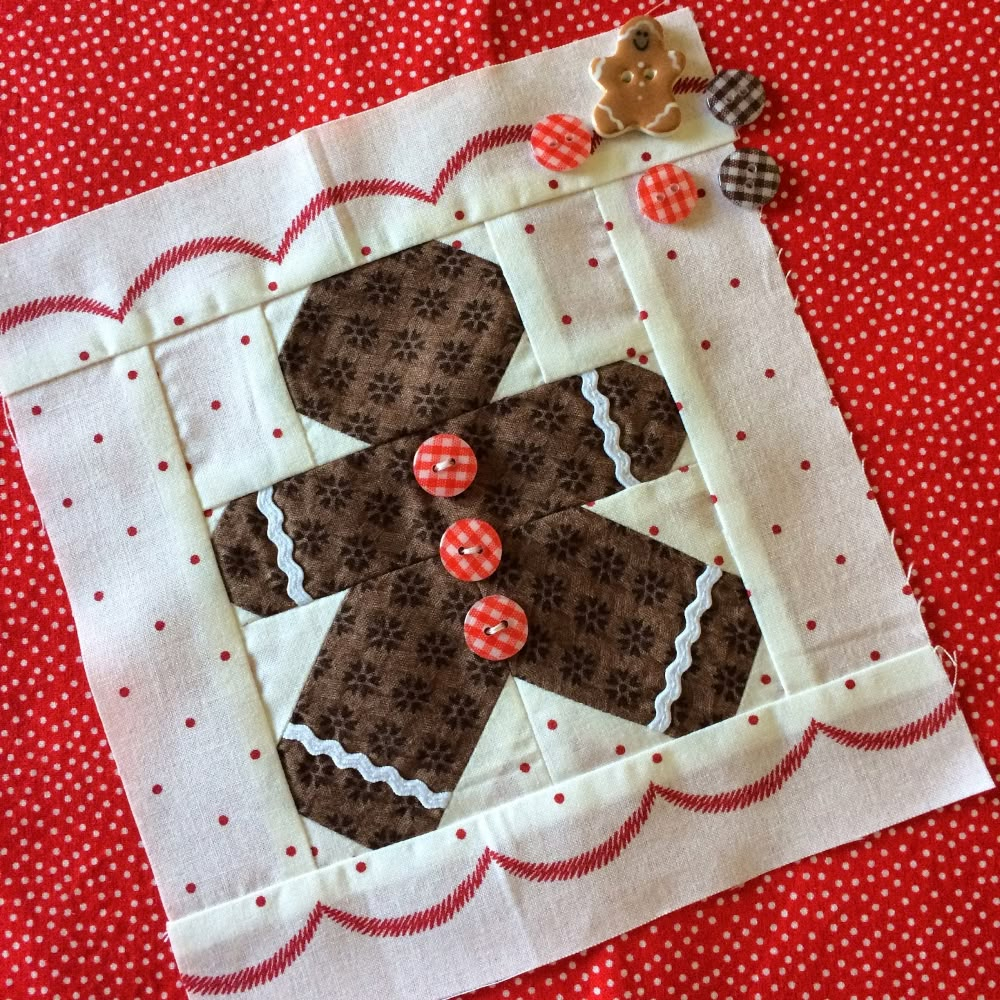
The Gingerbread Quilt Block Tutorial is a charming Christmas sewing project that combines traditional patchwork, appliqué, decorative trim, and playful holiday details in one cheerful block. Inspired by the handmade gingerbread figure shown in the reference, this design features a brown fabric gingerbread character surrounded by a light background and framed with red-and-white accents. Small buttons and ric-rac trim give the block dimension and help recreate the look of an iced gingerbread cookie without making the construction unnecessarily complicated.
This gingerbread quilt block works beautifully as part of a Christmas quilt, but it can also become a mini wall hanging, pillow front, table topper, mug rug, placemat, or fabric gift. Because the gingerbread figure is assembled from relatively simple geometric and curved shapes, the project is approachable for confident beginners while still offering enough decorative possibilities to interest experienced quilters. You can make every block identical or create an entire family of gingerbread characters using different fabrics, trims, buttons, and borders.
For this tutorial, the suggested finished block is approximately 12 × 12 inches (30.5 × 30.5 cm). You can enlarge or reduce the pattern as needed. The instructions use a standard 1/4-inch (6 mm) seam allowance for patchwork seams. The gingerbread character is applied separately to the background, so its proportions can also be adjusted without changing the surrounding block. Before beginning, press all fabrics and read through the complete Gingerbread Quilt Block Tutorial so you understand how the background, appliqué, decorations, borders, and quilting layers work together.
Materials, Measurements, and Preparing the Gingerbread Quilt Block
For one 12-inch (30.5 cm) finished Gingerbread Quilt Block, choose quilting cotton in brown for the character, cream or off-white for the background, and red or Christmas-print fabrics for accents. Small scraps are ideal for this project, making it an excellent scrap fabric Christmas quilt idea.
DISCOVER MORE FREE PATTERNS HERE!
You will need approximately one 10 × 10-inch (25.5 × 25.5 cm) piece of light background fabric, a 9 × 9-inch (23 × 23 cm) brown fabric scrap, several red-and-white scraps, lightweight fusible web for appliqué, coordinating sewing thread, and batting if you intend to quilt the block individually. Keep a backing piece approximately 14 × 14 inches (35.5 × 35.5 cm) if finishing it as a mini quilt.
The gingerbread figure can measure approximately 7–8 inches (18–20 cm) tall. A practical proportion is a head approximately 2.5–3 inches (6.5–7.5 cm) across, a torso around 3 inches (7.5 cm) wide, arms extending about 2.5 inches (6.5 cm) from the body, and legs approximately 3 inches (7.5 cm) long.
To reproduce the cookie-like decoration, prepare narrow white ric-rac trim. Small pieces can be placed across the arms and legs to resemble piped white icing. Three decorative buttons placed vertically down the torso provide the traditional gingerbread appearance. Red gingham or red-and-white buttons are especially effective.
For the surrounding patchwork, cut cream strips approximately 2–2.5 inches (5–6.5 cm) wide. These strips can be arranged around the central appliqué section using a log-cabin-style construction. A wider outer border may then be added to bring the unfinished block to approximately 12.5 × 12.5 inches (31.75 × 31.75 cm).
Before cutting the character, trace your gingerbread appliqué template onto paper. Fold the paper vertically through the center before drawing half of the character. Cut through both layers and unfold it. This simple technique produces symmetrical arms, legs, and sides and prevents the finished gingerbread figure from appearing unintentionally crooked.
Cutting and Building the Gingerbread Man Appliqué
Begin the central character by preparing the brown fabric. Apply fusible web to the wrong side according to the manufacturer’s instructions, keeping the paper backing attached until the shape has been cut. Trace the complete gingerbread silhouette onto the paper side.
Cut slowly around the curves of the head, shoulders, hands, and feet. Smooth curves are important because the character becomes the focal point of the Christmas appliqué quilt block. Small irregularities can be corrected with embroidery or satin stitching later, so the shape does not need to be mechanically perfect.
Remove the paper backing and position the gingerbread figure on the light background. Leave generous space around all sides for the patchwork frame. Centering does not have to be mathematically exact; a slightly playful handmade placement can work beautifully for this design.
Fuse the character in place using the temperature recommended for your fusible product. Once cooled, secure the edges with a small zigzag stitch, blanket stitch, satin stitch, or straight appliqué stitch. Brown thread produces a subtle finish, while contrasting thread creates a decorative outlined effect.
Next, cut pieces of white ric-rac slightly wider than each arm and leg. Position them near the ends of the limbs to resemble icing. Stitch directly through the center of the ric-rac using matching white thread. Trim the ends neatly at the character edges if necessary.
Add three buttons down the torso. For a washable quilt, sew the buttons securely using strong thread. If the block will be used by a baby or very young child, avoid loose buttons and other detachable embellishments. Instead, create the button shapes with fabric appliqué or embroidery for a safer finish.
Constructing the Patchwork Background and Decorative Christmas Frame
Once the gingerbread man appliqué is complete, begin building the surrounding patchwork. The image uses light fabrics with small red accents, which work particularly well because they allow the darker gingerbread figure to remain visually dominant.
Start with the central background rectangle and sew narrow cream strips around it. Place one strip right sides together with the central section, stitch using a 1/4-inch (6 mm) seam allowance, press the seam toward the strip, and trim it flush with the block.
Continue adding strips around the remaining sides. This creates a framed or simplified log cabin quilt block effect. Alternate plain cream, small red polka dots, subtle holiday prints, or tone-on-tone fabrics to create additional visual interest.
For a more whimsical version, some background sections can be slightly angled. Sew a fabric strip at an angle, press it open, and square the unit afterward. This technique produces the irregular patchwork appearance often associated with folk-art Christmas quilts.
A decorative lower and upper border can be made from wider cream strips. After attaching them, add red decorative stitching in a repeating scallop design. If your sewing machine includes decorative stitches, select a gentle scallop or wave. Otherwise, draw the curve lightly with a removable fabric marker and stitch it manually.
Small fabric circles can also be appliquéd near one corner to imitate extra Christmas candies or cookie decorations. Use red gingham, brown checks, polka dots, or other coordinated scraps. A tiny additional gingerbread motif can be placed near the corner for an especially playful finish.
After completing all patchwork borders, place the block on a cutting mat and carefully square it to 12.5 × 12.5 inches (31.75 × 31.75 cm). This leaves the correct seam allowance for a 12-inch finished quilt block when incorporated into a larger quilt.
Quilting, Finishing, and Creative Ways to Use the Block
To quilt the block individually, cut batting and backing approximately 1–2 inches (2.5–5 cm) larger than the quilt top on every side. Place the backing wrong side up, batting in the middle, and completed gingerbread block right side up.
Baste the three layers using quilting pins, temporary spray, or your preferred method. For this design, simple straight-line quilting works beautifully because the appliqué already provides plenty of decorative interest.
Quilt approximately 1/4 inch (6 mm) away from the gingerbread silhouette to emphasize its shape. Additional straight lines can follow the seams of the surrounding patchwork. This method is often called stitch-in-the-ditch quilting when the quilting follows directly along seam lines.
For extra dimension, quilt around the head, arms, legs, and ric-rac details while leaving the central gingerbread figure less densely quilted. The character will appear slightly raised against the background, giving the finished block a soft dimensional effect.
If the project will become a mini quilt or Christmas wall hanging, square the quilt sandwich after quilting and add binding around all four edges. A red polka-dot or gingham binding coordinates particularly well with the gingerbread theme. A finished mini quilt could measure approximately 12 × 12 inches (30.5 × 30.5 cm).
To create a larger quilt, make several blocks and join them with 2–3-inch (5–7.5 cm) sashing strips. Try alternating gingerbread characters with Christmas trees, candy canes, stars, stockings, hearts, or simple patchwork blocks. Repeating the same background colors throughout the quilt will help different motifs feel like part of one coordinated collection.
Frequently Asked Questions About the Gingerbread Quilt Block Tutorial
What is a good finished size for this Gingerbread Quilt Block?
A 12 × 12-inch (30.5 × 30.5 cm) finished block is versatile and provides enough room for the appliqué and decorative details.
What fabric should I use for the gingerbread character?
Medium or dark brown 100% quilting cotton works especially well. Small floral, tonal, or textured prints can make the character resemble a decorated cookie.
Do I need fusible web?
It is highly recommended because it stabilizes the gingerbread appliqué before edge stitching. Traditional needle-turn appliqué can also be used.
What seam allowance should I use?
Use a consistent 1/4-inch (6 mm) seam allowance for the patchwork portions.
Can beginners make this block?
Yes. A confident beginner who understands straight seams and basic machine stitching can complete it. The appliqué curves require a little patience but are very manageable.
Can I make the gingerbread figure larger?
Yes. Simply enlarge the template while keeping enough background space around the figure for the borders and seam allowances.
What can I use instead of ric-rac?
White embroidery, narrow bias tape, decorative machine stitching, lace trim, or small fabric strips can imitate the icing.
Do I have to use buttons?
No. The three buttons can be replaced with fabric circles, felt circles, embroidered French knots, or satin-stitched circles.
How can I make this design child-friendly?
Avoid detachable buttons and small embellishments. Use securely stitched fabric appliqué or embroidery instead.
Can the block be used for a pillow?
Yes. A 12-inch gingerbread block can become a small pillow front, or you can add borders to increase it to 16, 18, or 20 inches.
Can I turn it into a placemat?
Yes. Add side borders until the project measures approximately 12 × 18 inches (30.5 × 45.5 cm), then quilt and bind it.
Should I quilt over the appliqué?
You can, but it is not necessary. Quilting around the outside of the gingerbread shape often creates better definition.
What colors work best with this design?
Traditional red, cream, white, and gingerbread brown create a classic Christmas palette. Forest green, gold, burgundy, or pastel Christmas colors can also work.
Can scraps be used for this project?
Definitely. The small borders, buttons, decorative circles, and appliqué pieces make this an excellent Christmas scrap quilt project.
How many blocks would I need for a throw quilt?
For 12-inch finished blocks, a layout of four blocks across by five blocks down creates a 48 × 60-inch center before borders. Adding sashing and outer borders will increase the final dimensions.
Conclusion
The Gingerbread Quilt Block Tutorial is a wonderful way to combine holiday sewing with classic quilting techniques. The project uses a simple patchwork foundation but becomes distinctive through the brown gingerbread appliqué, white icing-inspired trim, colorful buttons, and cheerful red-and-cream details.
Making the block successfully depends primarily on careful preparation. Create a symmetrical gingerbread template, stabilize the appliqué, use an accurate 1/4-inch seam allowance, press every patchwork seam as you work, and square the block before final assembly. These basic quilting habits make a significant difference in the finished appearance.
One of the best features of this Christmas quilt pattern is how easily it can be personalized. Every gingerbread character can have different buttons, fabric prints, decorative icing, facial details, or surrounding borders. Several variations placed together can create an entire gingerbread family across a Christmas quilt.
Whether you use the finished Gingerbread Quilt Block for a holiday quilt, pillow, placemat, wall hanging, table decoration, or handmade Christmas gift, the combination of appliqué and patchwork creates a warm handcrafted look that fits naturally into seasonal décor. It is also a practical project for using treasured fabric scraps and turning small pieces of Christmas fabric into something that can be enjoyed year after year.