
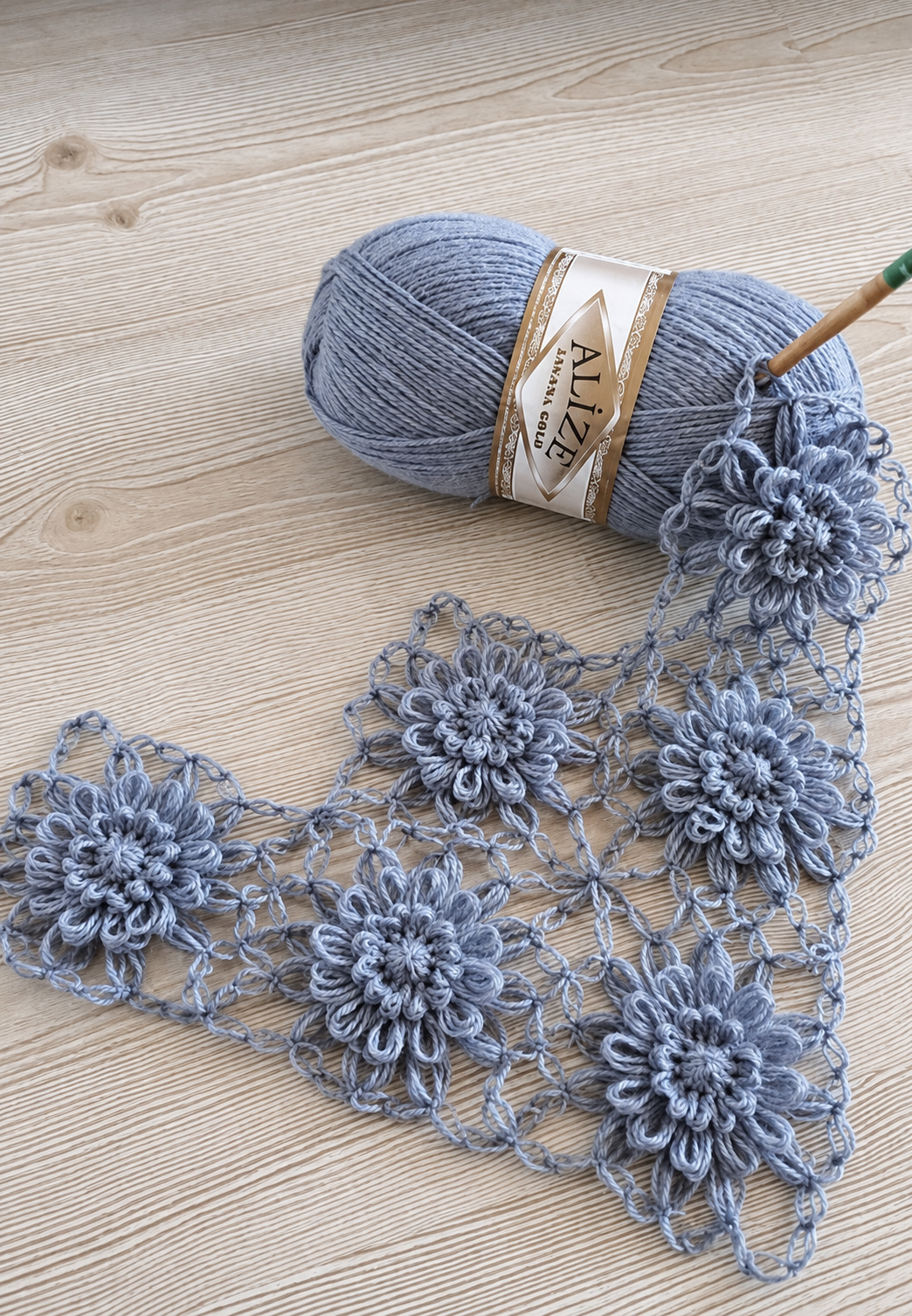
The Spring Flower Crochet Pattern is a beautiful way to bring texture, softness, and a fresh botanical feeling into your crochet projects. Inspired by the dimensional flowers shown in the reference design, this pattern combines layered petals, looped stitches, airy chain spaces, and connecting motifs to create a delicate floral fabric. The finished flowers have a pronounced 3D crochet effect, making them especially attractive for decorative pieces where ordinary flat motifs might not provide enough visual interest.
One of the most appealing characteristics of this crochet flower pattern is its versatility. A single flower can become an applique, brooch, bag decoration, or embellishment, while several flowers can be connected through open chain-work to create scarves, table runners, decorative panels, shawls, curtains, or lightweight spring accessories. The floral centers can also be worked in contrasting colors to completely change the appearance of the design.
Although these flowers look intricate, the construction becomes much easier when divided into layers. The center is worked first, followed by progressively larger loops and petals. Once the basic flower is understood, repeating the motif becomes surprisingly rhythmic. This tutorial uses U.S. crochet terminology and focuses on creating a dimensional flower approximately 4–5 inches (10–13 cm) across, depending on yarn, hook size, tension, and the length of the outer petals.
Materials, Crochet Stitches, and Preparing the Flower Center
For the Spring Flower Crochet Pattern, a smooth cotton or cotton-blend yarn works especially well because it provides enough stitch definition to highlight the individual petals. A lightweight DK or light worsted yarn creates flowers with good structure without making them excessively heavy. For a delicate version, you can substitute sport-weight cotton.
DISCOVER MORE FREE PATTERNS HERE!
A 3.5–4.0 mm crochet hook is a practical starting point for DK-weight yarn. Use a smaller hook if you want firm, highly defined petals or a slightly larger hook if you prefer softer flowers. You will also need scissors, a yarn needle, stitch markers, and optional blocking pins.
The main U.S. crochet abbreviations used throughout the project are ch = chain, sl st = slip stitch, sc = single crochet, hdc = half double crochet, dc = double crochet, tr = treble crochet, st = stitch, sp = space, and rep = repeat. The flower also relies heavily on elongated chain loops to produce its dimensional petals.
Begin with a magic ring. If you prefer not to use a magic ring, ch 4 and join the first chain with a sl st to create a small ring. Work 12 sc into the center and join with a sl st. Pull the magic ring firmly closed.
For the next round, create small loops around the center: ch 4, sl st into the next stitch. Repeat around. These loops establish the first layer of tiny petals. Keep your tension consistent because uneven chains will produce petals of noticeably different sizes.
Work into each loop using a combination such as sc, hdc, 2 dc, hdc, sc. This forms a rounded petal. Repeat around the entire center. At this stage, the motif should resemble a compact flower, but the dimensional effect is only beginning.
Building the Layered 3D Crochet Flower Petals
The characteristic appearance of this 3D crochet flower comes from building new petals behind the previous ones rather than simply enlarging a single flat round. Turn the flower slightly and locate the back of the stitches from the previous petal round.
Insert the hook behind the first petal and secure the yarn with a sl st. Ch 5, then anchor the chain behind the next petal. Continue around, creating one new loop behind every front petal. These loops should remain visible when the first layer is gently pushed forward.
For the second petal layer, work approximately sc, hdc, dc, 2 tr, dc, hdc, sc into each ch-5 loop. This produces taller petals that extend beyond the first layer. If your yarn is particularly thick, eliminate one of the treble crochets to prevent overcrowding.
The third layer can be made even more dramatic. Create new ch-7 or ch-8 loops behind the second layer. Into each loop, work a gradual sequence of stitches that rises toward the center and decreases again: sc, hdc, dc, tr, 2 tr, dc, hdc, sc. Adjust the sequence as needed so each petal fills its chain space without curling excessively.
To reproduce the elongated appearance visible in the Spring Flower Crochet Pattern, add another outer round consisting primarily of long chain loops. Ch approximately 10–14, depending on your yarn, and anchor behind the next petal. These loops may remain largely open rather than being completely filled with stitches.
After several layers, use your fingers to separate the petals. Pull the smallest petals toward the center and arrange progressively larger petals behind them. This simple shaping step dramatically increases the flower’s three-dimensional appearance.
Creating the Openwork Mesh and Joining Multiple Flowers
A single motif makes a lovely applique, but joining several flowers produces the striking crochet floral lace appearance of the reference project. Instead of sewing completed flowers together tightly, connect them with generous chain spaces.
Begin at an outer petal or loop. Ch approximately 8–12 stitches, depending on the desired spacing. Anchor the chain into an outer loop of the neighboring flower with a sl st or sc. Ch again and connect to another point, gradually creating an open network between the motifs.
For larger spaces, use a combination such as ch 8, sc into connecting loop, ch 10, sc into next flower. Varying the chain lengths slightly can create the organic web-like appearance associated with freeform floral crochet.
When making a rectangular panel, arrange the flowers on a flat surface before joining them. A useful arrangement is to stagger the motifs rather than placing every flower directly above another. This creates a more natural composition while reducing large empty areas.
For a scarf or table runner, you might create two or three flowers across and continue the design lengthwise. For a decorative curtain, considerably more motifs can be added while maintaining generous open spaces between them.
The join-as-you-go crochet method can save time. Complete most of one flower, and while making its final chain loops, connect selected loops directly to a neighboring completed motif. This eliminates much of the sewing required at the end.
Do not make every connection extremely tight. The beauty of this pattern comes partly from the movement between the flowers. Allowing the chains to remain relaxed creates a softer drape and emphasizes the dimensional petals.
Finishing, Blocking, Color Ideas, and Project Variations
Once all the flowers are completed and connected, weave in the yarn tails using a yarn needle. Pass each tail through several stitches on the back of the motif before trimming it. Because the flowers are highly textured, the ends can usually be concealed very effectively.
Blocking should be done carefully. The goal is to straighten the connecting chains without flattening the 3D flower petals. Pin the open mesh into position while allowing each flower center to remain raised. Lightly steam or wet block according to the yarn manufacturer’s care recommendations.
For a romantic spring design, try blush pink, dusty rose, cream, lavender, or soft blue. For a botanical appearance, combine several flower colors with green connecting chains. A monochromatic version can look especially sophisticated because shadows naturally emphasize the different petal layers.
You can also create flowers in several sizes. Use the same construction but stop after the second petal layer for a small motif. Continue through all the outer loops for the larger flowers. Combining different sizes creates an attractive crochet flower garden effect.
The pattern can also become a decorative edge. Crochet individual flowers and attach them along the lower edge of a shawl, cardigan, bag, or curtain. Connecting the flowers with chains instead of sewing them directly against the fabric preserves their airy appearance.
Before finishing a wearable project, check the overall weight. Numerous dimensional flowers can use more yarn than flat motifs. Lightweight cotton or cotton-blend yarn helps maintain comfortable drape while preserving enough structure for clearly defined petals.
Frequently Asked Questions About the Spring Flower Crochet Pattern
Is the Spring Flower Crochet Pattern suitable for beginners?
An adventurous beginner can make it, although experience with chains, single crochet, double crochet, treble crochet, and working in the round will make the process easier.
What crochet terminology does this tutorial use?
All stitch names and abbreviations are given in U.S. crochet terminology.
What yarn is best for dimensional crochet flowers?
Cotton and cotton-blend yarns are excellent because they offer strong stitch definition and help the petals maintain their shape.
What hook size should I use?
Approximately 3.5–4.0 mm works well with many DK-weight yarns. Always match the hook to your yarn and desired firmness.
How large is each finished flower?
A typical motif can measure approximately 4–5 inches (10–13 cm) across, although size depends heavily on yarn, hook, tension, and petal length.
How do I make the flowers more three-dimensional?
Create each new petal layer behind the previous round and gradually increase the chain-loop length.
Why are my petals curling?
Too many stitches inside a small chain loop can cause curling. Reduce the number of stitches or increase the chain-loop length slightly.
Why are my petals floppy?
The hook may be too large for the yarn. Try dropping one hook size or using cotton yarn with better structure.
Can I make the flowers smaller?
Yes. Simply stop after one or two petal layers.
Can I make larger flowers?
Yes. Add additional rounds behind the existing petals and gradually increase the chain-loop lengths.
Can I use different colors in one flower?
Absolutely. Changing colors between petal rounds creates beautiful layered flowers.
How are multiple flowers connected?
They can be connected using chain spaces, slip stitches, single crochet, or a join-as-you-go technique.
Can this pattern be used for a scarf?
Yes. The lightweight open mesh makes it particularly attractive for decorative scarves and wraps.
Can I use these flowers for a curtain?
Yes. Multiple motifs joined into a large openwork panel can create a beautiful crochet flower curtain.
Do I need to block the finished project?
Blocking is recommended for the connecting mesh, but avoid pressing the flowers flat because their raised texture is an important part of the design.
Conclusion
The Spring Flower Crochet Pattern combines traditional crochet stitches with layered construction to produce an impressive dimensional floral motif. The small center, progressively larger petals, elongated loops, and open chain connections work together to create a design that looks elaborate while remaining based on familiar crochet techniques.
The key to achieving attractive flowers is consistency. Keep the central rounds compact, make matching chain loops, build each new petal layer behind the previous one, and avoid overcrowding the outer rounds. Once the first flower is complete, the construction sequence becomes much easier to repeat.
This pattern also provides enormous creative freedom. Make a single 3D crochet flower for an applique, connect several motifs into a decorative runner, or build a larger crochet floral lace panel. Changing the yarn weight, colors, number of petal layers, and connecting chains can produce completely different results from the same basic technique.
PATTERN VIDEO
Whether worked in soft spring pastels, elegant neutrals, vivid garden colors, or one sophisticated monochromatic shade, the Spring Flower Crochet Pattern is a versatile project for crocheters who enjoy texture and floral details. With carefully shaped petals and an airy joining structure, the finished work becomes a beautiful handmade piece that celebrates the decorative possibilities of crochet.