
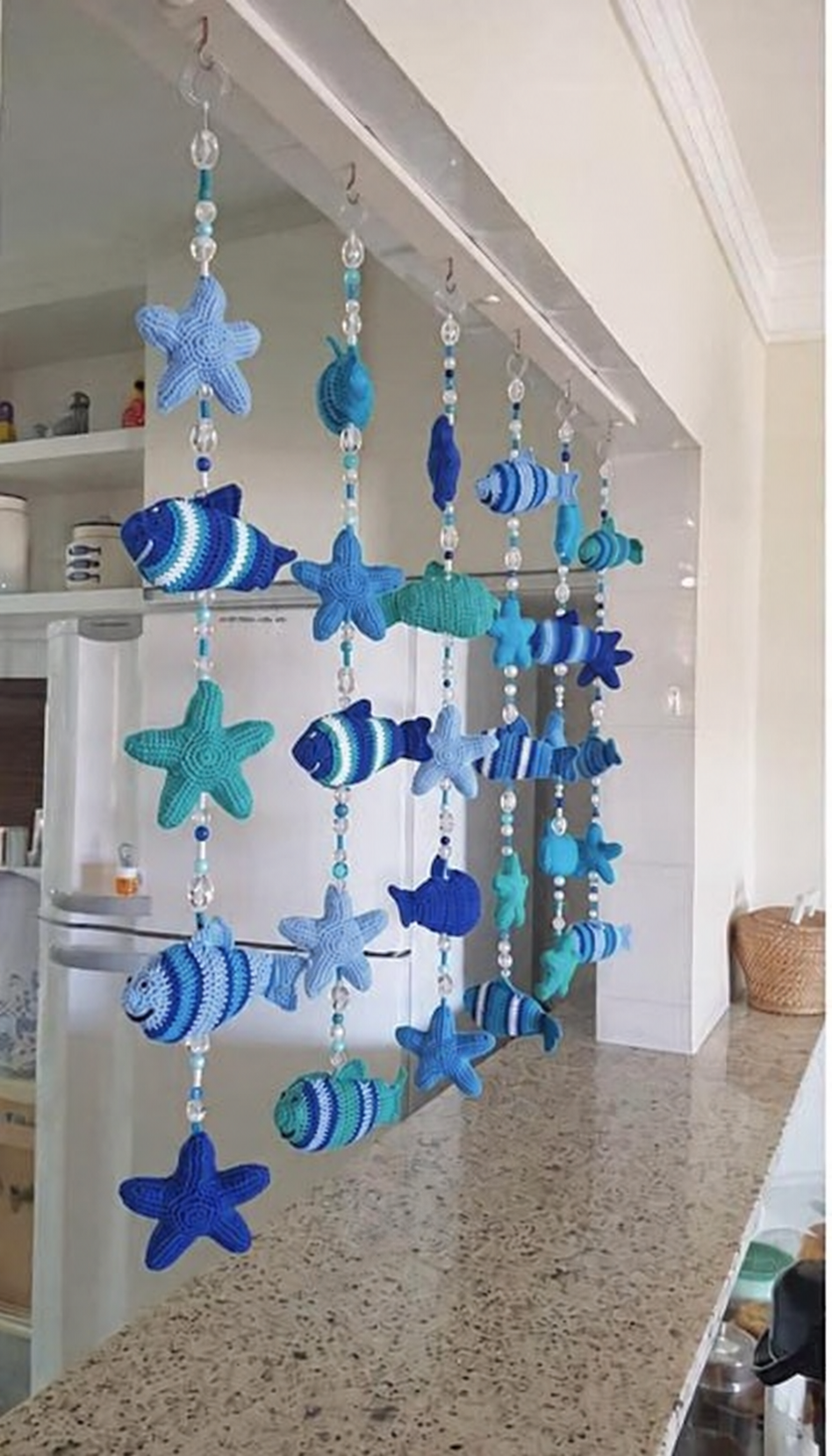
The Ocean Hanging Decor Pattern is a colorful crochet project inspired by the peaceful beauty of the sea. Combining crocheted fish, starfish, shells, decorative cords, and bead-like accents, this hanging decoration can transform a simple room into a cheerful coastal-inspired space. The design shown in the reference uses beautiful shades of ocean blue, turquoise, aqua, navy, and white, creating a fresh nautical appearance that works especially well in kitchens, sunrooms, craft rooms, beach houses, and covered decorative areas.
One of the most enjoyable features of this crochet ocean decor project is that you do not have to make every hanging strand identical. Different fish sizes, starfish, small sea-inspired motifs, and decorative elements can be arranged at different heights. This variation gives the finished piece movement and makes it resemble a playful underwater scene. It is also an excellent project for using leftover yarn because most individual motifs require only small amounts.
The tutorial below uses U.S. crochet terminology and provides a practical method for recreating the overall look rather than requiring every element to be exactly identical. You can make a small three-strand decoration or expand the project into a large crochet coastal mobile with six, eight, or even more strands. Because the motifs are made separately, you can arrange everything on a table before assembling the final hanging decoration.
Materials, Crochet Stitches, Yarn and Finished Measurements
For the Ocean Hanging Decor Pattern, medium-weight cotton yarn is an excellent choice because it creates defined stitches and holds the shapes well. Worsted weight #4 cotton yarn works particularly well for larger fish and starfish. A #3 DK cotton can be substituted when you want smaller and more delicate motifs.
DISCOVER MORE FREE PATTERNS HERE!
Choose four to six coordinated colors. A beautiful ocean palette might include navy blue, royal blue, sky blue, turquoise, aqua, seafoam green, and white. You can also add small amounts of sandy beige or coral for a warmer coastal variation.
Use a 3.5–4.0 mm crochet hook for medium-weight cotton. The exact hook size should be adjusted to your yarn and tension. For stuffed motifs, slightly tighter stitches are preferable because they help prevent the stuffing from showing through.
You will also need polyester fiberfill, a yarn needle, scissors, stitch markers, strong cotton cord or yarn for hanging, and optional decorative beads. If beads are included, use them only where appropriate for the intended environment and keep small detachable components away from young children and pets.
The primary U.S. crochet abbreviations used throughout this project are ch – chain, sl st – slip stitch, sc – single crochet, hdc – half double crochet, dc – double crochet, tr – treble crochet, inc – increase, and dec – decrease. A magic ring is useful when beginning circular motifs.
A medium stuffed fish can measure approximately 6–8 inches (15–20 cm) from nose to tail. Smaller fish can measure 3–5 inches (8–13 cm). Starfish work nicely at approximately 4–7 inches (10–18 cm). A complete hanging decoration can measure anywhere from 30–50 inches (76–127 cm) depending on the length of the strands.
How to Crochet the Ocean Fish and Starfish Motifs
Begin with the crochet fish pattern, since fish create the strongest visual elements in this design. One simple approach is to crochet the body in continuous rounds, beginning at the nose, increasing toward the widest section, and then decreasing toward the tail.
Start with a magic ring and work 6 sc into the ring. On the next round, increase evenly to 12 stitches. Continue increasing gradually until the body reaches the desired circumference. For a medium fish, approximately 24–30 stitches around the widest portion usually creates a pleasing shape, depending on yarn weight and tension.
Work several rounds without increases to establish the main body. This is the ideal area for creating the striped appearance. Change between blue, turquoise, aqua, and white yarn every two or three rounds. Carrying unused colors is unnecessary; simply fasten off neatly and weave the ends inside.
Begin decreasing gradually as you approach the tail. Before closing the opening completely, fill the fish lightly with polyester stuffing. The fish should remain soft enough to hang naturally rather than becoming extremely firm.
For the tail, flatten the remaining opening and crochet through both layers. Work outward using combinations of sc, hdc, dc, and tr to create two fan-shaped tail sections. Increase toward the widest part of each tail fin and decrease again toward the edge.
Side fins can be crocheted separately or worked directly onto the body. Attach yarn approximately halfway along the fish, work several increasing stitches to create a small triangular fin, and then decrease back toward the body.
Now make the crochet starfish. Begin with a magic ring and work 10 sc into it. Increase over the following rounds until you have a small flat center circle approximately 1½–2½ inches (4–6 cm) across.
The five arms are worked outward from this central section. Divide the outer stitches into five approximately equal groups. For each arm, crochet outward in rows while gradually decreasing the number of stitches. This creates the characteristic tapered starfish point.
Another method is to crochet two identical flat starfish pieces. Place them together, sc around the perimeter, and lightly stuff each arm as you work. This produces a soft 3D crochet starfish similar to the dimensional sea creatures used in hanging decorations.
Creating Shells, Small Sea Motifs and Decorative Hanging Strands
Adding several smaller shapes between the fish and starfish makes the Ocean Hanging Decor Pattern look fuller and more interesting. Simple shells, tiny fish, spiral motifs, or abstract sea shapes are perfect for filling empty spaces.
For a basic shell, begin with a magic ring and crochet several dc into the center. On the following row, increase across the stitches to create a semicircular fan. Use surface slip stitches or contrasting embroidery to suggest the ridges commonly seen on seashells.
A small spiral shell can begin with 6 sc in a magic ring. Increase for several rounds, then work one or two rounds without increases. Finish with a short curled section worked from a chain. Using two shades of blue creates additional depth.
Tiny fish can follow the same construction as the larger fish but with fewer rounds. Another quick option is to crochet two flat fish silhouettes and join them with sc around the edge. Add only a tiny amount of stuffing before closing.
Once all motifs are complete, lay them on a large table before assembling the strands. This allows you to experiment with color balance, spacing, motif size, and strand length without repeatedly taking the decoration apart.
Prepare approximately five to seven hanging cords. For a medium decoration, make the cords between 30 and 45 inches (76–114 cm) long. Varying their lengths creates the relaxed cascading appearance associated with coastal mobiles.
Thread decorative beads onto the cords between motifs if desired. Clear, white, turquoise, and blue elements work especially well because they resemble bubbles and sea glass. Alternatively, crochet small balls or rings if you prefer an entirely yarn-based project.
Attach the sea creatures approximately 5–8 inches (13–20 cm) apart. Do not make every strand symmetrical. One might contain a starfish followed by a fish, while another might feature two fish and a small shell. Controlled variation gives the display much more personality.
Assembly, Hanging, Finishing and Customizing Your Ocean Decor
After completing the individual strands, choose the support for your crochet ocean hanging decoration. A wooden dowel, decorative branch, covered hoop, curtain rod, or another suitable interior support can work depending on where the piece will be displayed.
Arrange all strands temporarily before tying them permanently. Place larger and heavier crochet motifs slightly lower whenever possible. Smaller shapes near the upper area keep the design visually balanced.
Step several feet away and inspect the arrangement. If two large dark-blue fish are next to each other, move one to another strand. Distributing navy, aqua, turquoise, white, and light blue throughout the project creates a more harmonious composition.
Secure each motif carefully to its cord using the yarn needle. Pass the cord through a structurally strong portion of the crochet rather than attaching it to only one loose stitch. Weave yarn tails securely into the stuffed pieces.
To create additional movement, allow a few fish to hang horizontally. Attach one point near the upper back of the fish and test its balance before securing the knot. Starfish generally look attractive when suspended vertically from the tip of one arm.
You can easily customize this nautical crochet decoration for different rooms. Soft aqua, white, and beige create a subtle beach-house style, while royal blue, turquoise, and white produce a brighter Mediterranean appearance. Children’s decorative versions can use cheerful rainbow colors, provided the finished item is positioned safely out of reach.
For a sophisticated version, limit the palette to three colors—for example, deep navy, ivory, and seafoam. Keeping the shapes varied while simplifying the colors creates a more coordinated decorative piece.
Finally, gently shape each crochet motif with your fingers. If necessary, lightly steam-block suitable fibers while following the yarn manufacturer’s care guidance. Avoid crushing the stuffed shapes. Once everything hangs evenly, the Ocean Hanging Decor Pattern is ready to bring a handmade coastal atmosphere to the room.
FAQ – Ocean Hanging Decor Pattern
What yarn is best for this crochet ocean decoration?
Cotton or a cotton-blend yarn works particularly well because it provides good stitch definition. Worsted weight #4 is useful for larger pieces, while DK yarn produces smaller motifs.
What crochet hook should I use?
A 3.5–4.0 mm hook is a practical starting point, although the ideal hook depends on the selected yarn and your tension.
Is the Ocean Hanging Decor Pattern suitable for beginners?
An advanced beginner who understands single crochet, double crochet, increases, decreases, and working in the round should be able to complete the project.
How many fish should I crochet?
There is no fixed number. For a medium display, approximately 8–12 fish mixed with 5–8 starfish and smaller motifs creates a full arrangement.
How large should each fish be?
Try combining small 3–4 inch (8–10 cm) fish with larger 6–8 inch (15–20 cm) fish.
Do the fish need stuffing?
No. They can be made flat, but light stuffing produces a more dimensional 3D crochet fish.
Can I make the starfish without stuffing?
Yes. Flat starfish are lighter and particularly useful near the upper portions of the decoration.
Which colors create the strongest ocean theme?
Turquoise, aqua, royal blue, navy, seafoam, sky blue, and white provide an immediately recognizable coastal palette.
Can I use leftover yarn?
Yes. This is an excellent scrap yarn crochet project because individual sea creatures require relatively small amounts of yarn.
How long should the hanging strands be?
Approximately 30–45 inches (76–114 cm) works for many displays, but the length can be customized to the available space.
Can I make the strands different lengths?
Yes. In fact, varied lengths usually make the arrangement more visually interesting.
Can I add beads between the crochet pieces?
Yes, provided the finished decoration is positioned appropriately. Beads can create an attractive bubble or sea-glass effect, but small detachable pieces should be kept away from children and pets.
Can I add other ocean animals?
Certainly. Seahorses, jellyfish, turtles, octopuses, shells, whales, and crabs can all be incorporated using compatible crochet motifs.
Can this be used as a baby mobile?
For decorative nursery use, it should remain securely installed and completely out of a baby’s reach. Long cords, beads, and detachable elements are not suitable within reach of an infant or young child.
How can I make the fish stripes neat?
Change yarn colors at the end of a round and complete the final pull-through with the new color. Keep the color-change area consistently positioned along the less-visible side of the fish.
How can I make a larger version?
Increase the number of rounds in each motif and use additional hanging strands. You can also use thicker yarn with a correspondingly larger hook.
Conclusion
The Ocean Hanging Decor Pattern turns simple crochet techniques into an eye-catching collection of handmade sea creatures. Fish, starfish, shells, and small ocean motifs can be combined freely, making every finished decoration unique.
The project is particularly enjoyable because it can grow gradually. Crochet one striped fish today, a turquoise starfish tomorrow, and a few small shells whenever you have leftover yarn. Once enough pieces have been collected, arranging them into hanging strands becomes a creative project of its own.
Using different shades of blue, turquoise, aqua, seafoam, navy, and white gives the finished work the layered colors associated with the ocean. Varying the size and height of each motif adds dimension and movement while preventing the arrangement from looking overly uniform.
Whether displayed as coastal home decor, a handmade beach-house accent, or a decorative feature in a craft room, this Ocean Hanging Decor Pattern offers a beautiful way to combine crochet, color, and ocean-inspired design in one memorable handmade project.