
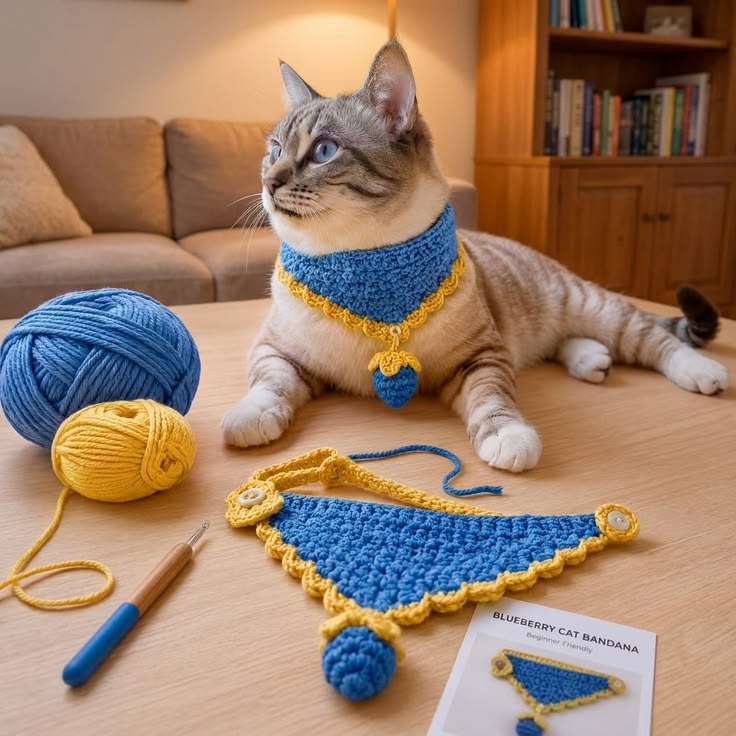
The Blueberry Cat Bandana Pattern is a charming crochet accessory that combines a simple triangular bandana with decorative edging and a small blueberry-inspired pendant. Designed as a lightweight handmade accessory, this project is especially attractive when worked in blue and golden yellow yarn, creating a bright contrast that stands out beautifully against many coat colors. The finished piece can be customized in size, making the basic construction useful for cats of different builds.
This crochet cat bandana pattern is also a practical project for crocheters who want to practice shaping without committing to a large garment. The main triangle can be created with basic crochet stitches, while the decorative border introduces simple shell or scallop techniques. Small details, such as the crocheted blueberry charm and decorative side accents, turn an otherwise basic triangular neck accessory into something much more distinctive. Because relatively little yarn is required, it can also be a useful scrap yarn crochet project.
The instructions below use U.S. crochet terminology and are designed to help you reproduce the overall style of the pictured project while adapting the dimensions to your own cat. Pet comfort should always come before appearance: the bandana should be lightweight, should never restrict breathing or movement, and should be worn only under supervision. A breakaway-style attachment is preferable to a fixed neck loop because it can release if the accessory becomes caught.
Materials, Measurements and Crochet Stitches
For the Blueberry Cat Bandana Pattern, choose a soft, lightweight yarn that will not feel bulky around the animal’s neck. DK #3 cotton or cotton-blend yarn is an excellent option because it offers good stitch definition while remaining relatively light. A soft acrylic can also work if it does not irritate the cat.
DISCOVER MORE FREE PATTERNS HERE!
For the color combination pictured, prepare approximately 50–70 yards (46–64 m) of blue yarn and 20–30 yards (18–27 m) of golden yellow. Only a small additional amount is required for the blueberry charm. Yardage varies according to the size of the bandana, yarn weight, hook, and individual tension.
A 3.5 mm or 4.0 mm crochet hook is a useful starting point for DK yarn. You will also need scissors, a yarn needle, removable stitch markers, and a flexible measuring tape. Optional supplies include a pet-safe breakaway attachment for the neck straps.
The principal U.S. crochet abbreviations are ch – chain, sl st – slip stitch, sc – single crochet, hdc – half double crochet, dc – double crochet, inc – increase, and dec – decrease. The decorative scallops can be created using combinations of single and double crochet.
Before beginning, measure loosely around the cat’s neck without pulling the tape tightly. As a general example rather than a universal size, a small bandana body might measure approximately 5–6 inches (13–15 cm) wide and approximately 3½–4½ inches (9–11.5 cm) deep. A larger cat may need a triangle approximately 7 inches (18 cm) wide.
The decorative triangle should cover only the front portion of the chest. It should not wrap tightly around the throat. Check the fit carefully before completing the attachment system, and never rely on generic measurements when a real animal will wear the finished piece.
How to Crochet the Blue Triangular Bandana
Begin the crochet pet bandana with blue yarn. One convenient construction method is to start at the narrow lower point and increase outward. This makes the finished width easy to customize because you simply continue until the triangle reaches the required measurement.
Foundation: Ch 2. Work 2 sc into the second ch from the hook. Ch 1 and turn.
Row 2: Work 2 sc into the first stitch and 2 sc into the final stitch. Ch 1 and turn. The increases begin forming the triangular shape.
For the following rows, continue working sc across, placing an increase near each outer edge. The important principle is consistency: increase at both sides of the triangle at regular intervals so the fabric expands evenly.
If you prefer a softer, slightly more flexible fabric, use hdc instead of sc for the body. Single crochet produces a compact texture, while half double crochet works up faster and provides a little more drape.
Continue increasing until the upper edge reaches the desired width. For a medium example, aim for approximately 6 inches (15 cm) across the top and approximately 4 inches (10 cm) from the center top edge to the bottom point.
Periodically place the unfinished piece against the cat’s chest without attaching it around the neck. This visual check helps ensure that the triangle is not becoming unnecessarily large. It should sit neatly on the upper chest rather than extending far down the body.
When the triangle reaches the required dimensions, fasten off the blue yarn and weave in the tail. Do not worry if the edges appear slightly plain at this stage; the contrasting gold crochet border will define the shape.
Crochet the Golden Scalloped Border, Straps and Blueberry Charm
Join the golden yellow yarn at one upper corner of the triangle. Work sc evenly down the first diagonal edge. Proper spacing is important because too many stitches will cause the border to ripple, while too few can pull the fabric inward.
For a simple crochet scalloped edging, work a repeating sequence such as: sl st in the next stitch, 4 dc in the following stitch, sl st in the next stitch. Repeat along the lower diagonal edges, adjusting the spacing near the point if necessary.
The scallops do not have to be oversized. Small shells create a delicate decorative frame and are less bulky for a pet accessory. Keep the top edge relatively flat so it sits comfortably beneath the neck.
The pictured style can be recreated with narrow crocheted extensions from the upper corners. However, for actual pet wear, avoid making a permanently closed or non-releasing collar. A commercial pet-safe breakaway mechanism is a more appropriate way to secure a decorative bandana.
Now make the little crochet blueberry charm. With blue yarn, create a magic ring and work 6 sc into the ring. Increase evenly during the next round. Work one or two rounds without increases, depending on the desired size.
Begin decreasing evenly. Before closing, add only enough fiberfill to give the blueberry a soft rounded shape. Finish the decreases, cut the yarn, and close the remaining opening with a yarn needle.
The blueberry should remain small and lightweight—approximately ¾–1 inch (2–2.5 cm) in diameter is sufficient. Secure it firmly to the bottom center of the bandana with multiple passes of yarn. Because detachable decorations can become chewing hazards, this embellishment is best used only for supervised wear; omit it for cats that chew accessories.
You can also create a tiny golden connector between the triangle and blueberry. Ch approximately 5–7 stitches, sl st back through the chain, and sew one end securely to the bandana and the other to the blueberry.
Finishing, Sizing and Customizing the Cat Bandana
Once all crochet work is finished, inspect the Blueberry Cat Bandana Pattern carefully. Weave every yarn tail securely into the wrong side of the fabric. Trim only after the ends have been properly secured.
Check the decorative edging with your fingers. No loops should be excessively loose, especially around the blueberry attachment. Examine the bandana periodically during use because repeated movement can loosen handmade embellishments.
Sizing is more important than following an exact stitch count. Yarn thickness, hook size, tension, and the animal’s proportions can significantly change the finished measurements. Treat the dimensions in this tutorial as starting references rather than universal pet sizes.
For a smaller version, stop increasing when the top edge measures approximately 4½–5 inches (11.5–13 cm). For a larger version, continue until it measures around 7–8 inches (18–20 cm), provided the resulting depth remains appropriate.
The same crochet cat bandana can be customized with many color combinations. Blue and yellow create the distinctive blueberry-inspired appearance, but navy and cream can create a classic style, while lavender and white offer a softer variation.
You can also adapt the decorative charm. A strawberry, flower, heart, pumpkin, or tiny crochet fish could replace the blueberry. Keep any embellishment small, lightweight, securely attached, and appropriate for supervised pet use.
For the cleanest finish, lightly shape the bandana by hand after completion. Cotton pieces can often benefit from gentle blocking according to the yarn manufacturer’s care instructions. Allow the piece to dry completely before fitting it to the pet.
Most importantly, supervise the cat while the accessory is being worn. Remove it if the cat appears uncomfortable, tries repeatedly to pull it off, or if any part becomes damaged. A handmade pet accessory should be decorative without interfering with normal movement, grooming, eating, or breathing.
FAQ – Blueberry Cat Bandana Pattern
Is the Blueberry Cat Bandana Pattern beginner-friendly?
Yes. The main triangle primarily uses basic crochet stitches and increases, making the project approachable for an advanced beginner.
Which yarn is best for a crochet cat bandana?
A soft DK cotton or cotton-blend yarn is a practical choice because it provides clear stitches without making the bandana excessively heavy.
What hook size should I use?
A 3.5–4.0 mm crochet hook works well with many DK yarns. Always check the yarn label and adjust according to your crochet tension.
How wide should the bandana be?
The width depends on the individual cat. Approximately 5–7 inches (13–18 cm) across the decorative triangle is a useful starting range for many adult cats, but measuring the actual pet is more reliable.
How deep should the triangle be?
Around 3½–4½ inches (9–11.5 cm) can work for many versions. Smaller cats will require a shallower triangle.
Can I make the entire bandana with single crochet?
Absolutely. Single crochet creates a dense, structured fabric that works particularly well for a small accessory.
Can half double crochet be used instead?
Yes. Half double crochet creates a slightly softer fabric and works up more quickly.
How do I make the yellow scalloped border?
Alternate slip stitches with small groups of double crochet. A basic repeat of sl st, 4 dc, sl st can produce a simple shell effect.
How is the blueberry made?
Crochet a small sphere in continuous rounds using sc, increases, straight rounds, and decreases. Add a tiny amount of stuffing before closing.
Can I leave off the blueberry?
Yes. The bandana works perfectly well without a hanging charm and may be preferable for cats that like to chew dangling objects.
Should I crochet a fixed collar around the cat’s neck?
For practical pet use, a fixed non-releasing crochet neck loop is not recommended. A properly fitted breakaway pet attachment provides a safer release option if the accessory catches on something.
Can I make this pattern for a dog?
The triangular portion can be resized for a small dog, but the attachment and dimensions should be adapted specifically to that animal.
Can I use worsted-weight yarn?
Yes, but the finished accessory will be thicker. Use a suitable hook and reduce the stitch count or number of rows as necessary.
Can the bandana be washed?
That depends on the yarn. Follow the yarn manufacturer’s washing instructions and remove any hardware when appropriate.
How can I prevent the triangle from curling?
Maintain relaxed, consistent tension and avoid placing too many stitches in the border. Gentle blocking can also improve the finished shape.
What colors work well besides blue and yellow?
Try teal and cream, lavender and white, pink and gray, sage and ivory, or red and white. The basic pattern is easy to customize.
Conclusion
The Blueberry Cat Bandana Pattern is a small but highly customizable crochet project that combines a classic triangular shape with playful decorative details. The textured blue body, contrasting golden scallops, and tiny blueberry-inspired charm create an accessory with plenty of handmade character.
Because the main construction relies on single crochet, increases, basic edging, and simple amigurumi shaping, the project also provides useful practice for crocheters developing their skills. More experienced makers can easily modify the stitch texture, border, colors, or decorative charm.
The most useful feature of this crochet pet bandana pattern is its adjustable sizing. Rather than relying entirely on a fixed stitch count, you can build the triangle gradually and stop once it reaches dimensions appropriate for the individual cat.
Finished in blueberry blue and golden yellow, the design has a cheerful contrast that photographs beautifully while remaining recognizable as a handmade crochet project. With careful sizing, secure finishing, supervised use, and an appropriate breakaway attachment, the Blueberry Cat Bandana Pattern can become a delightful addition to your collection of small crochet projects.