
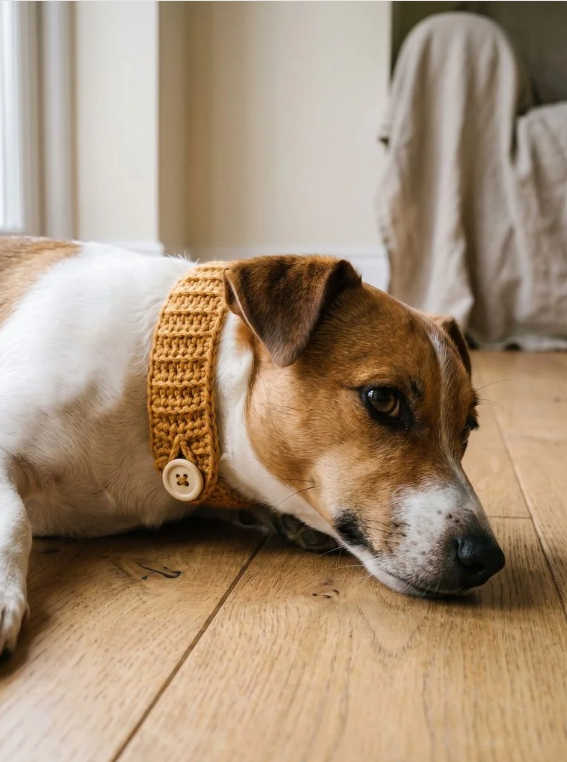
Crochet Pet Collar Pattern is a practical and attractive project for anyone who enjoys creating handmade accessories for pets. Inspired by the simple textured collar shown in the reference image, this design uses a compact crochet band, neat edging, and a button-style detail to create a warm handmade appearance. The project is small enough to complete quickly, yet it offers plenty of opportunities to practice basic crochet stitches, measuring, shaping, edging, and finishing techniques. A golden mustard or caramel shade gives the collar a classic look, but the pattern can easily be customized with almost any color.
Unlike a decorative bandana, a crochet pet collar needs special attention to fit and construction because it sits directly around the animal’s neck. Crochet naturally stretches, so the finished piece should never be treated as a substitute for a properly manufactured collar intended for restraint, identification, or leash attachment. This tutorial therefore focuses on creating a decorative supervised-wear accessory. For practical use, incorporating an appropriate commercially manufactured breakaway or quick-release pet closure is preferable to relying on yarn, a decorative button, or a crocheted loop as the sole fastening system.
The Crochet Pet Collar Pattern can be adapted for different neck sizes by measuring the individual pet before starting. Instead of following one fixed number of stitches, you will crochet until the band reaches the required dimensions. This approach is particularly useful because yarn thickness, hook size, crochet tension, and animal size can all affect the finished fit. The instructions below use U.S. crochet terminology and include measurements in both inches and centimeters so you can create a clean, comfortable, personalized accessory.
Materials, Measurements and Crochet Stitches
For this Crochet Pet Collar Pattern, choose a smooth yarn that feels comfortable against the skin. A DK #3 cotton or cotton-blend yarn is an excellent option because it provides good stitch definition without creating an excessively thick band. A light worsted #4 cotton can also work for a slightly more substantial version.
DISCOVER MORE FREE PATTERNS HERE!
Approximately 30–60 yards (27–55 m) of yarn should be sufficient for many small or medium decorative collars. Larger versions may require more. The warm golden brown shown in the inspiration creates a rustic appearance, while blue, sage, burgundy, cream, lavender, or dusty pink can completely change the personality of the project.
A 3.5 mm to 4.0 mm crochet hook works with many DK and light worsted yarns. Also prepare a yarn needle, scissors, flexible measuring tape, stitch markers, and your chosen pet-appropriate closure. A decorative button can be added for appearance, but it should not be relied upon as a safety-release mechanism.
The principal U.S. abbreviations are ch – chain, sl st – slip stitch, sc – single crochet, hdc – half double crochet, dc – double crochet, BLO – back loop only, and FLO – front loop only. You can make the entire project with single crochet, although alternating stitch placement creates a more interesting ribbed texture.
Before crocheting, measure the pet’s neck where the accessory will naturally sit. Do not use an old collar measurement unless you know it still fits correctly. The finished decorative band should sit comfortably without pressing against the throat.
As rough references only, a small pet may have a neck circumference around 8–12 inches (20–30 cm), while medium and larger animals can require substantially more. Individual animals vary greatly, so actual measurement is essential.
The band in the reference has a moderately wide appearance. For a similar result, aim for approximately 1½–2 inches (4–5 cm) in width. Very small animals should receive a proportionally narrower version so the collar does not interfere with normal head and neck movement.
How to Crochet the Main Pet Collar Band
A simple way to construct this easy crochet pet collar is to crochet the band sideways. This means the starting chain determines the width, while the number of completed rows determines the circumference.
Using your main color, ch 8–12, depending on yarn thickness and desired width. With DK yarn and a 3.5 mm hook, beginning with approximately 10 chains provides a useful starting point for a medium-width sample.
Row 1: Sc in the second ch from the hook and in each chain across. Ch 1 and turn.
Row 2: Work 1 sc in the BLO of every stitch across. Ch 1 and turn.
Row 3: Repeat Row 2. Continue working the same sequence until the strip begins developing a subtle ribbed texture.
Using back-loop-only single crochet produces flexible horizontal ridges that resemble the structured texture visible in the reference. It also gives the band enough flexibility to curve naturally around the neck.
Continue crocheting until the strip approaches the required length. Measure the band in a relaxed state rather than stretching it. Crochet fabric can become longer during use, so deliberately stretching the strip while measuring may result in an oversized accessory.
When the band reaches the approximate required length, stop and test its placement around the pet without fastening it permanently. Check that the width looks proportional and that the fabric lies flat.
If you are installing a manufactured breakaway or quick-release closure, follow the closure manufacturer’s instructions and account for the hardware length when determining the final crochet length. This is important because the closure itself adds to the total circumference.
Once you are satisfied with the dimensions, fasten off while leaving a sufficiently long yarn tail for finishing. Weave the end through several stitches securely.
Adding the Edging, Closure and Decorative Button
A clean border makes a major difference in the finished Crochet Pet Collar Pattern. Join the same yarn—or a contrasting color—at one corner of the completed strip.
Work sc evenly around the perimeter. Place approximately one stitch into each stitch across the short ends and distribute stitches evenly along the row ends. Avoid overcrowding the edges because excessive stitches can make the collar flare.
At each corner, work approximately 2 sc into the same space if needed to turn cleanly. The objective is a smooth rectangular band rather than pronounced pointed corners.
For a slightly more decorative appearance, work a second border round in sl st or reverse single crochet. Keep the border relatively flat and compact because bulky decorative edging is unnecessary around a pet’s neck.
The button visible in the inspiration can be treated as an optional decorative element. If you add one, sew it securely using strong thread and inspect it frequently. Do not add loose decorations to an animal that is likely to chew or pull at them.
For supervised decorative wear, a suitable pet breakaway closure can be attached to the ends of the crochet strip. The precise installation depends on the hardware, so follow its manufacturer’s directions rather than improvising a load-bearing connection.
Do not attach a leash directly to the crochet fabric or decorative button. Crochet stitches and yarn are not designed to provide the predictable strength of purpose-built walking equipment. Use a properly fitted commercial harness or collar for leash control.
Once the closure is installed, check every yarn tail and seam. Nothing should protrude toward the animal’s skin. The inside surface should feel smooth when you run your fingers around the complete band.
Sizing, Customization, Finishing and Pet Comfort
The biggest advantage of this adjustable crochet collar pattern is that the length can be customized simply by adding or removing rows before finishing. This is much easier than trying to force one universal stitch count to fit every pet.
For a narrower collar, begin with fewer chains. For a wider decorative band similar to the photograph, add several chains to the foundation. Remember that increasing width also increases weight, so keep the finished accessory appropriately lightweight.
Color customization is another easy way to personalize the project. Mustard yellow, caramel, forest green, denim blue, burgundy, cream, dusty rose, and charcoal gray can all create attractive results. You can also work alternating rows in two colors to produce subtle stripes.
For extra texture, alternate one row of BLO sc with one standard sc row. Another possibility is to use hdc throughout the band for a softer, slightly taller stitch. Make a small swatch first because changing stitches changes both width and stretch.
After finishing, gently shape the collar by hand. Cotton yarn can often be lightly blocked according to the care instructions supplied with the yarn. Do not aggressively stretch the piece during blocking because you want the final measurements to remain predictable.
Before putting the collar on the pet, inspect the entire accessory. Check the closure, seams, decorative button, and woven ends. Repeat these checks regularly because crochet fabric can change with repeated wear.
A handmade crochet dog collar or crochet cat collar should not interfere with eating, drinking, sleeping, grooming, breathing, or normal movement. Remove it immediately if the pet scratches excessively at it, attempts to chew it, appears uncomfortable, or if the accessory becomes damaged.
For the safest approach, consider this project primarily a decorative crochet pet accessory for supervised use, photographs, or short periods at home. Identification tags and leash connections should remain on equipment specifically manufactured for those purposes.
FAQ – Crochet Pet Collar Pattern
Is the Crochet Pet Collar Pattern suitable for beginners?
Yes. The basic band uses chains and single crochet, while the ribbed version introduces the simple back-loop-only technique.
What is the best yarn for a crochet pet collar?
A smooth cotton or cotton-blend DK yarn is a practical choice for a lightweight decorative accessory.
What crochet hook should I use?
A 3.5–4.0 mm hook works well with many DK and light worsted yarns, but always consider the yarn manufacturer’s recommendation.
How wide should a crochet pet collar be?
Approximately 1½–2 inches (4–5 cm) can work for a medium-sized version. Smaller animals usually need a narrower accessory.
How do I determine the correct length?
Measure the individual animal’s neck and account for the dimensions of the closure. Do not estimate the size based only on breed.
Can I use single crochet for the entire collar?
Yes. Single crochet creates a compact fabric that works very well for this project.
How do I create the ribbed texture?
Work single crochet through the back loop only (BLO) on each row. This creates raised horizontal ridges.
Can I use half double crochet instead?
Yes. Hdc produces a slightly softer and faster-working fabric, although it will change the gauge.
Can the button be used as the main closure?
A decorative button can contribute to the appearance, but a purpose-made pet breakaway or quick-release closure is preferable for actual supervised wear.
Can I attach a leash to the crochet collar?
No. Use properly manufactured walking equipment for leash attachment rather than relying on crochet yarn or stitches.
Can I make this pattern for cats?
The decorative band can be resized for a cat, but a cat-appropriate breakaway mechanism is particularly important.
Can I make the collar in two colors?
Absolutely. Alternating colors every two or three rows can produce attractive stripes.
How much yarn is required?
Many small and medium versions require only approximately 30–60 yards (27–55 m), although the exact amount depends on dimensions and yarn thickness.
How can I make the collar softer?
Choose a soft cotton blend and avoid crocheting excessively tightly. A slightly larger hook can also improve flexibility.
Can I add flowers or charms?
Decorations are possible for supervised use, but they should be lightweight and firmly secured. Avoid detachable pieces for animals that chew accessories.
How should I wash the collar?
Follow the care instructions for the yarn and any installed hardware. Allow the accessory to dry completely before using it again.
Why is my crochet band curling?
Tension may be too tight or the border may contain an uneven number of stitches. Relaxing your tension and gently blocking the finished piece can help.
Can I make matching collars for multiple pets?
Yes. Measure each animal separately and customize the colors while using the same basic construction.
Conclusion
The Crochet Pet Collar Pattern is an approachable project that transforms a small amount of yarn into a neat handmade pet accessory. Its straightforward rectangular construction makes it especially useful for practicing single crochet, BLO ribbing, edging, measuring, and finishing.
The warm mustard color shown in the inspiration gives the project a cozy handmade character, but the design can easily be recreated in blue, green, cream, burgundy, pink, lavender, or multicolored yarn. Changing the yarn and border provides many variations without changing the fundamental construction.
Accurate measurement is the key to achieving a successful result. Rather than depending on a universal number of stitches, crochet the band according to the individual pet’s proportions and account for any closure hardware before completing the project.
With careful finishing, a suitable release closure, and supervised wear, this Crochet Pet Collar Pattern makes a charming decorative accessory. Keep purpose-built equipment for identification and leash restraint, while enjoying the crochet version as a creative handmade project that can be personalized in countless colors and textures.