
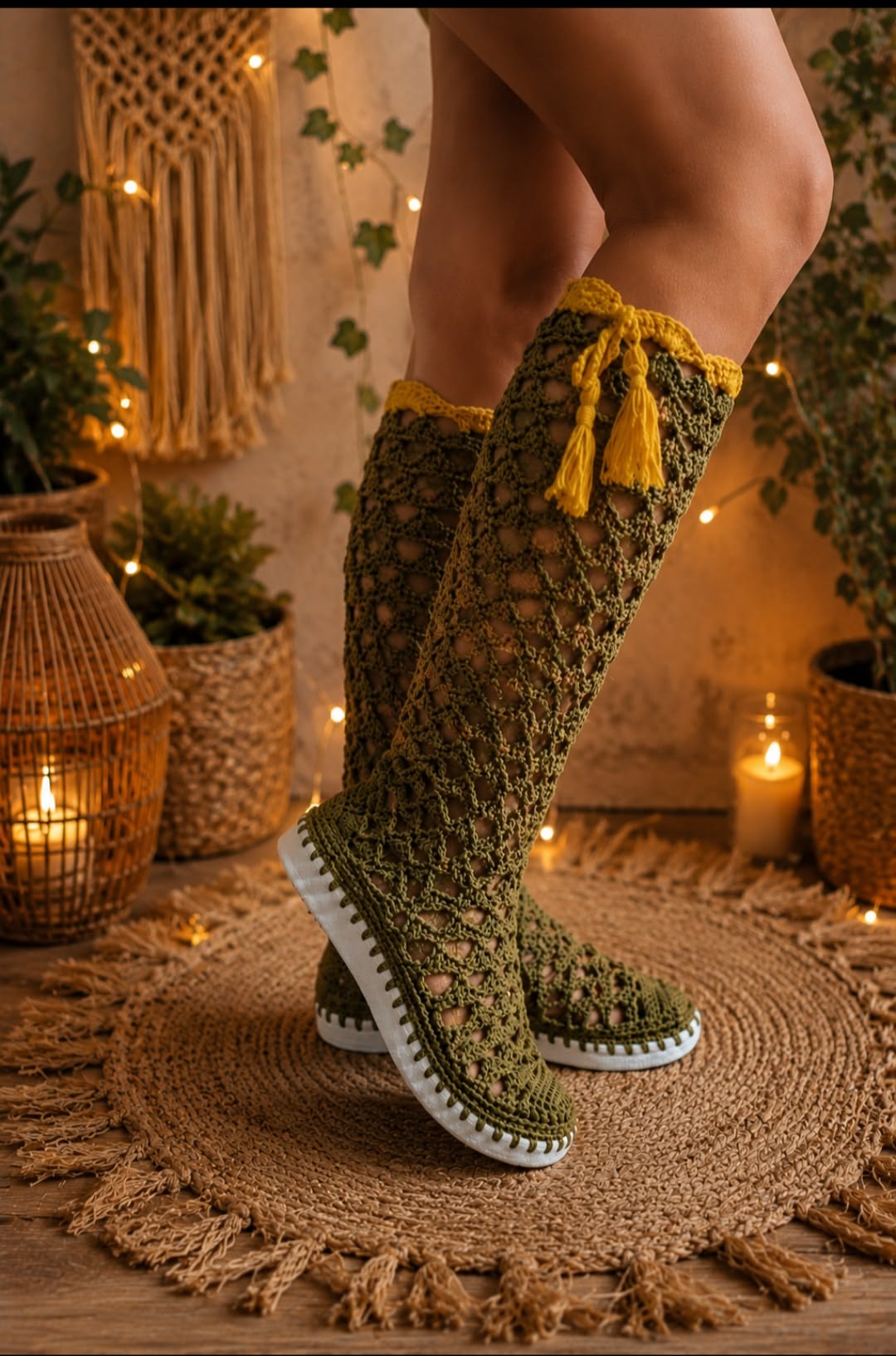
Crochet Boot Pattern is a beautiful project for crocheters who enjoy combining fashion, texture, and decorative lacework in one handmade piece. Inspired by the tall openwork boots shown in the reference image, this design features a fitted crochet foot, an airy lace shaft that reaches toward the knee, a contrasting decorative cuff, and adjustable ties finished with tassels. The result has a relaxed bohemian character while still looking polished and carefully constructed.
One of the most interesting features of this Crochet Boot Pattern is the combination of a structured lower section with a much lighter openwork upper. The foot needs enough stability to keep its shape, while the leg section should remain flexible and comfortable. For that reason, the project uses tighter single crochet and half double crochet stitches around the foot before transitioning into a repeating lace mesh. A pre-made sole can also be used as the foundation, as suggested by the appearance of the reference project.
These instructions use U.S. crochet terminology and are intended as a customizable construction guide rather than a one-size-fits-all formula. Feet, ankles, calves, yarns, soles, and crochet tension vary considerably, so measurements should always be checked while working. The finished boots can be made ankle-high, mid-calf, or knee-high simply by changing the number of lace repeats. For the tall version, a finished shaft of approximately 15–17 inches (38–43 cm) measured upward from the sole is a useful starting point.
Materials, Measurements and Crochet Stitches
For this Crochet Boot Pattern, a strong cotton or cotton-blend yarn is an excellent choice. Cotton provides crisp stitch definition for the lace pattern and does not usually stretch as dramatically as some softer fibers. A DK or light worsted-weight yarn gives the boot enough structure without making the finished fabric excessively heavy.
DISCOVER MORE FREE PATTERNS HERE!
For an adult pair of tall boots, plan for approximately 700–1,000 yards (640–915 m) of the main color. The exact amount depends on foot size, boot height, lace density, and yarn weight. The reference-inspired version can be worked primarily in olive green, with mustard or golden yellow used for the upper edging, ties, and tassels.
A 3.0–4.0 mm crochet hook is suitable for many cotton yarns. You will also need a yarn needle, scissors, stitch markers, measuring tape, blocking supplies, and two compatible soles. Choose soles specifically suitable for craft construction and ensure they provide appropriate traction and durability for your intended use.
Useful U.S. abbreviations include ch – chain, sl st – slip stitch, sc – single crochet, hdc – half double crochet, dc – double crochet, tr – treble crochet, st – stitch, sts – stitches, sp – space, inc – increase, and dec – decrease. Familiarity with working in rounds is particularly useful for this project.
Measure the foot from heel to longest toe, the widest circumference around the foot, ankle circumference, calf circumference, and desired boot height. Measure both legs because small differences are common. For comfortable decorative boots, allow approximately ½–1 inch (1.3–2.5 cm) of ease around the calf depending on how stretchy your chosen stitch pattern is.
For example, a medium sample could be planned around a foot length of 9½ inches (24 cm), ankle circumference of approximately 9–10 inches (23–25.5 cm), calf circumference of 13–15 inches (33–38 cm), and finished shaft height of approximately 16 inches (40.5 cm). These are example measurements only; customize the pattern to the wearer.
Before beginning both boots, crochet a swatch. A practical starting gauge for the denser sections is approximately 18–20 sc = 4 inches (10 cm). More important than matching an exact gauge is creating fabric that feels firm enough to hold its shape while remaining comfortable.
Building the Sole, Toe, Foot and Heel
If you are using a pre-made sole with crochet-ready holes, begin by working around those openings. If the sole is not manufactured for crochet attachment, do not puncture or modify it unless the material and construction are specifically suitable for that purpose. The attachment between the crochet fabric and sole carries significant stress.
Join the main-color yarn near the heel. Work 1 sc into each prepared opening around the sole. Maintain even tension so the first round lies flat rather than pulling the sole upward. Join the round with a sl st.
Work another round of sc around the foundation. Depending on the spacing of the holes, you may need occasional increases. Place increases gradually rather than concentrating several stitches in one location.
The toe can be developed with hdc or sc. Place stitch markers at both sides of the foot. Work evenly around the sides and heel while shaping the front with controlled decreases. Try the developing upper against the foot frequently.
Continue until the crochet fabric rises approximately 1½–2 inches (4–5 cm) above the sole. The toe should follow the natural curve of the foot without becoming excessively tight.
To create a slightly decorative transition, work one round of hdc in the back loops only. This produces a subtle ridge and visually separates the lower foot from the lace section.
Begin introducing small open spaces over the upper foot. One simple repeat is dc, ch 1, skip 1 st, dc. Do not make the openings excessively large around the toes because this portion receives more movement than the upper leg.
Continue the patterned section toward the ankle. Maintain denser stitches underneath and around areas that require more stability. Decorative crochet footwear benefits from balancing openwork with structural rows.
The heel can remain relatively dense. Work sc or hdc around the back of the ankle for several rounds. If necessary, use evenly spaced decreases to bring the fabric closer to the ankle.
Once the ankle section is complete, count the stitches around both boots. Adjust them so the stitch counts match before beginning the tall shaft. Matching stitch counts will make it much easier to produce two symmetrical boots.
At this stage, try the boot on carefully. Check the toe length, heel position, ankle opening, and transition into the leg. Corrections are much easier now than after crocheting the entire shaft.
Creating the Openwork Lace Shaft
The tall crochet lace boot gets much of its character from the open diamond-style stitch pattern. Begin the shaft with one foundation round of sc or hdc around the ankle.
For the first mesh round, work a repeat such as ch 4, skip 2 sts, sc in next st around. Adjust the number of skipped stitches if necessary so the repeats are distributed evenly.
For the following round, work ch 4, sc into the next ch-4 sp. Continue around. This begins forming a flexible mesh.
A more decorative variation can be made by working (2 dc, ch 2, 2 dc) into selected chain spaces. On the next round, work into the ch-2 spaces to create small shells or V-shaped lace elements.
Alternate open mesh rounds with more structured decorative rounds. For example, work two rounds of chain mesh followed by one round of small shells. Repeating this sequence creates an interesting vertical texture without making the fabric too dense.
Continue upward for approximately 4–5 inches (10–13 cm) before checking the calf fit. Because the leg becomes wider toward the calf, increases will probably be necessary.
Add increases gradually. Instead of suddenly adding many stitches, create one additional mesh repeat at each side of the leg every few rounds. This allows the shaft to expand smoothly.
Continue measuring the circumference every few inches. The boot should sit close enough to maintain its shape but should not compress the leg. Remember that cotton crochet may relax slightly during wear.
For a knee-high design, continue until the shaft reaches approximately 14–16 inches (35.5–40.5 cm) above the ankle or until it reaches the desired point below the knee.
You can also shape the upper opening slightly wider by adding several extra mesh repeats during the final 2–3 inches (5–7.5 cm). This gives the top a relaxed appearance and provides room for the decorative drawstring.
Before adding the cuff, work one stabilizing round of sc. If the mesh has many large spaces, work several sc into each chain space rather than attempting to place stitches into individual chains.
Decorative Cuff, Drawstring, Tassels and Finishing
The contrasting cuff gives this Crochet Boot Pattern a distinctive finished appearance. Join the contrast color at the upper edge and work one complete round of sc.
For the second cuff round, work 3 dc into one stitch, skip 1 st, sc in next st, skip 1 st, and repeat. This produces a gentle scalloped effect.
For a larger ruffle, work 5 dc into one stitch, skip the appropriate number of stitches, and anchor the shell with sc. Keep the ruffle relatively small so it does not overwhelm the lace shaft.
Next create a drawstring channel. With the main or contrast color, work dc, ch 1, skip 1 st around the upper section. This provides regularly spaced openings through which the cord can be threaded.
Make the cord by chaining approximately 30–40 inches (76–102 cm) and slip stitching back along the chain. Alternatively, crochet a narrow Romanian cord for a thicker, more decorative tie.
Thread the cord through the openings around the cuff. Leave equal lengths at both ends and test the boot before deciding how tightly the drawstring should close.
To make each tassel, wrap yarn approximately 20–30 times around a piece of cardboard measuring about 3 inches (7.5 cm). Tie one end securely, cut the opposite loops, and wrap yarn several times around the upper portion to form the tassel head.
Attach one tassel to each end of the drawstring. Trim the yarn ends evenly. The contrasting tassels provide movement and create the decorative bohemian finish suggested by the reference design.
Weave in all remaining yarn ends securely. Pay special attention to the junction between the crochet fabric and sole because this area experiences the greatest movement.
Lightly block the shaft if your chosen fiber allows it. Avoid aggressively stretching the ankle or foot sections. The objective is simply to open the lace stitches and straighten the upper edge.
Finally, compare both boots side by side. Check height, circumference, tassel length, toe shaping, and lace alignment. Small differences can sometimes be corrected with gentle blocking.
Because handmade crochet uppers and craft soles vary in durability and traction, treat this design primarily as decorative or light-use handmade footwear unless the sole system you use is specifically designed and securely constructed for regular outdoor footwear.
FAQ – Crochet Boot Pattern
Is this Crochet Boot Pattern suitable for beginners?
It is best for confident beginners or intermediate crocheters. The basic stitches are straightforward, but shaping the foot and matching two boots requires patience.
What yarn should I use for crochet boots?
A durable cotton or cotton-blend yarn is a practical option because it provides clear stitch definition and reasonable structure.
How much yarn will I need?
For tall adult boots, approximately 700–1,000 yards (640–915 m) is a useful estimate, although size and stitch density can change the amount significantly.
What crochet hook should I use?
Approximately 3.0–4.0 mm works with many DK and light worsted cotton yarns. Always match the hook to the yarn and desired fabric density.
Can I make ankle boots instead?
Yes. Stop shortly after completing the ankle section and add the decorative cuff.
How do I make the boots fit larger calves?
Add mesh repeats gradually as you work upward. Measuring frequently is more reliable than following a fixed stitch count.
Can I make the shaft shorter?
Absolutely. The same construction can produce ankle, mid-calf, or knee-high crochet boots.
Why does my lace section look uneven?
Check that each mesh round contains the correct number of chain spaces. Blocking can also dramatically improve the appearance of lace crochet.
How do I keep both boots the same size?
Record every round, increase, decrease, and measurement from the first boot and repeat those instructions exactly for the second.
Can I use acrylic yarn?
Yes, but acrylic may behave differently from cotton. Make a swatch first and check stretch and recovery.
Can I change the colors?
Yes. Olive and mustard create an earthy bohemian combination, while cream and brown, navy and beige, burgundy and gold, or black and gray can create very different styles.
How tall should knee-high crochet boots be?
Approximately 15–17 inches (38–43 cm) from the sole is a useful starting range, but always measure the wearer.
How can I make the foot section stronger?
Use tighter stitches, a smaller hook if appropriate, and a durable yarn. Avoid using excessively open lace in high-stress areas.
Can the drawstring be removed?
Yes. You can finish the boot with a simple scalloped cuff instead.
Should I block the finished boots?
Light blocking can help open the lace pattern, but follow the care recommendations for the yarn and sole materials.
Can these be worn outdoors?
That depends entirely on the sole and construction method. A decorative craft sole should not automatically be assumed suitable for outdoor walking. Use footwear components designed for the intended conditions.
Conclusion
The Crochet Boot Pattern combines practical crochet construction with beautiful openwork lace to create a striking pair of handmade tall boots. Beginning with a stable lower foot, the design gradually changes into an airy crochet lace shaft, giving the project both structure and visual lightness.
The most important part of making these boots successfully is customization. Rather than relying exclusively on standard sizes, measure the foot, ankle, calf, and desired shaft height and compare those measurements with the project frequently. Gradual shaping will produce a much cleaner result than trying to correct the fit at the end.
Decorative details make the pattern especially versatile. An olive-green crochet body, golden mustard cuff, matching drawstring, and handmade tassels create the earthy bohemian appearance of the inspiration, but the same construction can be adapted to countless color combinations.
Whether you create an ankle version, a mid-calf design, or dramatic knee-high boots, this Crochet Boot Pattern offers an enjoyable way to practice shaping, openwork stitches, color accents, cords, tassels, and garment-style fitting in a single project.