
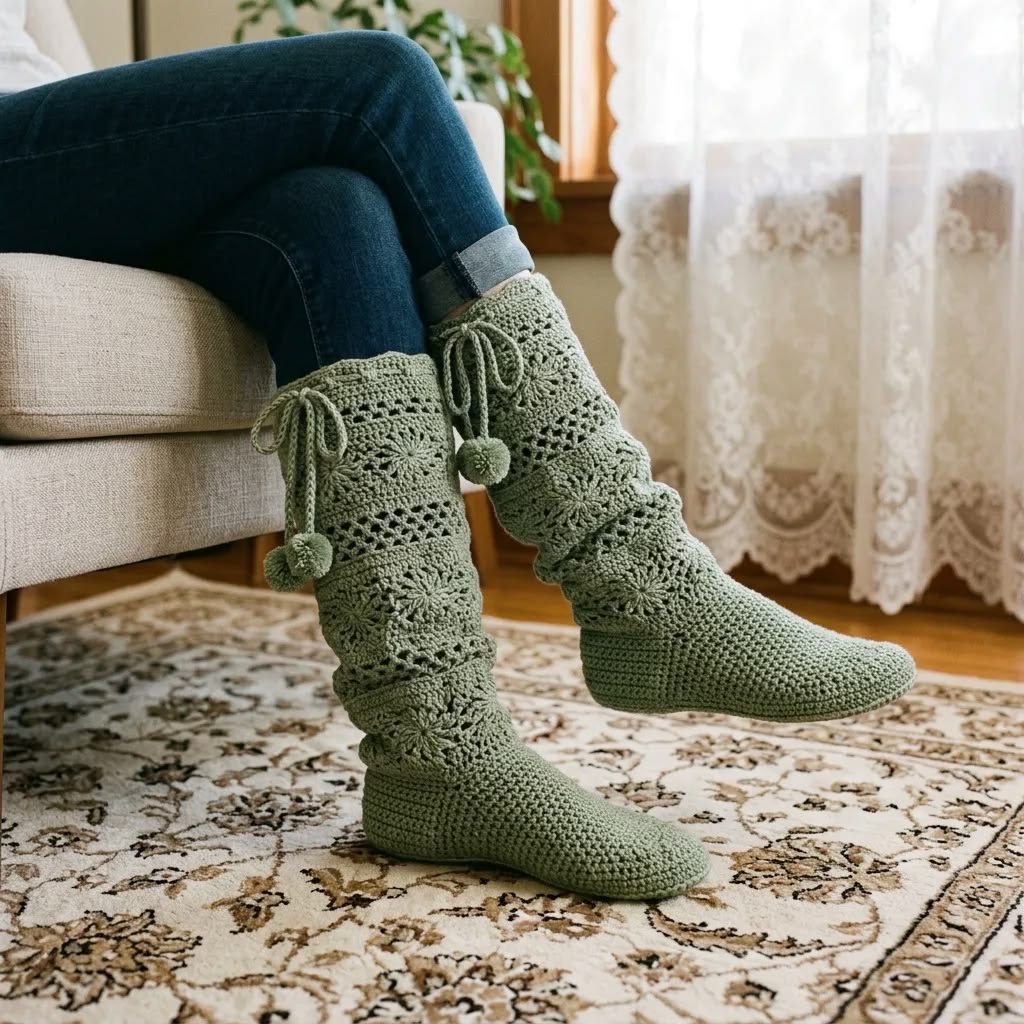
Sage Floral Crochet Slipper Boots Pattern is a beautiful way to combine the comfort of handmade slippers with the elegant appearance of tall crochet boots. Inspired by the sage-green pair shown in the reference image, this design features a softly shaped foot, a comfortable ankle section, decorative floral lace crochet panels, an adjustable drawstring, and playful yarn pom-poms. The result is a cozy pair of indoor slipper boots with a charming handmade look that works especially well for cool mornings and relaxing evenings at home.
The most attractive feature of this Sage Floral Crochet Slipper Boots Pattern is the contrast between the dense stitches around the foot and the more decorative stitches along the leg. The lower portion needs enough structure to maintain its shape, so single crochet and half double crochet are useful choices. As the work moves upward, open spaces and flower-inspired stitch groups can be introduced to create the beautiful lace texture visible in the finished boots. Keeping everything in a soft sage color gives the project a calm, coordinated appearance.
This tutorial uses U.S. crochet terminology and provides measurements that can be adjusted for different adult sizes. A medium sample can be made for a foot approximately 9–9½ inches (23–24 cm) long, with a finished boot height of approximately 14–16 inches (35.5–40.5 cm). Because feet, ankles, calves, yarns, and individual crochet tension differ, fitting the boot as you work is more reliable than depending on a single universal stitch count. These slipper boots are designed primarily for comfortable indoor use; if desired, a suitable non-slip treatment or purpose-made slipper sole can be added according to its manufacturer’s instructions.
Materials, Measurements and Stitches for Sage Crochet Slipper Boots
For this Sage Floral Crochet Slipper Boots Pattern, choose a soft but reasonably durable yarn. A worsted-weight yarn (Category 4) is an accessible choice because it creates a substantial fabric while still allowing the floral details to remain visible. Wool blends, acrylic blends, and soft cotton blends can all work, depending on the warmth and texture you prefer.
DISCOVER MORE FREE PATTERNS HERE!
For an average adult pair, approximately 600–850 yards (550–775 m) of yarn is a practical starting estimate. Taller boots, larger sizes, or very dense stitching may require additional yarn. Purchasing an extra skein from the same dye lot is helpful when you want both boots to have exactly the same sage tone.
A 4.0 mm to 5.0 mm crochet hook works with many worsted-weight yarns. The ideal hook should produce stitches that are firm enough for the foot but still flexible enough to feel comfortable. If your stitches are unusually loose, move down one hook size.
You will also need scissors, a yarn needle, stitch markers, a flexible measuring tape, blocking supplies, and a pom-pom maker or a small piece of cardboard. Optional materials include removable insoles and purpose-made non-slip slipper material.
The primary U.S. crochet abbreviations used throughout the project are ch – chain, sl st – slip stitch, sc – single crochet, hdc – half double crochet, dc – double crochet, tr – treble crochet, st – stitch, sts – stitches, sp – space, inc – increase, and dec – decrease.
Before crocheting, measure the foot from the heel to the longest toe. Also record the widest foot circumference, ankle circumference, calf circumference, and the distance from the floor to the desired upper edge of the boot.
For a medium example, you might work toward a finished foot length of approximately 9½ inches (24 cm), an ankle circumference near 9½–10½ inches (24–27 cm), and a shaft approximately 12–14 inches (30.5–35.5 cm) above the ankle.
The boots should have enough room for comfortable movement but should not be extremely loose. Remember that crochet fabric can relax with repeated wear.
A useful approximate gauge is 16–18 sc = 4 inches (10 cm) with worsted-weight yarn. Gauge may vary, so make a small swatch before starting.
Most importantly, write down every adjustment made to the first slipper boot. When making the second one, repeat the same stitch counts, increases, decreases, and number of rounds so the pair matches.
Crocheting the Toe, Foot, Heel and Ankle
Begin the crochet slipper boot at the toe. Make a magic ring and work 8–10 hdc into it, or begin with a short chain if you prefer an oval toe construction. Join with a sl st.
Increase evenly around the next several rounds. For example, work 2 hdc in each st on the first increase round, followed by evenly spaced increases on subsequent rounds. Continue until the circumference comfortably fits around the widest portion of the toes.
Once the correct width is achieved, stop increasing. Work even rounds of hdc or sc until the toe and front foot section reach approximately two-thirds of the total foot length.
Try the developing slipper against the foot frequently. The crochet should fit closely without pulling tightly across the toes. If the fabric stretches excessively, a slightly smaller hook may provide better structure.
When the work reaches approximately 6–6½ inches (15–16.5 cm) for a medium adult size, begin preparing for the heel. Instead of continuing in complete rounds, work back and forth across approximately half of the stitches.
Continue these heel rows until the back section is long enough to reach the heel. Fold the final heel row in half and join the edges with slip stitches or a neat whip stitch.
Turn the work right side out. You should now have a basic crochet slipper shape with a closed toe and heel.
Join yarn at the ankle opening. Work one round of sc around the entire opening, distributing the stitches evenly. Avoid adding too many stitches because this can make the ankle flare outward.
Work several additional rounds of sc or hdc to create a supportive ankle band. Approximately 1½–2½ inches (4–6.5 cm) of dense stitching creates a stable transition between the foot and decorative shaft.
The reference-inspired boot has a subtly defined ankle before the floral section begins. You can create this effect with one round worked through the back loops only, producing a delicate horizontal ridge.
Before moving to the lace pattern, check the ankle fit. If it is too wide, decrease several stitches evenly. If it feels tight, add a few increases gradually rather than all in one area.
Creating the Floral Lace Crochet Boot Shaft
The defining element of the Sage Floral Crochet Slipper Boots Pattern is the decorative shaft. Rather than working plain stitches all the way to the top, alternate textured floral sections with simpler openwork bands.
Begin with a foundation round of sc. Count your stitches and adjust to a multiple that works comfortably with your chosen floral repeat. Multiples of 6 or 8 are convenient for many shell and flower patterns.
For a simple openwork round, work dc, ch 2, skip 2 sts, dc around. This creates evenly distributed openings and gives the upper boot flexibility.
For the next round, work into the chain spaces. A basic decorative shell can be made with (2 dc, ch 2, 2 dc) in each selected space, with sc stitches between the shells.
To create a more pronounced floral effect, work a cluster such as (yo, insert hook, pull up a loop, yo and pull through 2 loops) three times in the same space, yo and pull through all remaining loops. Combine several clusters around a center space to suggest petals.
After completing a floral band, work one or two rounds of sc or hdc. These solid rounds visually separate the floral motifs and help the boot maintain its shape.
Repeat the sequence of solid band, openwork section, floral motif, and solid band as you crochet upward. This produces the layered appearance visible in the inspiration without requiring every round to be complicated.
As the shaft approaches the widest part of the calf, increases may be necessary. Add one additional pattern repeat at each side every few rounds rather than making many increases at once.
Measure the circumference regularly. The boot should be loose enough to pull over the heel and calf comfortably while remaining fitted enough to stay upright.
For a medium tall slipper boot, continue until the shaft measures approximately 12–14 inches (30.5–35.5 cm) above the ankle, or approximately 14–16 inches (35.5–40.5 cm) from the floor.
Finish the final floral section with several rounds of sc or hdc. A solid upper band provides stability and creates a clean foundation for the drawstring.
For additional texture, work the final round in reverse single crochet (crab stitch) or a simple scalloped edging. Keep the finish flexible enough that the opening still passes comfortably over the calf.
Drawstring, Pom-Poms, Assembly and Finishing
To make the drawstring, chain approximately 32–40 inches (81–102 cm), depending on the circumference of the boot. Slip stitch back through each chain for a firm cord.
Alternatively, make a twisted yarn cord. Cut several long strands of sage yarn, twist them tightly together, fold the bundle in half, and allow it to twist back on itself.
Create openings for the drawstring approximately 1–1½ inches (2.5–4 cm) below the upper edge. If you included a dc-and-chain eyelet round, simply thread the cord through those spaces.
Use a yarn needle or safety pin to guide the drawstring through the openings. Bring both ends to the front of the boot and tie them into a relaxed bow.
Make two small crochet pom-poms or traditional wrapped-yarn pom-poms for each boot. Approximately 1½–2 inches (4–5 cm) in diameter works nicely with the proportions of a tall slipper.
Attach a pom-pom securely to each end of the drawstring. Trim the fibers carefully until the pom-poms appear round and even.
Repeat the entire construction for the second boot. Compare the two frequently rather than waiting until the end. Count every floral repeat and measure the height after each major section.
Weave in all loose ends securely on the inside. Avoid leaving bulky knots against areas of the foot where they could become uncomfortable.
Light blocking can improve the floral stitches considerably. Follow the care instructions for your yarn and concentrate primarily on the shaft rather than stretching the foot.
If you want additional cushioning, place a removable slipper insole inside each boot. Choose one that fits without distorting the crochet.
For smooth indoor floors, consider adding a purpose-made non-slip slipper sole or grip material according to its manufacturer’s directions. Crochet yarn alone can be slippery on polished surfaces.
The finished pair should feel flexible, cozy, and relatively lightweight. The sage color allows the stitch texture to become the main decorative feature instead of relying on multiple contrasting colors.
FAQ – Sage Floral Crochet Slipper Boots Pattern
Is the Sage Floral Crochet Slipper Boots Pattern beginner-friendly?
A confident beginner who understands working in rounds, increases, decreases, and basic lace stitches can attempt it. The floral shaft makes the project slightly more challenging than ordinary crochet slippers.
What is the best yarn for crochet slipper boots?
Soft worsted-weight yarn with good stitch definition works well. Choose a fiber that is comfortable against the skin and appropriate for the warmth you want.
How much yarn will I need?
Approximately 600–850 yards (550–775 m) is a useful estimate for an average adult pair.
What hook size should I use?
A 4.0–5.0 mm crochet hook is suitable for many worsted-weight yarns, but always check your gauge.
How tall should the slipper boots be?
A tall version can measure approximately 14–16 inches (35.5–40.5 cm) from the floor.
Can I make them shorter?
Yes. Simply crochet fewer floral repeats. The same construction works for ankle boots and mid-calf slippers.
How do I adjust the pattern for wider calves?
Add pattern repeats gradually while working upward. Measure every few rounds to avoid making the shaft unnecessarily wide.
Why is one boot larger than the other?
Differences usually come from tension or inconsistent stitch counts. Record the rounds from the first boot and follow the same notes for the second.
Can I make these in another color?
Absolutely. Sage creates the soft botanical appearance shown here, but dusty blue, cream, burgundy, lavender, charcoal, or warm beige can also showcase the floral texture.
How do I make the floral stitches stand out?
Use a smooth yarn with good stitch definition and block the finished shaft gently.
Can I add a contrasting color?
Yes. The floral bands, edging, drawstring, or pom-poms can be worked in a complementary color.
Are these designed for outdoor use?
This tutorial is intended primarily for indoor slipper boots. Outdoor footwear requires soles and construction specifically designed for outdoor wear.
How can I make them safer on smooth floors?
Use a commercially made non-slip slipper sole or grip product and follow the manufacturer’s installation instructions.
Can I wash crochet slipper boots?
Follow the care instructions for your yarn and any added sole or insole. Gentle washing and flat drying are often appropriate for handmade crochet items.
Do I have to add pom-poms?
No. Tassels, simple knots, wooden-style decorative beads, or plain cord ends can be used instead.
Can I make these as gifts?
Yes, but obtain the recipient’s foot length, ankle circumference, and calf circumference first. Accurate measurements make a substantial difference in fit.
Conclusion
The Sage Floral Crochet Slipper Boots Pattern turns basic crochet construction into a beautiful pair of cozy indoor boots. A dense crochet foot and ankle provide the foundation, while repeating openwork and floral bands transform the shaft into the main decorative feature.
The soft sage-green palette is particularly effective because it highlights the texture without making the design visually busy. Matching drawstrings and crochet pom-poms complete the handmade appearance and allow the upper opening to be adjusted comfortably around the leg.
Fit is the key to making this project successful. Measure the foot, ankle, calf, and desired boot height, try the work on throughout construction, and keep detailed notes while making the first boot so the second can be reproduced accurately.
Once you understand the basic construction, this Sage Floral Crochet Slipper Boots Pattern can easily become a reusable foundation for other designs. Change the yarn color, shorten the shaft, substitute different floral stitches, add contrasting cuffs, or replace the pom-poms with tassels to create a completely different pair while using the same fundamental technique.