
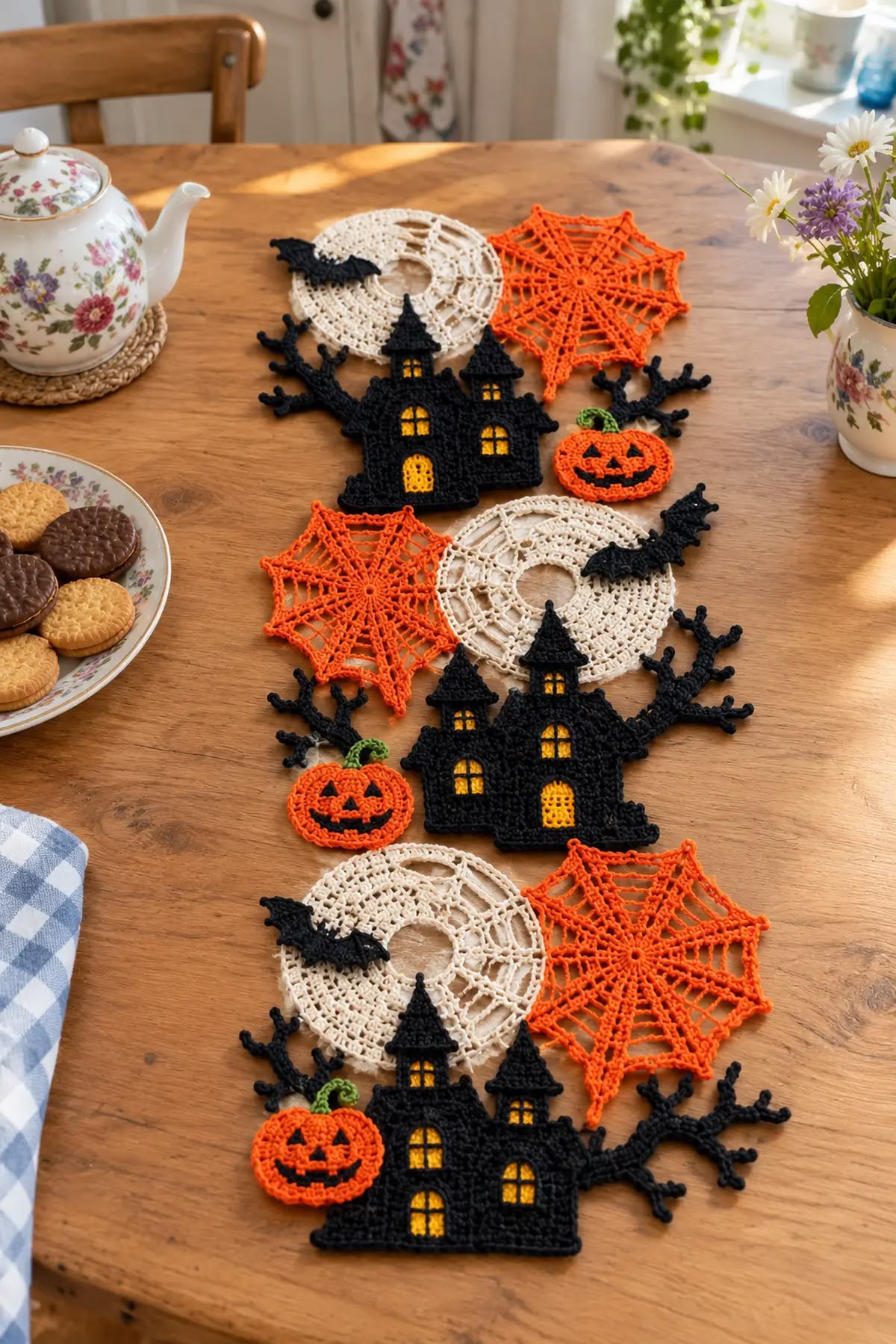
Halloween Crochet Table Runner Tutorial is a creative seasonal project that combines several classic Halloween motifs into one dramatic handmade decoration. Inspired by the arrangement shown in the reference image, this runner features crochet haunted houses, spiderwebs, moons, bats, pumpkins, and spooky tree branches worked primarily in black, orange, cream, yellow, and green. Instead of crocheting one long rectangular panel, the design is built from individual appliqués that are arranged and joined to create an artistic table runner.
This type of Halloween crochet pattern is especially enjoyable because each motif becomes a small project of its own. You can crochet one haunted house during one sitting, make several spiderwebs later, and then complete the pumpkins and bats before assembling everything. The modular construction also makes the runner highly customizable. A shorter dining table may need only two haunted houses, while a long farmhouse table can accommodate three or four repeating motif groups.
The finished runner suggested in this tutorial measures approximately 14–16 inches (35.5–40.5 cm) wide and 50–60 inches (127–152 cm) long, depending on motif placement and yarn tension. Cotton yarn is recommended because it gives the appliqués good stitch definition and helps the spiderwebs and architectural details hold their shape. The instructions below use U.S. crochet terminology and can easily be adjusted for different table sizes.
Materials, Crochet Stitches and Measurements
For this Halloween Crochet Table Runner Tutorial, choose DK or light worsted-weight cotton yarn. Black should be your primary color because it forms the haunted houses, bats, window outlines, and spooky branches. Approximately 350–450 yards (320–410 m) of black should be enough for an average runner.
DISCOVER MORE FREE PATTERNS HERE!
You will also need approximately 200–250 yards (183–229 m) of cream or off-white, 200 yards (183 m) of bright pumpkin orange, 40–60 yards (37–55 m) of golden yellow, and small amounts of green. Exact quantities will vary considerably depending on the number and size of motifs.
A 3.5 mm (E/4) or 4 mm (G/6) crochet hook is a useful starting point. Select a hook that produces a relatively firm fabric without making the stitches excessively tight. You will also need a yarn needle, scissors, stitch markers, blocking pins, and a blocking mat.
The main U.S. crochet abbreviations are ch – chain, sl st – slip stitch, sc – single crochet, hdc – half double crochet, dc – double crochet, tr – treble crochet, inc – increase, dec – decrease, st – stitch, sts – stitches, and sp – space.
Gauge is not critical because the runner is decorative. However, consistency matters. A useful target is approximately 18–20 sc = 4 inches (10 cm). If every motif is crocheted with the same yarn and hook, the finished composition will look much more balanced.
Plan the arrangement before beginning. For a runner approximately 54 inches (137 cm) long, consider making three haunted houses, three large spiderwebs, three cream moon motifs, three pumpkins, and several small bats and branches.
The haunted house can measure approximately 9–10 inches (23–25.5 cm) wide and 8–9 inches (20–23 cm) high. Spiderwebs can measure 8–9 inches (20–23 cm) across, while pumpkins can be approximately 4 inches (10 cm) wide.
Crocheting the Haunted House, Windows and Spooky Branches
Begin the crochet haunted house appliqué with black yarn. Ch 31. Starting in the second ch from the hook, sc across. Ch 1 and turn. Continue working approximately 18–22 rows of sc to create the main rectangular building.
To create an irregular haunted-house silhouette, begin decreasing near the upper section. Work one sc2tog at each side every second row until the central section becomes narrower. This creates a slightly tapered structure rather than a perfectly square building.
The towers can be crocheted separately. Ch approximately 11–15 sts depending on the desired tower width. Work rows of sc until the tower measures approximately 4–5 inches (10–13 cm). Make two or three towers in different heights for an intentionally uneven haunted appearance.
For each roof, begin with a narrow row and increase gradually until the triangle is slightly wider than its corresponding tower. Another method is to start at the bottom with approximately 15 sc and work sc2tog at both ends of alternate rows until one or two stitches remain.
Crochet the windows separately with yellow yarn. Make small rectangles approximately ¾–1 inch (2–2.5 cm) tall. Attach them to the black house with yellow or black yarn. Vertical and horizontal black surface stitches can divide each window into four glowing panes.
The front door can be made in orange or yellow. Ch approximately 7–9 sts and work short rows of sc. For a rounded doorway, finish the upper edge with several hdc or dc stitches arranged to form a shallow arch.
Arrange the towers over the main building and sew them securely with a yarn needle. Allow one tower to sit slightly higher than another. The asymmetry makes the silhouette more visually interesting.
For the crochet spooky tree branches, begin with a black chain approximately 20–25 stitches long. Slip stitch or sc back along the chain to create a firm branch. At selected points, add smaller chains of 5–10 stitches and work back along them to create crooked twigs.
Make branches on both sides of the haunted house. They do not need to match. In fact, slightly irregular branches contribute to the Halloween atmosphere and help connect the house visually with the surrounding motifs.
Crochet Spiderwebs, Moons, Bats and Pumpkins
The crochet spiderweb motif is one of the most recognizable elements of this table runner. With orange yarn, make a magic ring. Ch 3 and work 11 dc into the ring. Join with a sl st. You now have a compact circular center.
For the next round, create open spaces by alternating dc stitches with chains. A simple sequence is dc, ch 2 around. On subsequent rounds, gradually increase the number of chains between the structural dc stitches.
To create the characteristic web appearance, keep approximately eight radial sections. Each new round should move farther away from the center while maintaining these spokes. Work combinations such as dc, ch 3, then dc, ch 4, and finally dc, ch 5 or 6.
For a more angular outer edge, work small picots at the end of each spoke. A basic picot is ch 3, sl st into the first ch. Blocking is essential because the web may look uneven immediately after crocheting.
The cream moon can begin as a flat circle. Make a magic ring, work 12 dc into it, and increase evenly on subsequent rounds. For example, work 2 dc in each stitch on Round 2 and (dc, 2 dc in next st) around Round 3.
Continue increasing until the moon reaches approximately 7–8 inches (18–20 cm) across. To create a more open, lacy appearance, alternate groups of dc with chain spaces in the outer rounds.
Crochet the bats in black. Begin with a small central body made from several sc or hdc stitches. The wings can be shaped using combinations of ch, sc, dc, tr, dc, sc, producing pointed outer edges. Make several bats in slightly different sizes.
For the pumpkin, use orange yarn and begin with a magic ring. Work approximately 12 dc into the ring and increase evenly for two or three rounds. To suggest pumpkin segments, use surface slip stitches or slightly raised lines extending from the center toward the edge.
Create the jack-o’-lantern face with black yarn. Small triangles can represent the eyes and nose, while a short zigzag chain or embroidered line creates the mouth. Keep these pieces securely attached, particularly if the decoration will be handled frequently.
Finish each pumpkin with a short green stem. Ch 6–8, sc back along the chain, and attach it to the top. Add a curled vine by chaining approximately 12–15 stitches and working 2 or 3 sc into each chain so the strip curls naturally.
Arranging, Joining, Blocking and Finishing the Table Runner
Before joining anything, block every motif individually. This is particularly important for the crochet spiderwebs and moons, which need to remain flat and open. Follow the care instructions for your chosen yarn when blocking.
Place the blocked motifs on a large table or clean floor. Start with the haunted houses because they are the visual anchors. Position them at regular intervals along an imaginary center line.
Place a cream moon behind or slightly above each haunted house. The contrast between cream and black crochet makes the house silhouette stand out. Avoid completely covering the moon; leave enough visible area to establish its circular shape.
Position an orange spiderweb beside each moon. Rotate the web slightly rather than keeping every motif perfectly horizontal. This creates the relaxed, collage-like arrangement visible in the inspiration.
Add pumpkins beside the lower portions of the houses. Then place the bats around the moons and spiderwebs. Finally, extend the black branches outward to bridge some of the spaces between motifs.
When satisfied with the composition, photograph the layout before moving anything. This gives you a useful reference during assembly.
Use matching yarn and a yarn needle to join motifs where they overlap. Work small, discreet whip stitches through the back loops whenever possible. The goal is to connect the motifs securely without creating heavy visible seams on the front.
For areas that barely touch, crochet small hidden chain bridges in black, cream, or orange. These connections help maintain the overall shape of the Halloween table runner while preserving its openwork appearance.
Once assembled, measure the runner. A finished size around 14 x 54 inches (35.5 x 137 cm) works well for many tables, although your runner can be longer or shorter.
Perform one final gentle blocking after assembly. Pin the outer points of the spiderwebs, straighten the branches, align the houses, and shape the pumpkins. Allow the entire piece to dry completely before removing the pins.
For storage after Halloween, avoid folding the runner tightly through the spiderwebs. Rolling it loosely around a clean cardboard or fabric-covered tube can help preserve the blocked shapes until the following season.
FAQ – Halloween Crochet Table Runner Tutorial
Is this Halloween Crochet Table Runner suitable for beginners?
An adventurous beginner can make it, although basic knowledge of single crochet, double crochet, chains, increases, decreases, and working in the round is recommended.
What yarn is best for this project?
Cotton or a cotton-rich yarn works particularly well because it provides crisp stitch definition and blocks neatly.
What hook size should I use?
A 3.5 mm to 4 mm crochet hook is a good starting range for DK or light worsted cotton.
How large should the finished runner be?
Approximately 14–16 inches (35.5–40.5 cm) wide and 50–60 inches (127–152 cm) long is a useful standard size.
Can I make the runner shorter?
Yes. Use two haunted-house sections instead of three.
How can I make a longer Halloween runner?
Repeat the house, moon, web, pumpkin, and bat arrangement until you reach the desired length.
Why are my spiderwebs curling?
The chain spaces may be too tight, or the motif may simply need blocking. Open lace motifs often change dramatically after proper blocking.
Can I use acrylic yarn?
Yes, although cotton generally produces sharper details. If using acrylic, use an appropriate blocking method and avoid excessive heat.
How do I make the haunted house look dimensional?
Use separately crocheted towers and roofs, then layer them slightly over the main building before sewing.
Can I change the colors?
Certainly. Purple, lime green, charcoal gray, burgundy, and cream can all work beautifully with traditional Halloween orange and black.
Do the motifs have to be identical?
No. Slight differences in houses, bats, pumpkins, and branches can make the finished piece more interesting.
How many haunted houses should I crochet?
Three works well for a medium-to-long runner, but two may be enough for a smaller table.
Can I make placemats using the same pattern?
Yes. One haunted house, one moon, one spiderweb, and one pumpkin can be arranged into an individual decorative mat.
Can this pattern be used as wall décor?
Yes. The assembled motifs can also make an attractive Halloween crochet wall hanging.
Should I block the pieces before joining them?
Yes. Individual blocking makes assembly much easier and improves the final appearance.
How should I wash the finished runner?
Follow the yarn manufacturer’s care instructions. Gentle hand washing and flat drying are often appropriate for detailed crochet pieces.
Can I add beads or decorative eyes?
You can add embellishments to a decorative piece, but securely attach them and consider who may have access to the runner. Small detachable components can present a hazard to young children and pets.
Conclusion
The Halloween Crochet Table Runner Tutorial combines several enjoyable crochet techniques into one distinctive seasonal centerpiece. Instead of repeating a conventional rectangular stitch pattern, this design builds a Halloween scene from haunted houses, orange spiderwebs, cream moons, pumpkins, bats, and crooked black branches.
The modular approach also makes the project easy to personalize. You can crochet three large sections for a dining table, make a shorter version for a coffee table, or use individual motifs as Halloween appliqués, placemats, hanging decorations, or seasonal ornaments.
Black provides the dramatic foundation, while pumpkin orange, warm cream, golden yellow, and touches of green create the contrast that makes each detail visible. Careful blocking is especially important for achieving crisp spiderweb points, flat moons, well-shaped pumpkins, and recognizable architectural silhouettes.
Most importantly, there is no need for every motif to be perfectly identical. Slightly crooked branches, differently shaped towers, varied bats, and individual pumpkins contribute to the handmade character of the design. With patient assembly and secure finishing, this Halloween Crochet Table Runner becomes a detailed reusable decoration that can bring a playful handmade Halloween atmosphere to the table year after year.