
This Black Cat Quilt Block Tutorial is designed to help you create a charming, slightly mystical, and entirely adorable addition to your next quilting project. Whether you are preparing for a spooky Halloween-themed throw or you simply want to celebrate your love for feline friends, mastering this specific design is a rewarding milestone for any quilter. In this guide, we will walk through every step necessary to bring this black cat quilt block to life with precision and style.
Quilting is an art form that thrives on storytelling, and nothing tells a story quite like a handmade quilt pattern. Using this Black Cat Quilt Block Tutorial, you will learn how to manipulate fabric shapes to create the iconic silhouette of a cat, complete with pointy ears and a sturdy body. The beauty of this project lies in its versatility; you can stick to traditional black cotton fabric or experiment with textures like flannel or batik to give your kitty some extra personality.
Before we dive into the technical details, it is important to understand why this Black Cat Quilt Block Tutorial is so popular among the quilting community. It utilizes fundamental techniques like half-square triangles (HSTs) and stitch-and-flip corners, making it an excellent practice piece for beginners and a quick, satisfying make for seasoned experts. By the end of this article, you will have all the knowledge needed to assemble a feline-inspired masterpiece that looks professional and feels cozy.
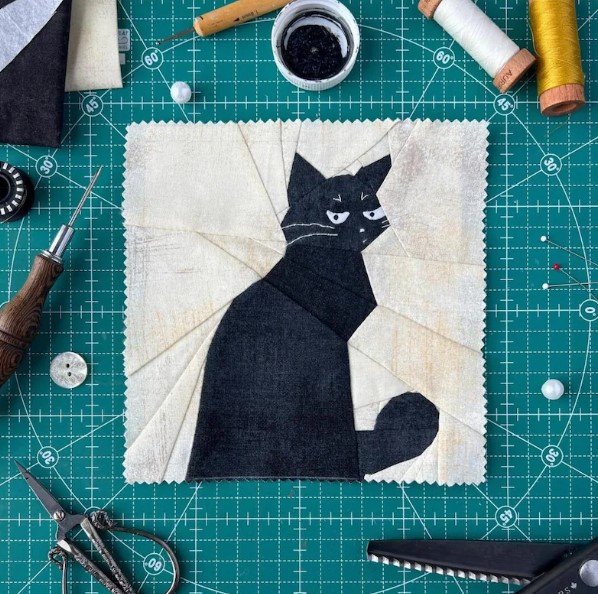
1. Essential Tools and Fabric Selection for Your Black Cat Quilt Block Tutorial
The first step in any successful quilting project is gathering the right materials. For this Black Cat Quilt Block Tutorial, you will need high-quality 100% cotton fabric in a solid black or a very dark charcoal print. Choosing a fabric with a subtle “tone-on-tone” pattern can add depth to the cat’s “fur” without losing the crispness of the silhouette against your background fabric.
DISCOVER MORE FREE PATTERNS HERE!
Your background fabric should offer a high contrast to the black cat. Most quilters prefer a creamy white, a light gray, or even a vibrant orange if they are leaning into a Halloween quilt aesthetic. Having a sharp rotary cutter and a self-healing cutting mat is non-negotiable here, as precise cuts are the secret to ensuring your quilt blocks line up perfectly during assembly.
Don’t forget the importance of a reliable quilting ruler. Since this Black Cat Quilt Block Tutorial involves small squares and triangles, an acrylic ruler with clear grid lines will help you maintain accuracy. Accuracy in the cutting phase prevents “wonky” blocks later on, ensuring that your cat’s ears are symmetrical and the body is perfectly squared up at the end.
In addition to fabric and cutting tools, you will need a high-quality thread. A 50-weight cotton thread in a neutral color or black is ideal. Using a quarter-inch presser foot on your sewing machine is also highly recommended, as it allows you to maintain a consistent seam allowance, which is the backbone of successful patchwork construction.
Marking tools are another essential component of this Black Cat Quilt Block Tutorial. You will need a water-soluble pen or a Hera marker to draw diagonal lines on the back of your fabric squares. These lines act as your “path” for sewing half-square triangles, ensuring that the diagonal seams of the cat’s ears and tail are straight and sharp.
Lastly, make sure your iron is ready. Pressing as you go is a golden rule in quilting. For the Black Cat Quilt Block Tutorial, you will want to press your seams toward the darker fabric to prevent the seam allowance from showing through the lighter background. A well-pressed block is a flat block, and flat blocks make the final quilting process much easier to handle.
2. Step-by-Step Cutting Instructions and Component Assembly
To begin the actual construction phase of this Black Cat Quilt Block Tutorial, you must cut your fabric into specific dimensions. For a standard 12-inch finished block, you will typically need several 4-inch squares for the body and smaller 2-inch squares for the ears and tail details. Consistency in your fabric cutting ensures that the final black cat looks balanced and proportional.
The most characteristic part of this Black Cat Quilt Block Tutorial is the head and ears. To create the ears, you will use the stitch-and-flip method. This involves placing a small background square on the corner of a larger black square, sewing diagonally across, and trimming the excess. This technique is a staple in modern quilting because it creates clean angles without the fuss of inset seams.
Next, you will assemble the body units. The body of the cat is usually a series of rectangle units and squares joined together. Following the Black Cat Quilt Block Tutorial steps, you will sew these pieces into rows first. It is often helpful to lay your pieces out on a design board or a flat table before sewing to make sure the cat’s “limbs” and “tail” are pointing in the right direction.
The tail is often the trickiest part for beginners. In this Black Cat Quilt Block Tutorial, we suggest using a series of small half-square triangles to create a curved or “hooked” tail effect. While it requires a bit more patience, the visual payoff of a jaunty, curved tail makes your quilt block stand out from simpler, more geometric versions.
Once your individual units (the head, the body, and the tail) are assembled, it is time to join them into a full block. This is where your 1/4 inch seam allowance becomes critical. Align your seams carefully, using pins to keep the fabric from shifting. In this Black Cat Quilt Block Tutorial, we emphasize “nesting” your seams—pressing them in opposite directions—so the fabric intersections lay flat.
After the rows are joined, give the entire block a final press with a hot iron. Measure your black cat quilt block to ensure it matches the intended size. If it is slightly larger, you can “square it up” using your rotary cutter and ruler. This step ensures that when you combine multiple blocks into a full quilt top, everything fits together like a perfect puzzle.
3. Customizing Your Design and Adding Creative Details
One of the best things about following this Black Cat Quilt Block Tutorial is that it serves as a foundation for your own creativity. While the basic silhouette is iconic, you can customize your black cat by adding “eyes” using applique techniques. Small yellow or green fabric circles can be stitched onto the face to give your cat a watchful, mysterious gaze.
If you aren’t a fan of applique, you can use embroidery to add whiskers and a nose. A simple backstitch with embroidery floss can transform a simple fabric block into a character-filled piece of art. This Black Cat Quilt Block Tutorial encourages you to think outside the box; perhaps your cat needs a colorful bowtie or a collar made from a scrap of floral fabric.
The background of your Black Cat Quilt Block Tutorial can also be customized. Instead of a solid color, consider using “low-volume” prints—white fabrics with very small, subtle patterns like dots or script. This adds a “shabby chic” or vintage quilt vibe to the project. You could even use a different background color for every block to create a “scrappy” rainbow quilt.
Another way to spice up this Black Cat Quilt Block Tutorial is to play with the orientation of the cat. You can mirror the pattern to have two cats facing each other, or tilt the blocks to make it look like the cats are jumping or stretching. This flexibility is what makes feline quilt patterns so popular among makers who like to tell a visual story through their craft.
For those looking for a more modern aesthetic, try using “wonky” cutting methods. While this Black Cat Quilt Block Tutorial focuses on precision, some quilters enjoy slightly asymmetrical ears or tails to give the cat a more folk-art appearance. There is no wrong way to create, as long as the quilt construction remains sturdy and the seams are secure.
Finally, consider the scale. You can shrink the dimensions of this Black Cat Quilt Block Tutorial to create 6-inch blocks for a table runner, or enlarge them to 18-inch blocks for a bold, graphic wall hanging. The mathematical principles of the quilt block remain the same regardless of size, allowing you to adapt the pattern to any project you have in mind.
4. Finishing Your Project and Professional Quilting Tips
After you have completed several blocks using this Black Cat Quilt Block Tutorial, you will need to decide on a layout for your quilt. You can set the blocks side-by-side for a “grid” look, or add sashing (strips of fabric between the blocks) to give each cat its own frame. Sashing is a great way to increase the size of your quilt without having to make dozens of extra blocks.
Once your quilt top is finished, it’s time for “the sandwich.” This involves layering your top, the batting (the middle fluffy layer), and the backing fabric. For a black cat quilt, a backing fabric with a moon or star print can look particularly striking. Secure these layers with pins or basting spray before you begin the actual quilting stitches.
When it comes to the actual quilting, you can use your home sewing machine for straight-line quilting or “stitch-in-the-ditch.” If you want to highlight the shapes from this Black Cat Quilt Block Tutorial, try quilting around the silhouette of the cat first to make it “pop” from the background. This creates a beautiful 3D effect known as echo quilting.
If you are feeling adventurous, free-motion quilting can add even more texture. You could quilt “yarn balls” or “paw prints” into the background spaces around your black cat. This adds a layer of whimsical detail that shows off your skills as a quilting artist and complements the theme of the Black Cat Quilt Block Tutorial.
Don’t forget the binding, which is the fabric strip that covers the raw edges of your quilt. A striped binding or a solid black binding can provide a clean, professional “frame” for your work. Squaring up your quilt one last time before applying the binding is a crucial tip we always include in our Black Cat Quilt Block Tutorial advice.
Finally, label your quilt! Every masterpiece deserves a signature. Use a fabric marker or an embroidered patch to include your name, the date, and the name of the project. Completing this Black Cat Quilt Block Tutorial is a wonderful achievement, and having a finished, labeled quilt is a legacy piece that can be passed down through generations of cat lovers.
FAQ: Frequently Asked Questions About the Black Cat Quilt Block
1. Is this Black Cat Quilt Block Tutorial suitable for absolute beginners? Yes! This tutorial uses basic shapes like squares and rectangles. While it requires careful alignment, it does not involve complex curves or difficult “Y-seams,” making it a perfect project for someone new to quilt making.
2. What is the best fabric for a black cat block? High-quality quilters’ cotton is the best choice. It has a high thread count which prevents fraying and keeps your seams crisp. Look for solids or “blender” prints to ensure the cat’s silhouette remains the focal point.
3. How do I make the cat’s eyes stand out? You can use fusible web to iron on small circles for eyes and then finish the edges with a blanket stitch. Alternatively, buttons or safety eyes can be used if the quilt is intended for display rather than for a baby or pet.
4. Can I change the size of the block? Absolutely. You can scale the measurements up or down. If you double the size of every piece cut, you will double the size of the finished block. Just remember to maintain the quarter-inch seam allowance regardless of the block’s scale.
5. How do I prevent my black fabric from bleeding onto the white background? It is highly recommended to pre-wash your dark fabrics or use a “color catcher” sheet in the laundry. This prevents the black dye from migrating into the lighter background fabric when the finished quilt is washed for the first time.
6. What other projects can I use this block for? Beyond full quilts, this black cat design works beautifully for throw pillows, tote bags, pot holders, or even as a decorative patch on the back of a denim jacket.
Conclusion
In this Black Cat Quilt Block Tutorial, we have covered everything from selecting the perfect high-contrast fabrics to the technical assembly of the cat’s ears, body, and tail. We explored ways to customize your feline friend with applique eyes and creative embroidery, and discussed how to finish your project with professional quilting techniques. This block is more than just a pattern; it is a versatile tool for expressing your creativity and love for animals through the medium of fabric.
We hope this guide inspires you to sit down at your sewing machine and start creating. Whether you make one block or one hundred, the process of piecing together a black cat is a joyful experience. Please leave your sincere opinion in the comments below—we would love to hear how your project turned out! Also, if you have any suggestions for future tutorials or variations on this design, feel free to share them with our community. Happy quilting!