
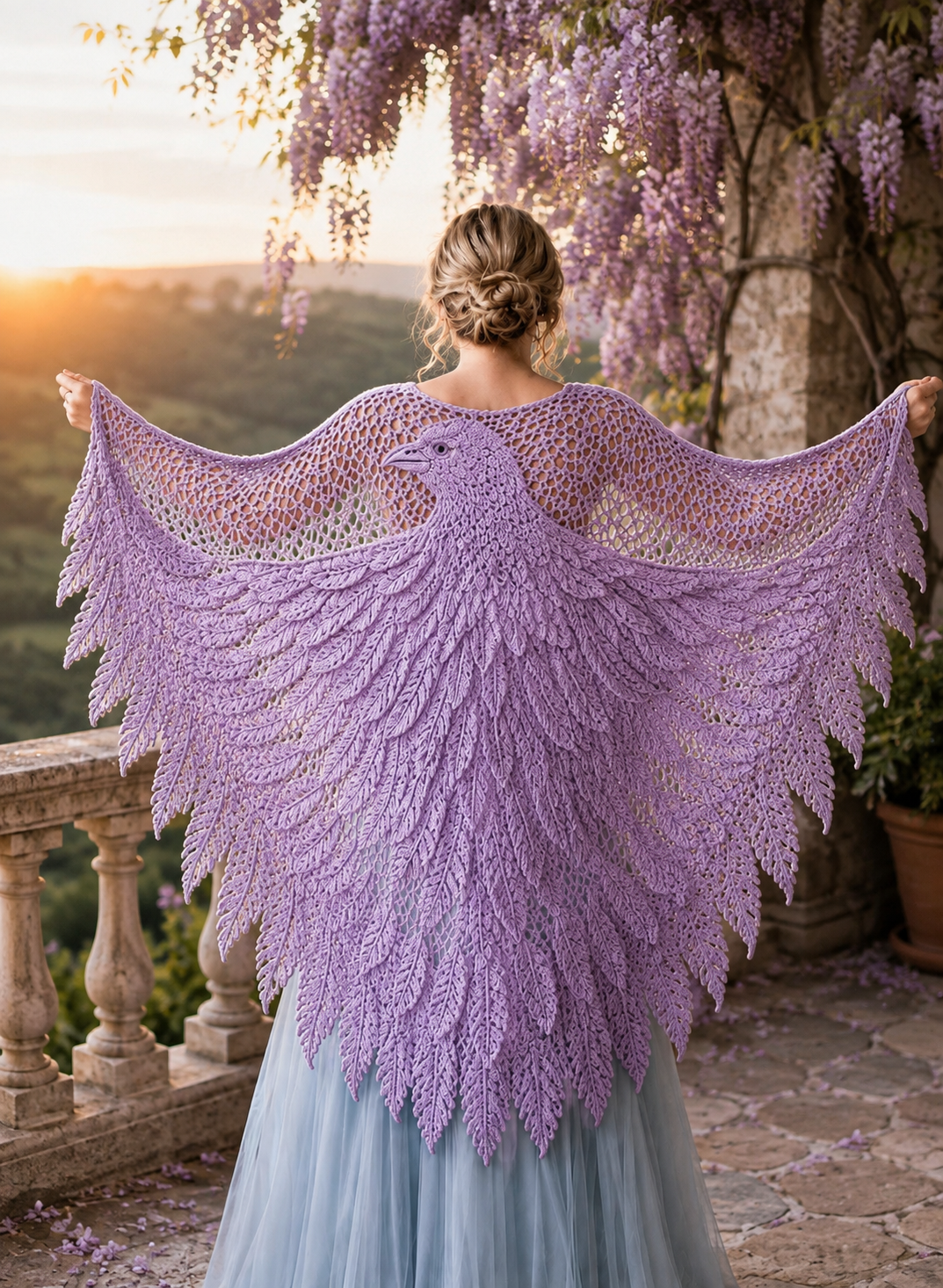
Crochet Bird of Feathers Shawl Pattern is a breathtaking crochet project designed to recreate the graceful silhouette of a bird with its wings fully extended. Inspired by the reference design, this shawl combines open lace crochet, layered feather-like textures, a sculptural bird motif at the center, and long pointed sections that cascade beautifully down the back. The result is much more than a traditional triangular shawl: it is a statement piece in which the crochet construction itself becomes wearable art. Although the finished design looks extremely elaborate, understanding it as a combination of smaller sections makes the construction much easier to approach.
One of the most attractive characteristics of this crochet feather shawl is the balance between dense and open stitches. The upper wings use airy chain spaces that allow the fabric to drape naturally across the shoulders, while the lower portion gradually develops increasingly pronounced crochet feather motifs. At the center, textured stitches create the impression of the bird’s head, neck, and body. These elements flow into long feathers that form the dramatic point at the bottom. A soft lavender or lilac yarn emphasizes the romantic appearance shown in the inspiration image, but cream, ivory, gray, blue, burgundy, or even gradient yarn can completely transform the personality of the project.
This Bird of Feathers crochet shawl is best suited to an intermediate or experienced crocheter who is comfortable reading repeats, maintaining symmetrical increases, working taller stitches, and blocking lace. However, an adventurous beginner can also use the project to practice these techniques one section at a time. The instructions below use US crochet terminology and provide an adaptable construction rather than claiming an exact stitch-for-stitch reproduction from a photograph. Because yarn weight, hook size, personal tension, and the desired wingspan all influence the finished measurements, checking the shawl frequently while crocheting is an important part of achieving a balanced result.
Materials, Measurements, Crochet Terms, and Preparation
For an adult-sized Crochet Bird of Feathers Shawl Pattern, a useful target measurement is approximately 175–185 cm (69–73 in) from wingtip to wingtip and around 85–95 cm (33.5–37.5 in) deep from the upper center to the longest feather point. These dimensions can easily be adjusted. A smaller number of feather repeats produces a compact shoulder shawl, while additional repeats create an oversized wrap.
DISCOVER MORE FREE PATTERNS HERE!
Choose approximately 800–1,000 m (875–1,095 yd) of fingering- or sport-weight yarn. Yardage is intentionally given as a range because this highly textured construction can consume considerably more yarn than ordinary open lace. Cotton blends provide excellent stitch definition, while bamboo blends create beautiful movement. Fine acrylic or wool blends can also work well. For the elegant appearance of the reference project, select yarn that is smooth enough to reveal the individual feather stitches.
A 3.5 mm (E-4) crochet hook is a practical starting point for sport-weight yarn. Fingering yarn may work well with approximately 3.0–3.5 mm, depending on your tension. The goal is not an extremely firm fabric. Your lace crochet shawl needs enough openness to fall naturally around the shoulders. Crochet a small swatch and gently block it before deciding whether the hook size provides the desired drape.
You will also need scissors, a yarn needle, several stitch markers, rust-resistant blocking pins, and blocking mats or another suitable blocking surface. Stitch markers are particularly useful because this design relies heavily on symmetry. Place one at the exact center and additional markers at the boundaries between the center body and each wing.
The principal US crochet abbreviations are: ch = chain, sl st = slip stitch, sc = single crochet, hdc = half double crochet, dc = double crochet, tr = treble crochet, dtr = double treble crochet, fpdc = front post double crochet, sp = space, st/sts = stitch/stitches, inc = increase, dec = decrease, and rep = repeat. Taller stitches such as tr and dtr are especially useful because they create the elongated lines needed for feathers.
Before beginning, remember that gauge is less rigid for a decorative shawl than for a fitted garment. What matters most is achieving a flexible fabric and maintaining equal dimensions on both sides. Measure your project regularly rather than relying only on row numbers.
How to Crochet the Bird Body and Build the Feathered Wings
Begin the crochet bird shawl at the upper center. Ch 9. Dc in the fourth ch from the hook and dc across. Turn. On the following row, ch 3, work 2 dc into the first stitch, continue in dc across, and work 2 dc into the final stitch. This creates the first controlled increases. Place a marker at the center and keep it there as the project grows.
Continue increasing gradually at both sides while maintaining a small central section. After several rows, begin shaping the upper bird motif. The center should remain denser than the surrounding wings. Alternating dc and fpdc stitches creates vertical texture that visually separates the bird from the airy lace. For example, work 2 dc, fpdc around the next post, 2 dc across the appropriate central stitches.
To suggest the bird’s head and neck, use shorter rows or controlled increases around the central portion. The head can be slightly wider before narrowing into the neck. A small beak may be constructed from a short chain extension: ch 5, sl st in the second ch from the hook, sc in the next ch, hdc in the next, dc in the final ch, and attach it carefully to the head. The decorative eye can later be embroidered rather than adding a hard component.
The wings begin to develop on either side of the center. Establish open spaces using combinations such as ch 5, skip 3 sts, sc in the next stitch or space. On the return row, work groups of taller stitches into these spaces. A simple feather-inspired group can contain sc, hdc, dc, tr, dtr, tr, dc, hdc, sc. This sequence rises gradually to a central point and then decreases again, producing an elongated leaf or feather shape.
Continue introducing new chain spaces at the outer edges to increase the wingspan. Every increase made on the left should have a corresponding increase on the right. After completing each major row, place the project on a flat surface. Compare the wings visually and count the motif repeats. Correcting one missing repeat early is far easier than discovering an imbalance after many additional rows.
As the wings become wider, alternate open mesh sections with denser feather rows. The upper area should remain lighter and more transparent, similar to the reference image, while the lower half becomes progressively richer in texture. This contrast gives the impression that the feathers emerge naturally from the bird’s body rather than appearing as a separate border.
Creating Long Crochet Feathers, Lace Sections, and the Pointed Silhouette
The signature feature of this Crochet Bird of Feathers Shawl Pattern is the cascading lower section. Instead of keeping every motif the same length, gradually lengthen the feathers as you approach the center. This produces the characteristic V-shaped silhouette. The center feather should ultimately become the longest, with neighboring feathers becoming progressively shorter toward each wingtip.
For an elongated crochet feather stitch, create a narrow central spine using post stitches or tall stitches. A practical foundation is a central fpdc surrounded by chain spaces. Along one side, work a sequence such as ch 3, tr, dtr, tr, ch 3, attaching the section back to the spine with sc or sl st. Mirror the same construction on the opposite side. Several repetitions form the barbed appearance associated with a real feather.
When working a long feather, make the middle branches the longest. Gradually shorten the branches toward the tip. This creates a tapered point without requiring abrupt decreases. You can also vary the number of chains between branches to make some feathers slender and others fuller. Variation helps produce the organic layered appearance visible in an elaborate bird wing crochet pattern.
Between these dense motifs, maintain open lace. One adaptable mesh sequence is ch 5, sc in next sp, ch 5, sc in next sp. On the following row, work combinations of dc, ch 3, and dc into the previous chain spaces. Larger ch-6 or ch-7 spaces can be introduced selectively if the fabric becomes too dense. The finished shawl should remain flexible rather than becoming a heavy crochet panel.
For the central tail area, arrange the feathers in graduated lengths. The longest center section can approach 85–95 cm (33.5–37.5 in) from the upper edge depending on your desired size. The next pair can be several centimeters shorter, followed by another shorter pair. Continue this graduation toward the outer wings. This produces a smooth visual transition instead of a perfectly straight lower border.
The outer wing feathers should also decrease gradually. Once the desired wingspan has been reached, stop adding new motifs. Begin using smaller feather groups such as sc, hdc, dc, tr, dc, hdc, sc. Near the very ends, even shorter scalloped groups may be appropriate. This shaping allows the wingtip to appear delicate and pointed.
Try the shawl around your shoulders several times while working. A wearable crochet lace shawl needs to curve naturally around the body. If the upper edge becomes too tight, additional chain spaces or increases may be necessary. If it begins to ripple excessively, reduce the increases. Small corrections throughout the project usually produce a better result than trying to reshape everything during blocking.
Edging, Blocking, Finishing, and Customizing Your Feather Shawl
Once all feather sections are complete, work a stabilizing row of single crochet around the appropriate outer edges. Space these stitches evenly rather than forcing one sc into every possible location. Along tall stitches, two or three sc may be necessary. Around narrow feather tips, fewer stitches will help preserve the pointed shape.
For a more decorative border, work ch 5, skip approximately 3 sts, sc in next st around the feathered edge. On the following round, work sc, hdc, dc, tr, dtr, tr, dc, hdc, sc into each ch-5 space. These miniature pointed shells echo the larger feathers. For an even more delicate finish, tiny picots can be placed at selected tips.
Finish the upper edge separately. Work a relaxed row of sc from one wingtip to the other. If desired, add a subtle picot by working sl st, ch 3, sl st into the same stitch at regular intervals. Keep this border soft. A tight upper edge can prevent the shawl from wrapping comfortably around the shoulders.
Weave in every yarn end carefully with a yarn needle. Open lace exposes poorly hidden ends more easily than dense crochet, so weave each tail through several stitches and change direction before trimming. Avoid large knots, especially around the bird motif and the pointed feathers.
Blocking is essential for achieving the dramatic finished appearance. Wash or soak the shawl according to the yarn manufacturer’s care instructions, gently remove excess water, and spread the shawl on blocking mats. Pin the upper center first, followed by both wingtips. Check that the distance from the center to each wingtip is equal.
Continue pinning every important feather point. Stretch the open mesh gently so the stitch structure becomes visible. Arrange the longest center feathers vertically and fan the neighboring feathers outward. Allow the shawl to dry completely before removing any pins. Proper blocking can make an enormous difference, especially when working with crochet lace and feather motifs.
Customization is one of the strengths of this design. Lavender produces a soft romantic result, while ivory creates a bridal appearance. Black can make the bird silhouette particularly dramatic, and jewel tones such as emerald, burgundy, or midnight blue create an elegant evening accessory. Gradient yarn can also be effective, especially when the color transition moves from the center outward.
Frequently Asked Questions About the Crochet Bird of Feathers Shawl Pattern
Is the Crochet Bird of Feathers Shawl Pattern suitable for beginners?
It is better suited to intermediate crocheters because the project combines lace, increases, elongated stitches, symmetry, and repeated feather shaping. A confident beginner who already understands chains, single crochet, double crochet, treble crochet, and reading stitch repeats can still approach it gradually.
What yarn is best for a feather crochet shawl?
Fingering or sport-weight yarn with good stitch definition is an excellent choice. Cotton, bamboo, linen blends, fine acrylic, and lightweight wool blends can all work. Avoid extremely fuzzy yarn if you want the individual feathers to remain clearly visible.
How much yarn will I need?
For an approximately 180 cm (70.8 in) wingspan, prepare roughly 800–1,000 m (875–1,095 yd). Larger sizes, tighter tension, heavier yarn, and additional feather repeats can require more.
Can I make the shawl smaller?
Yes. Stop increasing the wings sooner and work fewer complete feather repeats. Maintain the same symmetrical construction on both sides.
How can I make the shawl larger?
Continue the established lace-and-feather sequence before beginning the decreasing wingtip sections. Measure regularly and remember that additional feather rows can consume substantial yarn.
Why are my wings different sizes?
This usually happens because of a missed increase, chain space, or feather repeat. Keep a marker at the center and count the motifs on both sides after every major row.
Why don’t my feathers look defined?
The most common causes are overly tight tension, yarn with excessive fuzz, or insufficient blocking. A smooth yarn and careful blocking help open the stitches and define the feather points.
Is blocking really necessary?
For this particular crochet feather shawl, yes, it is highly recommended. Blocking opens the lace, separates the feather shapes, straightens the wings, and helps establish the dramatic pointed silhouette.
Can I use thicker yarn?
You can, but the shawl will become heavier and larger. If using DK or worsted yarn, consider a larger hook and fewer repeats. Always make a sample first.
Can the bird design be made in another color?
Absolutely. The structure is not dependent on color. Cream, white, gray, blue, green, burgundy, black, and gradient combinations can all create striking interpretations.
How should the finished shawl be washed?
Follow the yarn label first. In general, delicate handmade lace benefits from gentle washing in cool water, careful removal of excess moisture, and flat drying. Reshape the feathers while damp and reblock when necessary.
Conclusion
The Crochet Bird of Feathers Shawl Pattern combines the elegance of traditional lace crochet with an imaginative bird-inspired silhouette. Its open upper wings, textured central body, layered crochet feather motifs, and cascading pointed edge create a project that looks impressive both displayed flat and worn across the shoulders.
The key to successfully creating this shawl is patience rather than speed. Build the center first, expand both wings symmetrically, introduce the feathers gradually, keep the lace relaxed, and check the shape frequently as you work. The individual techniques are far less intimidating when the project is divided into manageable sections.
Most importantly, allow time for careful finishing and blocking. Once every feather has been shaped and the lace has opened, the full character of the design becomes visible. The result is an elegant handmade shawl that can serve as a special-occasion wrap, decorative textile, memorable handmade gift, or distinctive addition to a crochet collection.