
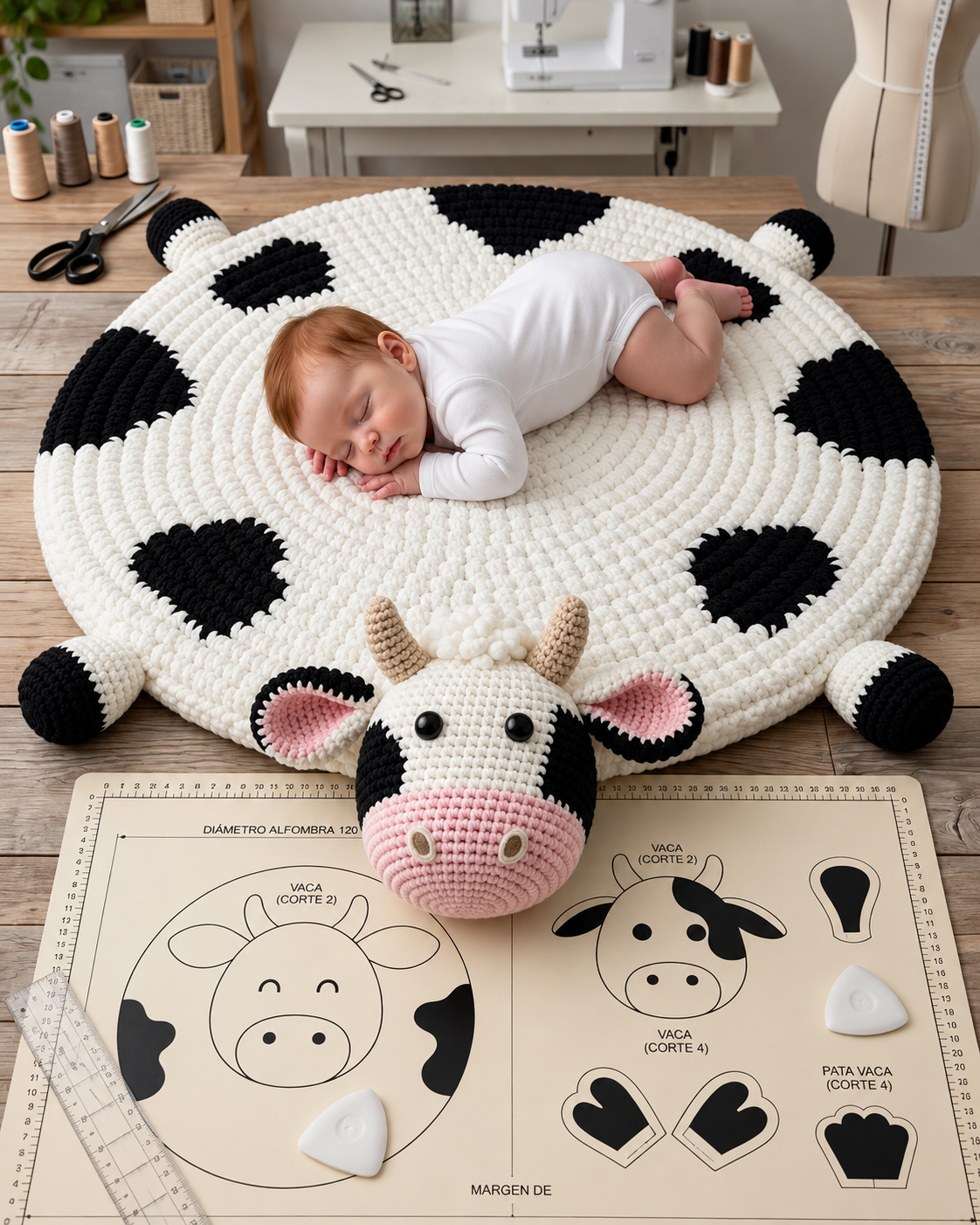
Crochet Cow Mat Pattern is a charming way to combine practical home décor with the playful personality of amigurumi crochet. Inspired by the round cow mat shown in the reference, this project features a large circular cream-colored body decorated with irregular black cow spots, four small legs, and an adorable three-dimensional cow head with a pink muzzle, ears, horns, and expressive facial details. The finished piece can become an eye-catching farmhouse crochet rug, nursery decoration, photography prop, or decorative floor mat.
The beauty of this Crochet Cow Mat Pattern comes from combining simple crochet construction with dimensional details. The main mat is essentially a large flat circle, which makes the foundation surprisingly approachable. Once the circle is complete, contrasting black sections create the recognizable Holstein-style markings. The separate head then adds the character: a rounded face, broad pink muzzle, little ears, short horns, and carefully positioned eyes transform an ordinary round mat into a delightful crochet cow rug.
This tutorial uses U.S. crochet terminology and can be adjusted to several sizes. Because the reference design is generously sized, a finished diameter of approximately 42–48 inches (107–122 cm) works well for a statement piece. Smaller versions are also possible. The measurements below are suggested rather than exact because yarn thickness, hook size, tension, and the number of rounds will affect the finished dimensions. For anything used around a baby, place it on the floor only under direct adult supervision; it should not be used as a sleep surface.
Materials, Measurements and Crochet Stitches
For a large Crochet Cow Mat Pattern, a thick yarn provides the best combination of structure and softness. A bulky or super-bulky washable yarn works particularly well. You can also hold two strands of medium-weight yarn together if you want a dense handmade texture.
DISCOVER MORE FREE PATTERNS HERE!
For the main color, choose cream, ivory, or soft white. You will need considerably less black yarn for the cow markings and feet. Keep smaller quantities of soft pink for the muzzle and inner ears, beige or tan for the horns, and dark yarn for embroidered details if required.
For a mat approximately 46 inches (117 cm) in diameter, expect to need roughly 1,200–1,800 yards (1,100–1,650 m) of yarn in total when using a substantial yarn. This is only a working estimate because yarn consumption varies significantly according to fiber, thickness, hook, and stitch density.
A crochet hook around 6.0–8.0 mm can work well with bulky yarn. Always check the yarn label and then adjust the hook according to your tension. The goal is to produce a fabric that is substantial without becoming excessively rigid.
Additional supplies include scissors, a large yarn needle, stitch markers, measuring tape, polyester fiberfill for the cow head, and optional removable markers for positioning the spots.
The principal stitches are ch (chain), sl st (slip stitch), sc (single crochet), hdc (half double crochet), dc (double crochet), inc (increase), and dec (decrease). The main circle can be constructed primarily with single crochet or half double crochet.
For a softer, more flexible rug, half double crochet is a useful choice. Single crochet creates a tighter and heavier fabric. Whichever stitch you select, use it consistently through the circular foundation.
The approximate finished mat can measure 42–48 inches (107–122 cm) across. The head can measure approximately 10–12 inches (25–30 cm) wide, depending on the scale of your mat.
Each small leg can extend approximately 5–7 inches (13–18 cm) beyond the edge. Keeping these relatively short preserves the rounded silhouette.
The cow head should be proportional without becoming excessively heavy. Light, even stuffing is preferable to packing it firmly.
Gauge is not critical for this decorative project, but the circle must remain flat. Measure it every few rounds and place it on a flat surface to check for rippling or cupping.
If the mat begins curling upward, you may need additional increases. If it develops excessive waves, there are probably too many increases.
Because a rug receives more friction than a traditional crochet project, weave every yarn end securely.
How to Crochet the Large Round Cow Mat
Begin the crochet cow rug with the cream or white yarn. Create a magic ring and work the first round into the center.
A simple single-crochet foundation begins with 6 sc in the magic ring. Place a stitch marker in the first stitch.
For Round 2, work 2 sc in each stitch around, giving you 12 stitches.
For Round 3, repeat (1 sc, inc) around.
For Round 4, repeat (2 sc, inc) around.
Continue this progression by adding one additional regular stitch between increases on every new increase round. This creates the mathematical foundation of a flat crochet circle.
If using half double crochet instead, you may need to modify the number and spacing of increases because taller stitches spread differently. The important goal is a flat circle rather than following a number mechanically.
Continue until the mat approaches approximately 42–48 inches (107–122 cm) in diameter.
Every four or five rounds, place the mat completely flat and inspect it.
A slight wave can often be corrected by working one round with fewer increases. A slight cup can usually be corrected with a few additional increases distributed evenly.
The reference design has bold black cow spots positioned across the cream background. There are several ways to reproduce this effect.
One option is tapestry crochet, changing between white and black while working the main circle. This produces integrated markings but requires careful color management.
A more beginner-friendly approach is to crochet irregular black appliqués separately and sew them onto the finished mat.
To make a cow spot, start with approximately 6 sc in a magic ring. Increase irregularly rather than creating a perfect circle.
Work combinations of sc, hdc, and dc along different sections of the edge. This produces organic curves.
Avoid making every spot identical. Natural-looking cow print crochet works best when some markings are round, others elongated, and others slightly angular.
Make approximately 6–10 spots depending on their size and the diameter of your rug.
Arrange them across the mat before sewing. Keep some close to the outer edge and others farther toward the center.
Once satisfied with the arrangement, sew each black appliqué firmly using matching yarn.
For the four legs, crochet short oval or cylindrical pieces using cream and black. Position one toward each diagonal area of the mat so that the legs appear to extend naturally from the body.
Finish the ends of the legs with black sections to represent hooves.
Sew the legs underneath or directly along the outer edge with strong stitches.
At this stage, lay the mat flat again and check that the additions have not distorted the circle.
Crocheting the Cow Head, Muzzle, Ears and Horns
The three-dimensional head is the focal point of the Crochet Cow Mat Pattern. Unlike the flat body, this section uses traditional amigurumi shaping.
Begin with cream yarn and a magic ring containing 6 sc.
Increase evenly through subsequent rounds: 12 stitches, then 18, 24, 30, and onward until the head reaches the desired width.
Instead of continuing as a perfect sphere, work several even rounds after the major increases. This creates a broad cow face.
Start decreasing gradually near the back while adding fiberfill.
Do not overstuff. The head should be dimensional but slightly soft so that it sits naturally against the mat.
Create black facial patches either with color changes or separate appliqués. An asymmetrical marking around one eye produces a recognizable cow appearance.
The pink crochet muzzle should be broad and oval. Begin with a foundation chain and work around both sides of it.
For example, chain approximately 12–16 stitches depending on your yarn. Work sc along one side, multiple stitches into the end chain, then continue down the opposite side.
Increase around both curved ends for several rounds until you have a soft oval approximately 7–9 inches (18–23 cm) wide for a large mat.
Lightly stuff the muzzle before sewing it onto the lower portion of the face.
Nostrils can be embroidered with beige, brown, gray, or black yarn. Keep them symmetrical and relatively small.
For each ear, begin with a short foundation chain or magic ring and gradually widen the shape using sc, hdc, and dc stitches.
Make a smaller pink inner-ear piece and attach it to the cream or black outer ear.
The reference-inspired appearance works especially well with black edging around the ears because it connects visually with the cow spots.
Crochet two small horns using beige or tan yarn.
Begin with approximately 5–6 sc in a magic ring and work upward in a narrow tube.
Add very subtle increases if you want the horns wider at the base.
A finished horn around 2½–3½ inches (6–9 cm) is sufficient for most large mats.
Stuff each horn lightly and sew it to the top of the head.
If desired, crochet a small cream-colored tuft for the top center of the head. Several loop stitches or small bobble-like sections can imitate fluffy cow hair.
Position the eyes carefully before completing the face. Embroidered eyes are a practical option, particularly when the project will be used in a child’s space.
For purely decorative projects, appropriately secured craft eyes can create a dimensional appearance, but detachable components are unsuitable where a young child could pull them loose.
Pin the ears, horns, muzzle, and facial details into place before sewing. Look at the head from several angles to ensure that the expression is balanced.
Assembly, Finishing and Customizing Your Crochet Cow Mat
Position the completed cow head along one edge of the circular mat. In the reference-inspired arrangement, the head extends slightly beyond the circle, giving the impression that the entire rug represents the cow’s body.
Pin the head temporarily before sewing.
Use a long strand of the main yarn and a sturdy yarn needle. Sew through both the head and several substantial stitches along the rug edge.
Make at least two passes across high-stress attachment points.
Once the head is secure, inspect the four legs. They should appear evenly distributed rather than clustered on one side.
Weave every yarn tail deeply into the surrounding stitches.
For a decorative floor mat, you may add an appropriate non-slip rug backing beneath the crochet piece, especially if it will be placed on a smooth floor. Choose a backing specifically designed for the floor surface and intended use.
Color customization is one of the easiest ways to transform this cow crochet pattern.
For a classic farmhouse version, use ivory, black, dusty pink, and beige.
For a Highland-inspired interpretation, try warm caramel, cream, and chocolate brown.
A nursery version can use white with pastel blue, lavender, sage green, or blush spots.
You could even make a whimsical strawberry cow using cream and pink.
For a smaller mat, simply stop the circular body earlier. A diameter around 30–36 inches (76–91 cm) makes a more compact decorative piece.
Remember to scale down the head, legs, ears, and horns accordingly.
Blocking can dramatically improve the finished appearance. Lay the mat flat, gently shape the circle, and allow it to dry completely according to the care requirements of your yarn.
Avoid aggressive heat when working with synthetic fibers.
The finished Crochet Cow Mat Pattern can be used as decorative nursery décor, a farmhouse-themed accent, a children’s reading-area mat, or a photography prop.
Because a crocheted mat is not a regulated infant sleep product, do not use it inside a crib, bassinet, or as an unattended infant sleep surface.
If photographed with a baby, keep the setup supervised and place the mat securely on the floor.
With careful finishing, the result is an impressive oversized crochet project that combines the flat construction of a rug with the personality of amigurumi.
FAQ – Crochet Cow Mat Pattern
Is the Crochet Cow Mat Pattern suitable for beginners?
Yes, although it is best for an adventurous beginner. The main circle is repetitive, while the head introduces basic amigurumi shaping.
How large should the finished cow mat be?
A large version can measure approximately 42–48 inches (107–122 cm) across. You can stop the circle earlier for a smaller rug.
What yarn should I use?
Bulky or super-bulky washable yarn works well. Two strands of medium-weight yarn held together are another option.
What hook size is recommended?
Approximately 6.0–8.0 mm is a useful range for many bulky yarns, but always adjust according to the yarn and your tension.
How do I keep a large crochet circle flat?
Distribute increases evenly and check the piece on a flat surface regularly. Too few increases cause cupping; too many create waves.
How are the black cow spots made?
They can be incorporated using tapestry crochet or made separately as irregular appliqués and sewn onto the mat.
Which method is easier for beginners?
Separate appliqué spots are usually easier because you can arrange and reposition them before sewing.
How many cow spots should I make?
Approximately 6–10 works well for a large rug, but there is no fixed number.
Should all the spots have the same shape?
No. Irregular shapes create a more natural cow-print effect.
How do I make the cow’s muzzle?
Crochet an oval in pink by working around both sides of a foundation chain and increasing around the curved ends.
Does the cow head need stuffing?
Yes. Use enough fiberfill to hold the shape, but avoid making the head excessively hard or heavy.
Can I make a brown cow instead?
Certainly. Cream with caramel or chocolate spots creates a beautiful alternative.
Can this mat be machine washed?
That depends on your yarn, stuffing, embellishments, and backing. Always follow the care instructions for the materials used.
Can I add a non-slip backing?
Yes. For floor use, an appropriate rug backing can help reduce movement on smooth surfaces.
Is this suitable as a baby sleep mat?
No. Treat it as decorative floor décor or a supervised play/photography prop rather than a sleep surface.
Can I make matching cow accessories?
Yes. The same colors and facial design could inspire a matching cow pillow, wall hanging, basket, or smaller crochet mat.
Conclusion
The Crochet Cow Mat Pattern is a wonderful project for crocheters who enjoy combining oversized home décor with adorable animal-inspired details. Its large circular foundation keeps the main construction relatively straightforward, while the black markings, dimensional head, ears, horns, muzzle, and tiny legs give the finished piece its unmistakable personality.
The project also offers plenty of opportunities to practice valuable techniques. You can improve your skills with crochet circles, amigurumi shaping, increases and decreases, color changes, appliqué, embroidery, stuffing, and assembly within a single design.
For the classic appearance shown in the inspiration, combine a creamy white body with bold black markings, a soft pink muzzle and inner ears, and small beige horns. The contrast makes the facial features immediately recognizable while maintaining the cozy farmhouse character of the rug.
Most importantly, take your time with the final arrangement. Place the spots before attaching them permanently, pin the facial components before sewing, and continually check the proportions of the head against the body. Those finishing decisions are what transform a simple round crochet mat into an expressive crochet cow rug.
Whether made as nursery décor, a playful farmhouse accent, a handmade gift, or a statement piece for a craft room, this Crochet Cow Mat Pattern offers a creative way to turn basic crochet techniques into a large and memorable project.