
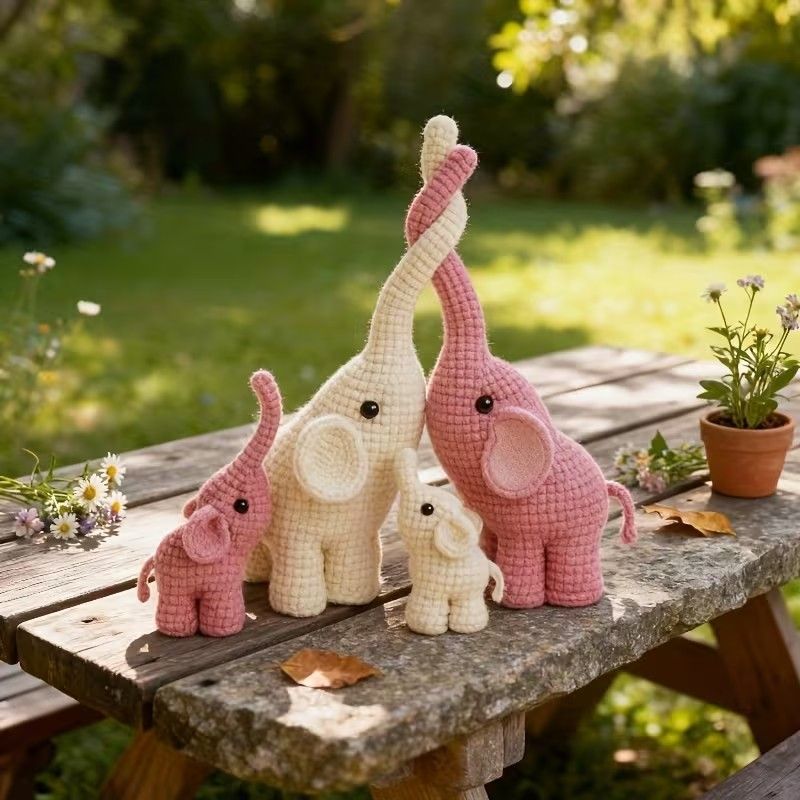
Crochet Elephant Family Pattern is a charming amigurumi project that lets you create a coordinated family of handmade elephants in different sizes. With their rounded bodies, oversized ears, curved trunks, sturdy little legs, and expressive faces, crochet elephants are wonderful projects for anyone who enjoys amigurumi animals, handmade nursery decorations, or thoughtful crochet gifts.
One of the nicest features of a Crochet Elephant Family Pattern is that the same basic construction can be adapted to make several elephants. A larger elephant can represent the adult, while smaller versions can be created by changing the yarn weight, hook size, or stitch counts. Using coordinated colors gives the finished collection a recognizable family appearance while allowing every elephant to have its own personality.
This tutorial uses standard U.S. crochet terminology and focuses on straightforward amigurumi construction. Most sections are worked in continuous rounds with single crochet stitches, increases, and decreases. The individual components are crocheted separately and assembled at the end, making this an approachable project for confident beginners who want to develop their shaping and finishing skills.
Materials, Crochet Stitches and Finished Measurements
For the main elephants, choose a smooth DK or light worsted-weight yarn that gives good stitch definition. Cotton and cotton-blend yarns create firm shapes, while acrylic produces a softer finished elephant. Medium gray is traditional, but dusty blue, lavender, sage, cream, pink, and warm beige can make a beautiful modern elephant family.
DISCOVER MORE FREE PATTERNS HERE!
For one medium elephant approximately 8–10 inches (20–25 cm) tall, plan on roughly 150–220 yards (137–201 m) of the main color. Smaller elephants may require approximately 80–140 yards (73–128 m). Actual yardage varies with yarn weight, tension, and finished size.
A 3.0–3.5 mm crochet hook is a practical starting point for DK yarn. If you use worsted-weight yarn, approximately 3.5–4.0 mm may work better. Amigurumi should normally be crocheted firmly enough that the stuffing does not show between stitches.
You will also need polyester fiberfill, stitch markers, a yarn needle, scissors, pins, and optional safety eyes. For pieces intended for babies or very young children, embroidered eyes are generally a better choice than detachable components.
The main U.S. crochet abbreviations used throughout the Crochet Elephant Family Pattern are ch (chain), sc (single crochet), inc (two single crochets in one stitch), dec (single crochet decrease), sl st (slip stitch), hdc (half double crochet), and dc (double crochet). An invisible decrease can produce especially neat shaping.
Gauge is less important than consistency in amigurumi, but your fabric should be dense. As a reference, approximately 20–24 single crochet stitches across 4 inches (10 cm) can produce a firm fabric depending on yarn and hook combination.
The medium elephant can finish around 9 inches (23 cm) tall, while a small elephant may measure approximately 6 inches (15 cm). A larger adult can measure approximately 11–12 inches (28–30 cm).
A magic ring is recommended for the beginning of most round pieces because it produces a tightly closed center. If you do not use a magic ring, chain two and work the first round into the second chain from the hook.
Use a stitch marker to identify the beginning of every round. Because most amigurumi rounds are continuous, losing the first stitch can quickly change the shaping.
Before beginning, select the colors for the entire family. Using one main palette with slightly different accent colors creates a particularly attractive collection.
Crocheting the Elephant Head, Body and Trunk
Begin the head with a magic ring and work 6 sc into the ring. In the following round, work 2 sc into every stitch to reach 12 stitches.
Continue increasing evenly. A typical sequence is (sc, inc) around, followed by (2 sc, inc), then (3 sc, inc). Continue until the head reaches the desired circumference.
Work several rounds evenly without increasing. This develops the rounded middle portion of the elephant’s head.
Begin decreasing gradually toward the lower part of the head. Do not close the opening immediately because the piece must still be stuffed.
Add fiberfill in small amounts. Push the stuffing outward toward the sides rather than placing one large lump in the center. This produces a smooth, rounded surface.
The crochet elephant trunk can be worked separately or developed directly from the face. A separate trunk is often easier for beginners because its position can be adjusted during assembly.
For a separate trunk, begin with approximately 6 stitches in a magic ring. Increase slightly near the base until you have approximately 10–12 stitches, depending on the desired thickness.
Continue working sc in continuous rounds to create a narrow tube. A medium elephant’s trunk may measure approximately 2½–3½ inches (6.5–9 cm).
To create a gentle upward curve, place occasional increases along one side and decreases along the opposite side. Keep these shaping stitches subtle.
Stuff only the wider base of the trunk lightly. Leaving the tip relatively unstuffed allows it to curve naturally.
Pin the trunk to the lower center of the face before sewing. Check the elephant from the front and side to make sure the placement looks balanced.
For the body, begin another magic ring and increase gradually until the base reaches the desired width.
Work several rounds evenly to establish the rounded belly. A slightly wider belly gives the elephant the lovable shape commonly associated with crochet amigurumi animals.
Begin decreasing toward the shoulders. Stuff the body progressively while working so that the filling reaches the lower edges evenly.
Leave enough room at the top to attach the head securely.
Before sewing the head and body together, pin them temporarily. Check that the elephant can sit or stand in the intended position.
Use a long strand of matching yarn and small, firm stitches to join the pieces.
Making the Ears, Legs and Elephant Family Details
The oversized ears are one of the defining characteristics of this Crochet Elephant Family Pattern. They can be worked as circles, ovals, or softly shaped semicircles.
Begin each ear with a magic ring and use a combination of sc, hdc, and dc stitches to create a rounded shape. Increasing with taller stitches toward the outer edge can help produce a natural ear silhouette.
For additional color, make each ear from two layers. Crochet the outer ear in the main body color and the inner ear in a lighter coordinating shade.
Place the smaller inner section over the larger ear and stitch them together around the edge.
The finished ears for a medium elephant may measure approximately 3½–4½ inches (9–11.5 cm) across.
Pin both ears to the sides of the head before attaching them permanently. Move them slightly higher or lower until the expression looks right.
Crochet four legs using small cylindrical shapes. Start each with a magic ring, increase to the desired width, and work several rounds without increases.
For an elephant approximately 9 inches tall, each leg may be around 2–2½ inches (5–6.5 cm) long.
Stuff the legs firmly at the bottom and more lightly near the attachment point. This prevents excessive stiffness.
Arrange all four legs symmetrically beneath the body. If you want the elephant to sit, position the back legs slightly toward the sides.
The tail requires only a short chain or narrow crocheted cord. Attach it to the back of the body and add a tiny yarn tassel at the tip.
Eyes dramatically change the character of an amigurumi elephant. Small embroidered eyes create a gentle appearance, while safety eyes can produce a brighter toy-like expression when appropriate for the intended use.
Add eyebrows with a few embroidery stitches if desired.
A small smile can be embroidered near the trunk using thin black or dark gray yarn.
For the smallest elephant, exaggerating the ears slightly can create an especially cute baby appearance.
To distinguish family members, add simple accessories. One elephant could wear a crocheted flower, another a miniature scarf, and another a tiny bow.
Keep removable decorations away from projects intended for very young children.
Creating Different Sizes, Assembly and Finishing
There are two convenient ways to create the complete crochet elephant family. The first is to use exactly the same pattern with different yarn weights and hook sizes.
For example, use worsted-weight yarn for the largest elephant, DK yarn for the medium version, and sport-weight yarn for the smallest elephant.
This method keeps the proportions nearly identical while naturally changing the finished size.
The second method is to alter the stitch counts. Stop increasing earlier for smaller elephants and work fewer even rounds through the body and head.
Whichever method you choose, maintain similar proportions between the head, body, ears, trunk, and legs.
Before final assembly, place all completed pieces on a table. Comparing them side by side helps identify differences in shape or size before sewing.
Use pins to position the ears, trunk, legs, and head.
Sew every component with matching yarn and a tapestry needle. Pass through several stitches on both pieces rather than attaching through only one strand.
After securing a seam, weave the yarn tail through the stuffed body and bring it out several inches away. Pull gently, trim the yarn, and allow the end to disappear inside.
Shape the finished elephant with your hands. Redistribute the stuffing if necessary to smooth uneven areas.
For a nursery-themed family, consider soft neutral shades such as cream, sage, dusty blue, blush, and warm gray.
For a playful collection, make each elephant a different bright color.
You can also create seasonal elephants. Pastel elephants work beautifully for spring, while red, green, cream, and gold accents create a festive holiday family.
A completed elephant can be displayed individually, but several sizes grouped together make the concept of the Crochet Elephant Family Pattern much more distinctive.
The elephants can also be used as shelf decorations, photography props, handmade gifts, or decorative elements in a child’s room.
If the project is intended primarily for display, decorative buttons, ribbons, and beads can provide additional detail. Consider the intended recipient before using small detachable embellishments.
Finally, inspect every seam and woven end. Amigurumi receives more handling than many decorative crochet projects, so strong finishing is important.
FAQ – Crochet Elephant Family Pattern
Is the Crochet Elephant Family Pattern suitable for beginners?
Yes. A confident beginner who understands single crochet, increases, decreases, and working in continuous rounds can make this project. Assembly requires patience but no highly advanced stitches.
What yarn is best for crochet elephants?
Cotton, cotton blends, and smooth acrylic yarns are all suitable. Choose a yarn that produces clear stitches and a firm fabric.
What crochet hook should I use?
Approximately 3.0–3.5 mm for DK yarn is a useful starting range. Choose a hook small enough to prevent stuffing from showing.
How large will the elephant be?
A medium version can measure approximately 8–10 inches (20–25 cm) tall. Changing the yarn, hook, and stitch counts will change the final dimensions.
How do I make a baby elephant?
Use thinner yarn and a smaller hook, or reduce the number of increase rounds in the head and body.
Should amigurumi be crocheted tightly?
Yes. The fabric should be firm enough to conceal the stuffing without becoming uncomfortable to crochet.
How much yarn do I need?
A medium elephant may require approximately 150–220 yards (137–201 m) of the primary color, plus small amounts for accents.
Can I make the ears in two colors?
Yes. Layering a lighter inner ear over the main ear creates attractive depth.
How do I make the trunk curve?
Use subtle increases on one side and decreases on the opposite side, or shape the lightly stuffed trunk during assembly.
Should I stuff the trunk completely?
Usually not. Light stuffing near the base and little or no stuffing toward the tip helps maintain flexibility.
Can I use safety eyes?
They can be appropriate for decorative projects intended for older recipients. For items intended for babies or very young children, embroidered facial features avoid detachable eye components.
How can I keep the legs even?
Count every round and compare the four legs frequently while crocheting them.
Can I make the elephants in colors other than gray?
Absolutely. Lavender, blue, pink, cream, sage, teal, and multicolored versions can all look beautiful.
How can I make the project look more professional?
Maintain consistent tension, stuff gradually, pin components before sewing, and take extra time when positioning the facial features.
Can I wash a crochet elephant?
Follow the washing instructions for the yarn and stuffing used. Gentle cleaning is generally preferable for assembled amigurumi.
Can I sell elephants made from my own version of this project?
If you create your own pattern or are working from a pattern whose terms permit finished-item sales, handmade elephants can be suitable for craft markets and gifts. Always respect the terms of any specific pattern you use.
Conclusion
The Crochet Elephant Family Pattern combines simple amigurumi techniques with enough shaping and detail to create a project full of personality. A rounded head, gently curved trunk, oversized ears, sturdy body, and small legs provide the essential elephant silhouette, while color choices and accessories make every finished animal unique.
Creating several sizes makes this project particularly enjoyable. Instead of stopping after one elephant, you can crochet an entire amigurumi elephant family, using coordinated yarn colors to visually connect the individual pieces. The largest elephant can be made with heavier yarn, while progressively lighter yarns provide an easy way to create smaller family members without dramatically changing the basic construction.
Take extra care during assembly. Accurate placement of the trunk, ears, eyes, and legs often makes a greater difference to the finished appearance than complicated crochet stitches. Pin everything first, examine the elephant from several angles, and only then sew the components permanently.
Whether made in traditional gray, gentle nursery colors, or a collection of cheerful shades, this Crochet Elephant Family Pattern offers plenty of opportunities for customization. It is a rewarding project for practicing amigurumi shaping, invisible decreases, crochet in continuous rounds, stuffing techniques, and professional finishing, while creating an adorable handmade family that can be enjoyed as decoration or given as a thoughtful crochet gift.