
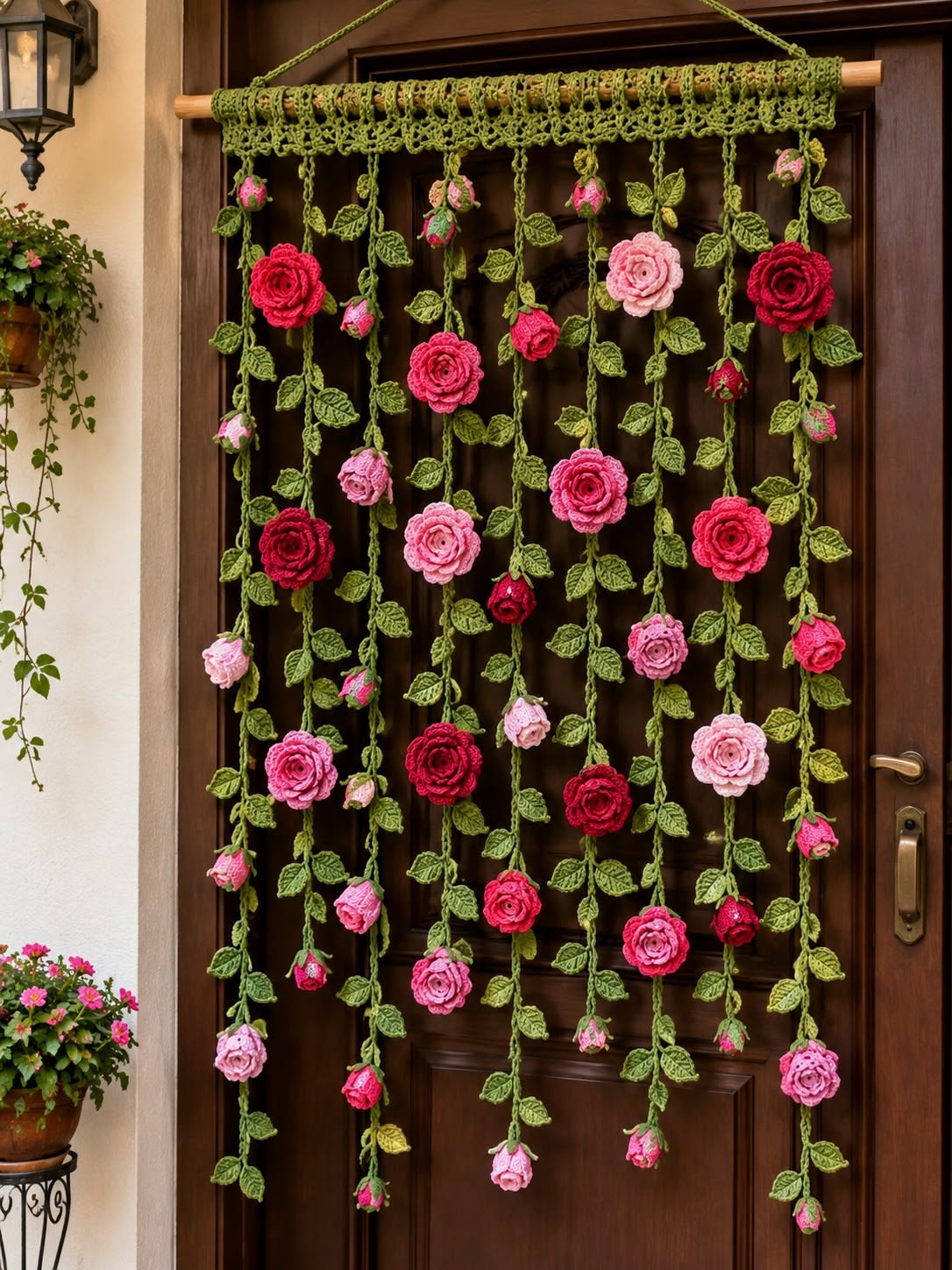
The Crochet Flower Curtain is a beautiful decorative crochet project that transforms handmade roses, delicate leaves, and long green vines into an eye-catching floral hanging for a doorway, window, wall, or special event. Inspired by the arrangement shown in the reference image, this design combines crochet roses, small rosebuds, textured leaves, chains, and an openwork upper border to create the appearance of a cascading rose garden. The result feels romantic and colorful while still showcasing the traditional charm of handmade crochet.
One of the most appealing things about this crochet flower curtain pattern is that the project is modular. Instead of crocheting one enormous piece, you can make individual flowers and leaves at a comfortable pace and assemble them afterward. Deep red, hot pink, blush pink, and pale rose yarns create beautiful variation between the blossoms, while olive or botanical green gives the vines a natural appearance. You can follow the color palette in the photo or customize it to coordinate with your own room.
This project is best suited to an adventurous beginner or intermediate crocheter who is comfortable with chain stitches, single crochet, half double crochet, double crochet, slip stitches, increases, and working in rounds. The finished dimensions can be adjusted easily by adding or removing hanging vines. For a doorway-sized version, a useful starting point is approximately 32–40 in (81–102 cm) wide and 60–72 in (152–183 cm) long, although every strand can be made to a different length for a more organic cascading effect.
Materials, Crochet Stitches, and Planning Your Flower Curtain
Choose a DK or light worsted-weight yarn for a curtain that has visible texture without becoming excessively heavy. Cotton yarn produces crisp flowers and leaves, while cotton-acrylic blends are softer and often lighter. For the main design, prepare several shades of pink or red plus at least one or two shades of green.
DISCOVER MORE FREE PATTERNS HERE!
A 3.5 mm to 4.5 mm crochet hook works well with many yarns in this weight range. Choose the hook that creates firm flowers without making the fabric stiff. You will also need a yarn needle, scissors, stitch markers, measuring tape, and a wooden dowel or curtain rod for displaying the finished project.
Useful U.S. crochet abbreviations include ch (chain), sl st (slip stitch), sc (single crochet), hdc (half double crochet), dc (double crochet), tr (treble crochet), st (stitch), sts (stitches), and rep (repeat). The roses use taller stitches to create petals, while the leaves rely on changing stitch heights to produce their pointed shape.
Before beginning, determine the desired width of your curtain. The photographed arrangement uses multiple vertical vines placed relatively close together. For a medium doorway, approximately 8–12 hanging strands creates a rich floral appearance. Wider windows may require additional strands.
Do not make every vine exactly the same length. For a handmade botanical appearance, alternate lengths such as 48, 54, 60, 64, and 68 in (122, 137, 152, 163, and 173 cm). Flowers can also be positioned at different heights so the design does not resemble perfectly repeated rows.
A beautiful color arrangement might include approximately 25% pale pink flowers, 30% medium pink, 25% bright pink, and 20% deep red. This creates the dimensional appearance visible in the inspiration image. Green should remain dominant along the vines and leaves so the flowers stand out naturally.
Make one sample rose and one sample leaf before producing all the motifs. This allows you to evaluate size, yarn weight, and hook tension. A finished open rose measuring approximately 3–4 in (7.5–10 cm) works beautifully as a focal flower, while smaller buds can measure approximately 1½–2½ in (4–6.5 cm).
How to Crochet Roses, Rosebuds, and Leaves
Begin the main crochet rose with a long foundation chain. For a medium flower, ch 51. Starting in the second chain from the hook, work a foundation that creates spaces for petals: sc in next ch, ch 2, skip 1 ch. Repeat across. The exact number of spaces is less important than maintaining an even foundation.
Turn the work. Inside each chain space, crochet groups of taller stitches to create petals. Start with smaller petals using 5 dc in the first several spaces. Progress to 6 dc, then 7 dc in later spaces. Gradually increasing the petal size produces a convincing rose when the strip is rolled.
Once the petal strip is finished, fasten off while leaving a long sewing tail. Beginning with the smaller petals, roll the strip tightly into a spiral. Allow the outer petals to loosen slightly as you continue rolling. Thread the tail onto a yarn needle and sew through several layers along the underside until the flower is secure.
For a crochet rosebud, make a shorter foundation of approximately ch 21–27. Work smaller petal groups across the strip and roll it more tightly than the full rose. Add a small green calyx underneath by crocheting several pointed sepals around a magic ring.
To make a leaf, ch 10. Beginning in the second chain from the hook, work sl st, sc, hdc, dc, tr, dc, hdc, sc, sl st. Work additional stitches around the opposite side of the foundation chain in reverse order. This creates a symmetrical pointed leaf.
For additional texture, surface slip stitch through the center of the leaf to imitate a central vein. You can also embroider smaller diagonal veins. Make leaves in slightly different sizes by starting with ch 8, ch 10, or ch 12. Variation makes the finished Crochet Flower Curtain appear much more organic.
Crocheting the Green Vines and Assembling the Hanging Strands
The hanging vines can begin as simple crochet chains. For a strand approximately 60 in (152 cm) long, create a chain until it reaches the desired measurement without stretching. If you want a stronger vine, return along the chain with sl st in each ch.
Another attractive option is working sc stitches along the chain. This produces a thicker stem capable of supporting larger roses. Because a curtain may contain dozens of motifs, sturdier vines are especially useful near heavy flowers.
Position leaves approximately every 3–6 in (7.5–15 cm). Avoid placing them at perfectly identical intervals. Sew some leaves individually to the stem and attach others as pairs. Angle them in different directions to imitate natural climbing rose vines.
Arrange your flowers before sewing them permanently. Place the largest open roses at visually important positions and distribute smaller buds between them. A typical long strand could include 2–4 large roses, 2–4 rosebuds, and 8–14 leaves, depending on the desired fullness.
Attach each flower securely with its yarn tail. Pass the needle through the base of the rose and around the vine several times. Keep the stitches hidden behind the blossom. Since the flowers have dimensional weight, weak attachment stitches may allow them to rotate or sag.
When all the vines are assembled, lay them side by side on a large table or clean floor. Step away and inspect the overall arrangement. Move flowers or leaves if two neighboring strands appear too similar. This planning stage makes a substantial difference in the finished floral crochet wall hanging.
Creating the Top Border and Finishing the Crochet Flower Curtain
The top section shown in the inspiration has a decorative openwork appearance. Begin by making a foundation chain approximately equal to the width of your dowel. Work one or two rows of single crochet to create a stable base.
For a simple openwork row, work dc, ch 2, skip 2 sts, dc repeatedly across. On the following row, crochet groups such as 3 dc, ch 3, 3 dc into selected chain spaces to create decorative arches. Repeat a combination of mesh and scalloped rows until the border reaches approximately 3–5 in (7.5–12.5 cm) deep.
Create large loops along the top edge so the curtain can slide onto a wooden dowel. One simple method is sc in the next stitch, ch 8–12, skip several stitches, sc in the next stitch. Keep every loop approximately the same size.
Attach the completed vertical vines along the lower edge of the header. Begin with the center strands and work outward. For a balanced design, leave approximately 3–5 in (7.5–12.5 cm) between attachment points, adjusting the spacing according to the width of your curtain.
Weave in every yarn end securely. With a project containing numerous roses and leaves, there may be many ends, so weaving them in during construction is easier than leaving all finishing work until the end. Lightly steam-block individual leaves if necessary, but avoid pressing dimensional roses flat.
Finally, slide the header onto the dowel and add a strong crocheted hanging cord. Hang the project and allow the strands to settle naturally. Rotate any flowers that face sideways and gently shape the leaves with your fingers.
Suggested Measurements for the Crochet Flower Curtain
| Element | Suggested Size |
|---|---|
| Overall width | 32–40 in / 81–102 cm |
| Overall length | 60–72 in / 152–183 cm |
| Number of vines | 8–12 |
| Large rose | 3–4 in / 7.5–10 cm |
| Rosebud | 1½–2½ in / 4–6.5 cm |
| Leaf | 2–3½ in / 5–9 cm |
| Header depth | 3–5 in / 7.5–12.5 cm |
| Vine spacing | 3–5 in / 7.5–12.5 cm |
These are suggested measurements rather than strict requirements. One advantage of a handmade crochet curtain is that virtually every dimension can be customized.
Recommended Yarn Quantities
For a doorway-sized project, approximately 1,200–2,000 yards (1,100–1,830 m) of yarn may be needed depending on the number of flowers, yarn thickness, and final dimensions. The green vines, leaves, and header usually consume a significant portion of the total yarn.
Buying extra green yarn from the same dye lot is useful because the entire structure depends on a consistent botanical background. Flower colors can vary more freely, making this an excellent project for coordinated yarn leftovers.
Tips for a Professional Result
Keep the roses dimensional rather than completely flat. Secure their bases firmly while allowing the outer petals to curve outward. This creates the lush appearance that makes the design visually striking.
Use multiple shades of green if desired. Darker leaves mixed with medium olive vines can create additional depth without distracting from the flowers.
Alternate large flowers and buds. Filling every strand only with large roses can make the curtain excessively heavy, whereas buds create visual interest with much less yarn.
For a more symmetrical design, arrange the strands on a flat surface before final assembly. For a natural garden effect, intentionally vary flower placement and vine length.
If the curtain will hang in strong sunlight, remember that some yarn colors may fade gradually. A location with indirect light may help preserve vibrant pink and red shades longer.
For households with small children or pets, mount the piece securely and avoid leaving long hanging cords where they could become entangled.
FAQ About the Crochet Flower Curtain
Is the Crochet Flower Curtain suitable for beginners?
An adventurous beginner can make it because most components use basic crochet stitches. The main challenge is producing and assembling many individual motifs.
What yarn is best for crochet flowers?
Cotton, cotton blends, and smooth acrylic yarns all work well. Cotton generally creates especially crisp petals and leaves.
What crochet hook should I use?
Approximately 3.5–4.5 mm is a useful range for DK or light worsted yarn, but always match the hook to your chosen yarn and desired tension.
How many roses do I need?
For a full doorway arrangement, approximately 20–35 flowers and buds can create a lush effect. A smaller window decoration may require considerably fewer.
How many leaves should I crochet?
Expect to make substantially more leaves than flowers. Approximately 60–120 leaves may be appropriate for a large curtain, depending on spacing.
Can I make the curtain shorter?
Yes. Simply shorten each vine. You can also create graduated strands for a V-shaped or curved lower edge.
Can I use different flowers?
Absolutely. Daisies, sunflowers, tulips, lavender, cherry blossoms, or mixed wildflowers could replace the roses while keeping the same basic hanging construction.
How do I keep heavy roses from sagging?
Use firm stitches for the flower bases and attach each rose to the vine through several points rather than relying on a single stitch.
Can this be used as an actual window curtain?
It works best as a decorative openwork curtain because it does not provide privacy or significant light blocking.
How can I wash it?
Follow the care instructions for your yarn. Gentle hand washing is generally easier on dimensional flowers than aggressive machine washing. Reshape the roses and leaves while drying.
Can I make it wider than 40 inches?
Yes. Extend the header and add more hanging vines. Keeping approximately the same spacing between strands will preserve the full appearance.
How can I change the style for another season?
Use white and pastel flowers for spring, bright mixed colors for summer, rust and mustard flowers for fall, or white flowers with deep green leaves for an elegant winter version.
Conclusion
The Crochet Flower Curtain turns relatively simple crochet techniques into a dramatic handmade decoration. By combining crochet roses, rosebuds, textured leaves, green vines, and an openwork crochet header, you can create a cascading floral display that looks detailed and impressive while remaining completely customizable.
The modular construction is also part of what makes this project enjoyable. Each rose or leaf is a small accomplishment of its own, and the curtain gradually grows as those individual motifs are connected. You can work on a few flowers at a time without needing to carry a large project everywhere.
PATTERN VIDEO
Whether displayed across a doorway, window, craft room wall, bedroom, celebration backdrop, or covered patio area protected from weather, this crochet rose curtain pattern brings texture, color, and handmade character to the space. Choose your favorite flower colors, vary the lengths of the vines, and allow every handmade rose to make the finished curtain uniquely yours.