
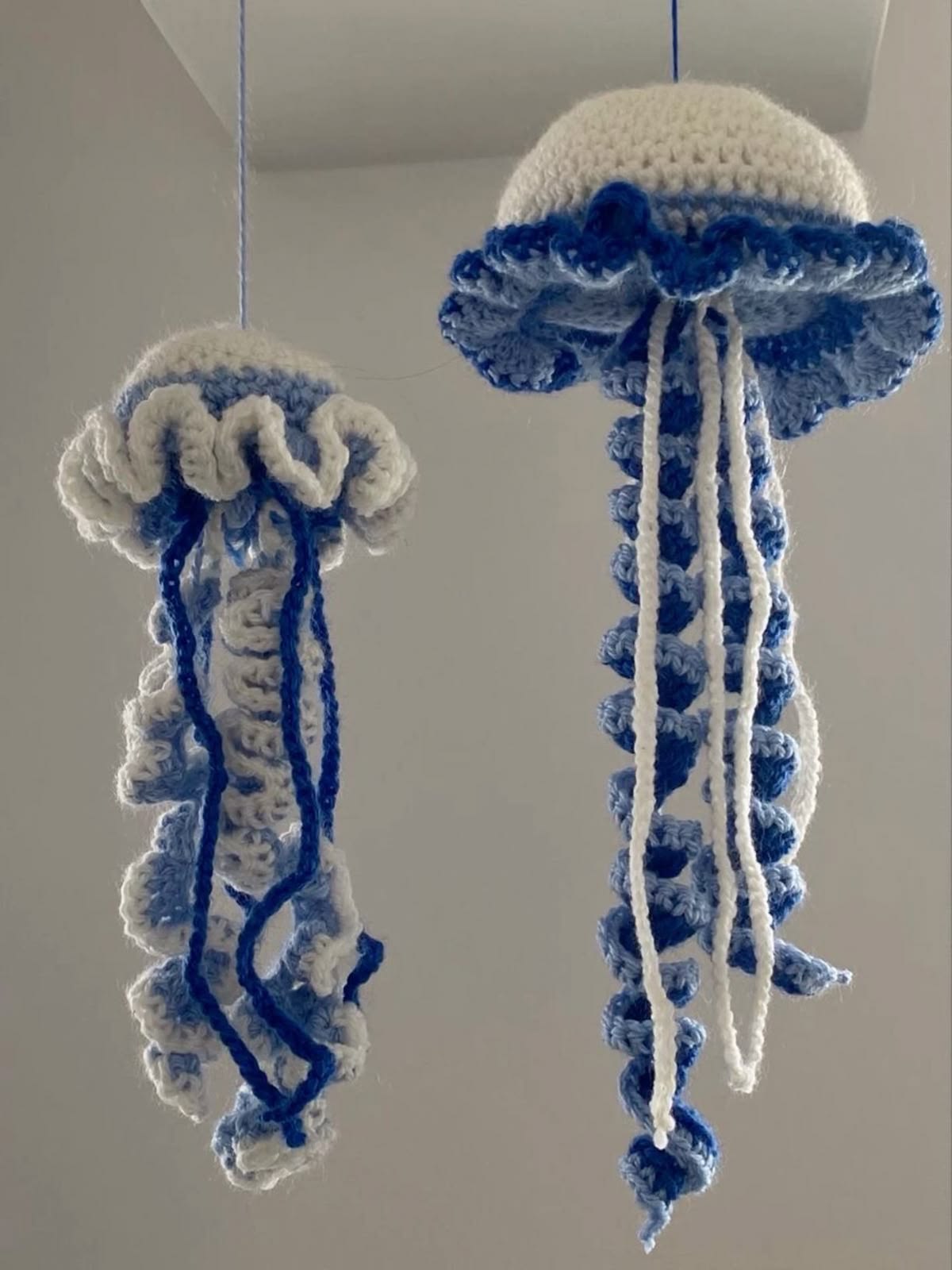
Crochet Jellyfish Pattern projects are a wonderful way to combine simple crochet techniques with flowing textures, soft colors, and creative three-dimensional details. Inspired by the hanging jellyfish shown in the reference image, this design features a rounded dome-shaped body, a decorative ruffled edge, and several long tentacles that move naturally when the finished piece is suspended. The combination of white, pale blue, and deeper ocean blue gives the project a peaceful coastal appearance that works beautifully in nautical décor, craft rooms, nurseries, or handmade decorative displays.
One of the most appealing features of this crochet jellyfish tutorial is that the project can look elaborate without requiring every component to be difficult. The upper dome is primarily constructed with single crochet, while the dramatic lower edge can be created with increases, shells, or ruffles. The tentacles provide another opportunity to experiment because some can remain straight while others can be transformed into spirals using multiple stitches worked into each foundation chain. This mixture of shapes creates the flowing underwater appearance associated with a jellyfish.
This tutorial uses U.S. crochet terminology and provides practical measurements that can be adjusted for different sizes. Because yarn thickness, hook size, and individual tension affect the final dimensions, treat the measurements as a flexible starting point rather than an absolute requirement. A medium jellyfish can have a dome approximately 5–7 inches (13–18 cm) wide, with tentacles ranging from approximately 12–24 inches (30–61 cm). By changing yarn weight or adding additional rounds, the same basic Crochet Jellyfish Pattern can easily become a miniature ornament or a much larger hanging decoration.
Materials, Yarn Colors, Hook Size, and Essential Crochet Stitches
For a medium crochet jellyfish, approximately 200–350 yards (183–320 m) of yarn should be enough, depending on the number and length of the tentacles. A worsted-weight #4 yarn works particularly well because it provides enough body for the dome while remaining soft enough for flowing tentacles. Cotton gives crisp stitch definition, while acrylic creates a softer and often lighter finished decoration.
DISCOVER MORE FREE PATTERNS HERE!
Choose three coordinating colors to reproduce the ocean-inspired appearance. A beautiful combination is soft white, powder blue, and deep royal or navy blue. White can form the upper dome, pale blue can create the lower ruffles, and dark blue can be used as a contrasting border and for selected tentacles. You can also experiment with turquoise, aqua, lavender, coral, or seafoam green.
A 3.5–4.0 mm crochet hook is a practical starting range for worsted-weight yarn. If your stitches are loose, move down one hook size. If the fabric feels excessively stiff, move up slightly. For the stuffed dome, however, the stitches should remain compact enough that the filling does not show through.
You will also need scissors, a yarn needle, stitch markers, and a small amount of polyester fiberfill. If the jellyfish is intended purely as hanging décor, only a modest amount of stuffing is necessary. Overstuffing can flatten the graceful dome shape.
The main crochet abbreviations used throughout the tutorial are ch – chain, sl st – slip stitch, sc – single crochet, hdc – half double crochet, dc – double crochet, inc – increase, and dec – decrease. An increase means working two stitches into one stitch from the previous round. These increases are what gradually transform a small magic ring into the rounded jellyfish dome.
A magic ring is particularly useful for the top because it creates a nearly closed center. If you prefer not to use a magic ring, chain 2 and work the starting stitches into the second chain from the hook. Both methods can produce a successful result.
How to Crochet the Rounded Jellyfish Body and Ruffled Edge
Begin the Crochet Jellyfish Pattern with white yarn and a magic ring. Work 6 sc into the ring and pull the center closed. Place a stitch marker in the first stitch because the dome is easiest to construct in continuous spiral rounds rather than joining every round.
For Round 2, work 2 sc in every stitch for a total of 12 stitches. For Round 3, repeat 1 sc, inc around to reach 18 stitches. Round 4 can use 2 sc, inc around for 24 stitches, followed by 3 sc, inc for 30 stitches. Continue this logical increase sequence until the circle measures approximately 5–7 inches (13–18 cm) across.
Once the desired diameter is reached, stop increasing and work several rounds of sc evenly around. This transforms the flat circle into a shallow dome. Depending on your yarn and desired proportions, approximately 5–9 even rounds should produce a pleasant curved shape.
Now begin shaping the underside. Work one or two rounds with occasional decreases, but avoid closing the dome completely. The bottom should remain broad enough to accommodate the decorative ruffles and tentacles. Add a light amount of stuffing while the opening is still easy to access.
The dramatic crochet ruffled edge can be created by increasing aggressively around the final body round. For example, work 3 dc into each stitch or alternate groups of 3 dc and 4 dc. The large number of stitches forces the fabric to ripple naturally. Work another ruffled round in pale blue if you want additional depth.
Finish the edge with deep blue using sc, picot stitches, or a combination such as sc, ch 3, sl st into the first chain. Repeating this sequence produces tiny decorative points around the ruffle. The contrasting border emphasizes the waves and gives the jellyfish a more polished appearance.
Creating Straight, Spiral, and Textured Crochet Tentacles
The tentacles are where this crochet jellyfish pattern becomes especially creative. Rather than making every strand identical, combine several styles and lengths. This creates the layered movement visible in decorative jellyfish designs and prevents the lower portion from appearing too uniform.
For a basic straight tentacle, attach yarn to the underside and chain 50–80 stitches. Turn and work one sl st or sc into each chain. A finished strand of approximately 16–20 inches (41–51 cm) works well for a medium jellyfish, although some strands can be deliberately shorter.
For a thicker straight tentacle, chain to the desired length and return using sc in every chain. You can also work a second row if you want a flatter ribbon-like strand. White tentacles against blue spirals create especially strong visual contrast.
To make the classic crochet spiral tentacle, chain approximately 50–70 stitches. Beginning in the second chain from the hook, work 2 or 3 sc into every chain. As the stitch count rapidly increases, the strand will twist automatically into a corkscrew.
For a larger, softer spiral, use 3 hdc in each chain instead. Double crochet can produce an even wider curl. Try making several spiral tentacles with different stitch heights so that the finished jellyfish has varied texture rather than identical curls.
Another attractive option is a scalloped tentacle. Crochet a long foundation chain and repeat sl st, sc, hdc, 3 dc, hdc, sc along it. This creates a gently waving strand instead of a tight spiral. Alternating dark and light blue yarn makes these textured sections particularly noticeable.
Arrange the finished tentacles before securing everything permanently. Place the longest strands near the center and distribute shorter curls around the outside. Approximately 6–12 tentacles provide a full appearance for a medium jellyfish. Sew each strand securely through several stitches on the underside.
Assembly, Hanging Loop, Finishing, and Customizing Your Jellyfish
After completing the tentacles, inspect the underside and weave in all yarn ends securely. The attachment points should be strong because long crochet spirals have more weight than they initially appear to have. A yarn needle makes it easy to bury the ends inside the stuffed body.
For hanging, attach yarn securely to the center of the dome and make a long chain. The loop can measure approximately 8–16 inches (20–41 cm) depending on where the jellyfish will be displayed. Slip stitch back along the chain if you want a stronger hanging cord.
Check the ruffles from every direction. If one section appears flatter than the others, additional shells can be crocheted directly into that section. If the ruffle is excessively dense, gently steam-blocking appropriate yarn fibers from a safe distance can help arrange the shape. Always follow the care recommendations for your specific yarn.
You can also create a family of crochet jellyfish decorations in several sizes. For a smaller version, stop the dome increases after 24 or 30 stitches and use shorter tentacles. For a larger version, continue increasing to 48, 54, or even 60 stitches before working the straight rounds.
Color changes dramatically alter the personality of the project. White and blue provide a classic ocean palette, while pink and lavender create a softer whimsical version. Turquoise and green feel tropical, and cream with muted blue works beautifully for coastal home décor. Variegated yarn can also produce interesting spiral tentacles.
If the finished project will be accessible to babies or young children, treat it as décor rather than a crib toy unless it has been specifically designed and tested for that use. Long cords and hanging strands can present entanglement hazards. Keep hanging decorations securely installed and out of a young child’s reach.
FAQ About the Crochet Jellyfish Pattern
Is this Crochet Jellyfish Pattern suitable for beginners?
Yes. A simplified version is very approachable for beginners who know chain stitches, single crochet, increases, and slip stitches. The ruffles and spiral tentacles are excellent techniques to learn after mastering basic stitches.
What yarn is best for a crochet jellyfish?
Cotton, acrylic, and cotton-acrylic blends can all work well. Cotton creates more defined stitches, while acrylic generally gives the tentacles a softer appearance.
What size hook should I use?
For worsted-weight yarn, a 3.5–4.0 mm hook is a useful starting point. Adjust according to your yarn label and personal crochet tension.
How do I make crochet tentacles curl?
Make a foundation chain and work multiple stitches into every chain. Working 2–3 sc or hdc into each chain creates excess fabric, forcing the strand into a spiral.
How many tentacles should a crochet jellyfish have?
There is no fixed number. Around 6–12 strands usually create a nicely filled medium decoration, but you can add more for a fuller appearance.
How long should the tentacles be?
For a medium project, try lengths between 12 and 24 inches (30–61 cm). Using several different lengths gives the finished piece more natural movement.
Can I use leftover yarn?
Absolutely. This is a useful scrap yarn crochet project, especially for the ruffles and individual tentacles.
Does the jellyfish body need stuffing?
A small amount helps maintain the dome shape. Avoid packing it too tightly because the body should remain softly rounded.
How can I make the ruffle fuller?
Increase the number of stitches worked into each stitch of the previous round. Three double crochets per stitch create considerably more movement than two.
Can I make the jellyfish without stuffing?
Yes. For lightweight hanging décor, the dome can be left mostly hollow, although it may not retain as rounded a shape.
Can I change the finished size?
Yes. Add or remove increase rounds from the dome and adjust the tentacle lengths proportionally.
Why is my crochet circle becoming wavy too early?
You may be adding too many increases. The upper dome should increase gradually. Save aggressive increases for the decorative ruffle.
Why is my dome curling inward?
Too few increases can cause the fabric to cup prematurely. Check your stitch count and make sure the increases are evenly distributed.
Can the tentacles use different crochet stitches?
Yes. Mixing sc, hdc, dc, chains, shells, and spiral crochet creates a more interesting finished piece.
How do I make several jellyfish look coordinated?
Use the same three-color palette while changing the size, tentacle arrangement, or order of the colors. This creates a coordinated set without making every jellyfish identical.
Conclusion
The Crochet Jellyfish Pattern is a creative project that turns basic crochet techniques into an eye-catching hanging decoration. A simple rounded dome provides the foundation, while layered ruffles and flowing tentacles create the movement and texture that make the design immediately recognizable.
The secret to achieving a beautiful result is variety. Combine straight crochet tentacles, spiral curls, scalloped strands, pale colors, and darker contrasting borders. Allow some tentacles to hang significantly lower than others, and avoid making every element perfectly symmetrical.
This project is also easy to customize. Changing the yarn weight alters the scale, changing the colors transforms the style, and adding or removing tentacles adjusts the overall fullness. Once you understand how the dome and spirals are constructed, you can create an entire collection of unique jellyfish.
PATTERN VIDEO :
Whether made in classic white and ocean blue or a completely different palette, this crochet jellyfish tutorial offers an enjoyable way to practice shaping, increases, decorative edging, color changes, and three-dimensional crochet. The finished piece brings together simple stitches and playful movement to create a distinctive handmade ocean-inspired decoration.