
The Lace Sleeve Crochet Blouse Pattern is an elegant combination of a beautifully fitted crochet body and dramatic openwork sleeves, creating a handmade garment that looks sophisticated while still feeling comfortable enough for everyday wear. The design shown here combines a relatively solid torso with decorative crochet lace sleeves, fitted cuffs, a softly rounded neckline, and a delicate openwork border along the lower edge. The contrast between dense and airy crochet gives the blouse its distinctive character and makes it an excellent project for crocheters who want to move beyond basic tops.
One of the most attractive details of this Lace Sleeve Crochet Blouse Pattern is the sleeve construction. Instead of using the same stitch throughout the entire garment, the sleeves incorporate an open shell or fan-inspired lace repeat. Extra width through the upper and middle sleeve creates the soft puff sleeve silhouette, while the fitted cuff gathers that fullness neatly around the wrist. The result is romantic without being overly complicated, particularly once the crocheter understands how the lace repeat is constructed.
This tutorial uses U.S. crochet terminology and provides a flexible construction method rather than relying on one fixed body measurement. For a medium adult size, a finished bust circumference of approximately 38–40 in (96.5–101.5 cm) works well, but the blouse can easily be customized. Measure the wearer before beginning and create a gauge swatch using the actual yarn and hook selected for the project. Accurate gauge, thoughtful yarn selection, and periodic fitting are essential when making a wearable crochet blouse pattern.
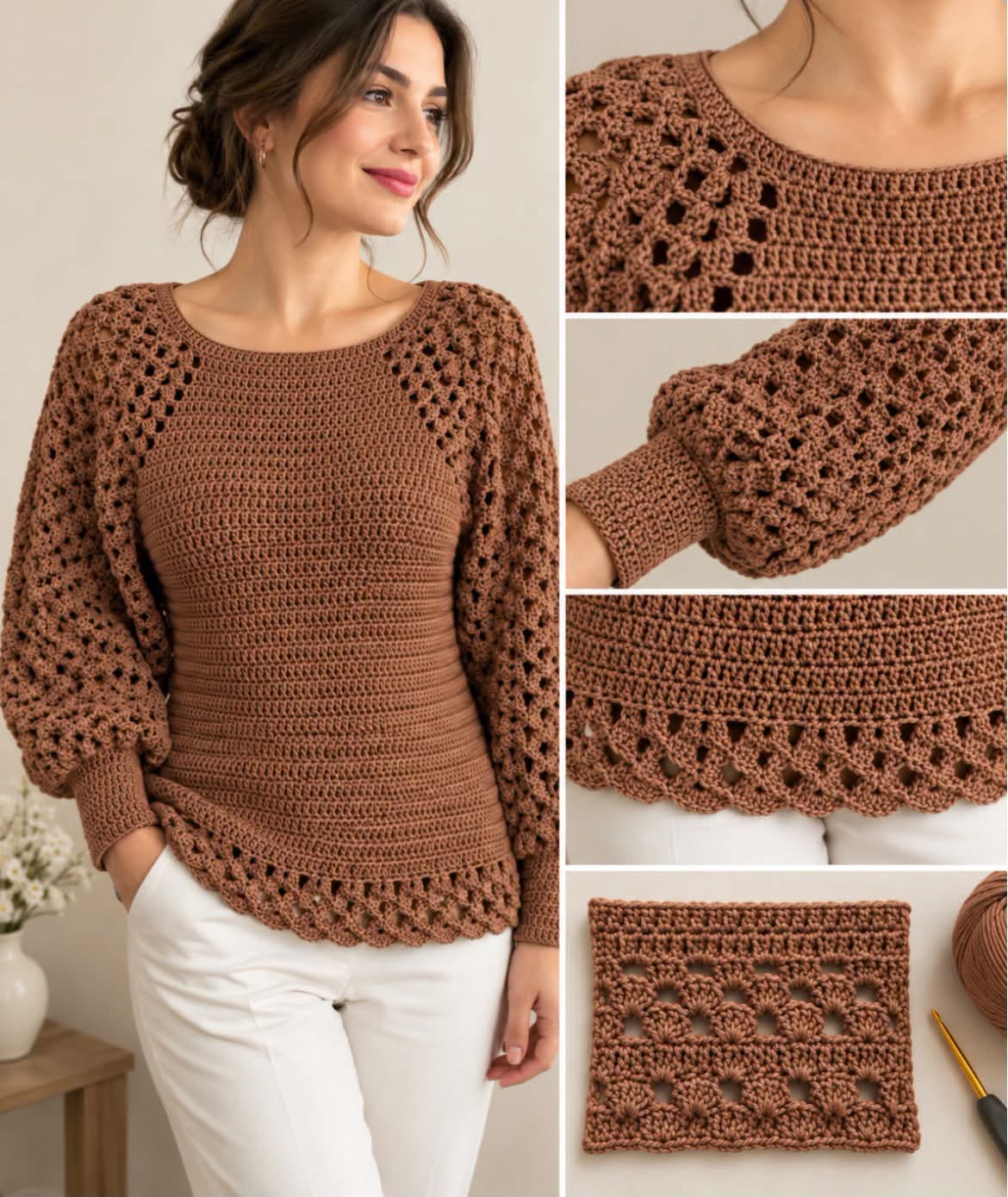
Materials, Gauge, Measurements, and Crochet Stitch Guide
A smooth DK weight yarn (Category 3) is an excellent choice for this blouse because it provides enough stitch definition for the lace while remaining light enough for comfortable sleeves. Cotton, cotton-bamboo, cotton-acrylic, or other soft plant-fiber blends can work particularly well. For an adult medium blouse, approximately 1,200–1,600 yards (1,100–1,460 m) may be required, depending on sleeve fullness, garment length, yarn characteristics, and individual gauge.
DISCOVER MORE FREE PATTERNS HERE!
Start with a 4.0 mm (G/6) crochet hook and adjust the hook size until the desired gauge is achieved. You will also need removable stitch markers, a flexible measuring tape, yarn needle, scissors, and blocking pins. A smaller hook, around 3.5 mm, can optionally be used for the neckline and cuffs when a firmer finish is desired.
A useful target gauge for the solid body is approximately 18 double crochet stitches × 10 rows = 4 × 4 in (10 × 10 cm) after blocking. This is only a suggested starting point. Your personal gauge determines the actual number of stitches required, so always make a generous swatch before calculating the blouse dimensions.
The main U.S. crochet abbreviations used in this project are: ch = chain, sl st = slip stitch, sc = single crochet, hdc = half double crochet, dc = double crochet, tr = treble crochet, sk = skip, sp = space, st/sts = stitch/stitches, and rep = repeat. A shell refers to several tall stitches worked into the same stitch or chain space to create a fan-like section.
For sizing, measure the full bust, waist or hip area where the blouse will finish, shoulder-to-hem length, upper arm circumference, wrist circumference, and desired sleeve length. Add approximately 2–4 in (5–10 cm) of positive ease to the bust measurement if you prefer a relaxed fit. For a closer-fitting body similar to the reference, use approximately 1–2 in (2.5–5 cm) of positive ease.
The blouse can be made in one color for a refined appearance. Warm brown, caramel, cream, burgundy, forest green, navy, dusty rose, or black can all emphasize the lace beautifully. Solid yarns generally show the crochet lace stitch pattern more clearly than highly variegated yarns.
Crocheting the Solid Body and Shaping the Neckline
The body can be constructed from two simple panels or worked in joined rounds from the lower edge upward. For easier size customization, this tutorial uses a front-and-back panel construction. Begin with a foundation chain that measures approximately half of your desired finished bust circumference.
For example, if you want a 40-inch (101.5 cm) finished bust, each panel should measure approximately 20 inches (51 cm) wide before seaming. Adjust the foundation chain according to your gauge rather than relying on a universal stitch count.
Work the first row in dc, beginning in the appropriate chain from the hook. Continue working even rows of dc until the panel reaches approximately the lower bust or underarm level. Check the width frequently because crochet fabric can relax as it becomes larger.
The front and back should remain relatively solid, reproducing the clean texture visible through the central portion of the blouse. If you prefer slightly denser fabric, substitute hdc for dc. A simple repeating stitch also allows the decorative sleeves to remain the visual focus.
When you reach the armhole area, continue the back panel straight or introduce modest shoulder shaping. For the front, begin forming the round neckline approximately 3–4 in (7.5–10 cm) below the final shoulder height. Divide the work into right and left shoulders and gradually decrease stitches along the neckline edge.
A simple neckline decrease can be made by working dc2tog near the inner edge on several consecutive rows. Rather than making a sudden rectangular opening, gradual decreases produce a smoother curve. Continue until each shoulder reaches the required width.
Create the back neckline with a shallower curve, usually beginning only 1–2 in (2.5–5 cm) below the shoulder. Once both panels are complete, lightly block them to the intended dimensions and seam the shoulder sections using mattress stitch or slip stitches.
Making the Openwork Lace Puff Sleeves and Fitted Cuffs
The sleeves are the signature feature of the Lace Sleeve Crochet Blouse Pattern. After joining the shoulders, mark the desired armhole depth on both sides. Sew the body side seams from the lower edge upward, stopping at these markers.
Join yarn at the underarm and work evenly around the armhole. The first sleeve round can be made in sc or dc, creating a stable foundation for the decorative lace. Count your stitches and adjust so the total accommodates the chosen lace repeat.
A simple lace foundation can use a sequence such as dc, ch 2, sk 2, dc, repeated around. On subsequent rounds, work shell groups into the chain spaces. For example, a decorative shell can be formed by working 3 dc, ch 2, 3 dc into selected spaces, with connecting chains or single crochets between shells.
To produce the dramatic crochet puff sleeve, gradually increase the number or width of lace repeats during the upper portion of the sleeve. Instead of adding increases randomly, distribute them evenly around the round. Continue without decreases through much of the sleeve so the openwork fabric remains full.
As the sleeve approaches the wrist, begin controlled decreases over several rounds. You can reduce chain spaces, replace larger shells with smaller groups, or work dc2tog between repeats. The goal is to gather the lace smoothly rather than creating abrupt folds.
Once the opening is close to the wrist measurement, switch to a denser stitch for the crochet cuff. Work several rounds of sc or hdc. For a ribbed appearance, crochet the cuff separately using back-loop-only single crochet, then seam it into a ring and attach it around the sleeve opening.
The cuff should fit comfortably without restricting movement. A finished depth of approximately 3–4 in (7.5–10 cm) creates the elongated cuff appearance seen in the design. Repeat the entire sleeve process carefully on the second side, counting rounds so both sleeves match.
Adding the Lace Hem, Neckline Finish, Assembly, and Blocking
After the sleeves are complete, return to the lower edge of the blouse. Join the yarn at a side seam and work one foundation round of sc or dc around the hem. Make sure the stitch count is suitable for your lace repeat.
Create the lower decorative border using the same visual language as the sleeves. A simple first lace round can alternate dc groups and chain spaces. The following round can expand those spaces into small shells or fans.
For a scalloped final edge, work something similar to (sc, hdc, 3 dc, hdc, sc) into each selected chain space. This creates the softly rounded motifs along the hem. Adjust the number of tall stitches if the border begins to ripple.
Finish the neckline with one or two rounds of sc. If the neckline feels too loose, work occasional decreases by skipping evenly distributed stitches. If it feels too tight, use a slightly larger hook or add small chain spaces at regular intervals.
Weave in all yarn ends securely using a yarn needle. Pay special attention to the underarms, cuffs, shoulders, and beginning and ending points of lace sections because these areas experience more movement during wear.
Finally, wet block the crochet blouse according to the yarn manufacturer’s care instructions. Shape the body to the correct dimensions and gently spread the lace motifs with your fingers. Do not overstretch the cuffs or neckline. Allow the garment to dry completely before wearing it.
Frequently Asked Questions About the Lace Sleeve Crochet Blouse Pattern
Is the Lace Sleeve Crochet Blouse Pattern suitable for beginners?
It is best suited to an adventurous beginner or intermediate crocheter. The solid body is straightforward, but garment sizing, neckline shaping, lace repeats, and puff sleeves require careful counting.
What yarn weight works best?
DK weight yarn (Category 3) is a good starting point because it balances drape, stitch definition, and coverage.
Can I use cotton yarn?
Yes. Cotton and cotton-blend yarns are excellent for a crochet lace blouse, especially when you want crisp stitch definition.
How much yarn will I need?
Approximately 1,200–1,600 yards (1,100–1,460 m) is a reasonable estimate for a medium adult size, but larger sizes, longer bodies, or fuller sleeves will require more.
What hook size should I use?
Start around 4.0 mm (G/6) and change hook size as necessary to achieve your intended gauge and fabric drape.
How do I make the blouse larger?
Calculate your desired finished bust measurement, divide it by two, and make each body panel to that width. Keep the lace repeat multiple in mind when adjusting sleeve stitch counts.
Can I make shorter sleeves?
Absolutely. Stop the lace section at the desired length and begin the fitted cuff earlier.
Why are my lace sleeves too wide?
You may have added too many increases or used a larger gauge than intended. Measure the upper arm and compare the sleeve circumference before continuing.
Why does my lace look tight?
Chains are often worked more tightly than other crochet stitches. Try consciously relaxing your chains or using a slightly larger hook for the lace section.
Can I make the body longer?
Yes. Add more straight rows before beginning the hem border.
Can the blouse be made without the scalloped hem?
Yes. Finish with several rounds of sc, hdc, or ribbing if you prefer a simpler appearance.
How can I make the sleeves less dramatic?
Use fewer increases and begin decreasing toward the wrist earlier. This creates a straighter sleeve while preserving the lace texture.
Should the blouse be blocked?
Yes. Blocking crochet lace helps open the motifs, smooth the body stitches, and improve the overall garment shape.
Can I use acrylic yarn?
A soft acrylic or acrylic blend can work, although its drape and blocking behavior will differ from cotton or bamboo blends.
How do I make both sleeves identical?
Write down every round as you complete the first sleeve. Record the stitch count, number of lace repeats, increase rounds, straight rounds, and decrease rounds, then reproduce them exactly.
Conclusion
The Lace Sleeve Crochet Blouse Pattern brings together several beautiful crochet techniques in a garment that can become a standout handmade wardrobe piece. The relatively simple solid body provides structure and comfortable coverage, while the openwork sleeves introduce texture, movement, and an elegant handcrafted character.
The most important part of making this blouse successfully is not rushing the preparation. Crochet a gauge swatch, take accurate body measurements, calculate the desired ease, and check the garment against those measurements throughout construction. This approach is much more reliable than depending entirely on a fixed stitch count.
The lace puff sleeves deserve particular attention. Consistent shell placement and evenly distributed increases create their soft volume, while gradual decreases and fitted cuffs bring that fullness under control. The same lace-inspired technique can then be echoed along the lower hem to create visual balance throughout the garment.
With its rounded neckline, fitted body, dimensional sleeves, decorative openwork, and scalloped hem, this crochet lace blouse offers a satisfying combination of practical garment construction and decorative crochet. Once you understand the basic structure, the pattern can easily be personalized with different sleeve lengths, body lengths, colors, yarn fibers, and lace repeats, making it a versatile design worth adapting again and again.