
The Denim Apron Pattern is a beautiful and practical sewing project that combines the durability of denim with the charm of traditional quilting, gingham fabric, decorative pockets, lace, appliqué, and a gathered ruffle. Inspired by the apron design shown in the reference image, this project creates a comfortable full-length apron with a shaped bib, neck strap, waist ties, useful front pocket, and decorative details that can be customized in many different ways.
A handmade denim apron is particularly useful because denim provides enough body to protect clothing while remaining easy to sew on a domestic sewing machine when a medium-weight fabric is selected. The contrasting gingham details give the apron a cheerful farmhouse character, while heart appliqués and decorative trims make it feel more like a carefully designed quilted accessory than an ordinary utility apron. Red-and-white, blue-and-white, and yellow-and-white gingham all coordinate beautifully with classic blue denim.
This DIY denim apron pattern can be adapted for cooking, baking, gardening, sewing, quilting, crafting, or simply as a decorative handmade gift. The tutorial below creates an adult apron approximately 32 inches (81 cm) long and 27½ inches (70 cm) wide at the lower edge, although the measurements can easily be adjusted. The construction uses straightforward sewing methods, making the project approachable for confident beginners while leaving plenty of room for experienced sewists to add quilting, embroidery, patchwork, or more elaborate appliqué.
Materials, Measurements, and Cutting the Denim Apron Pattern
For the main apron body, choose approximately 1¼ yards (1.15 m) of medium-weight denim. Avoid extremely heavy jeans denim because several construction areas will contain multiple layers. Lightweight or medium-weight cotton denim is easier to turn, topstitch, and decorate.
DISCOVER MORE FREE PATTERNS HERE!
You will also need approximately ¾ yard (70 cm) of gingham cotton for the ruffle, straps, appliqués, and optional pocket details. Select red, blue, yellow, pink, or another coordinating color. Approximately 1–2 yards (0.9–1.8 m) of cotton lace or decorative trim can be used around pockets and across the apron.
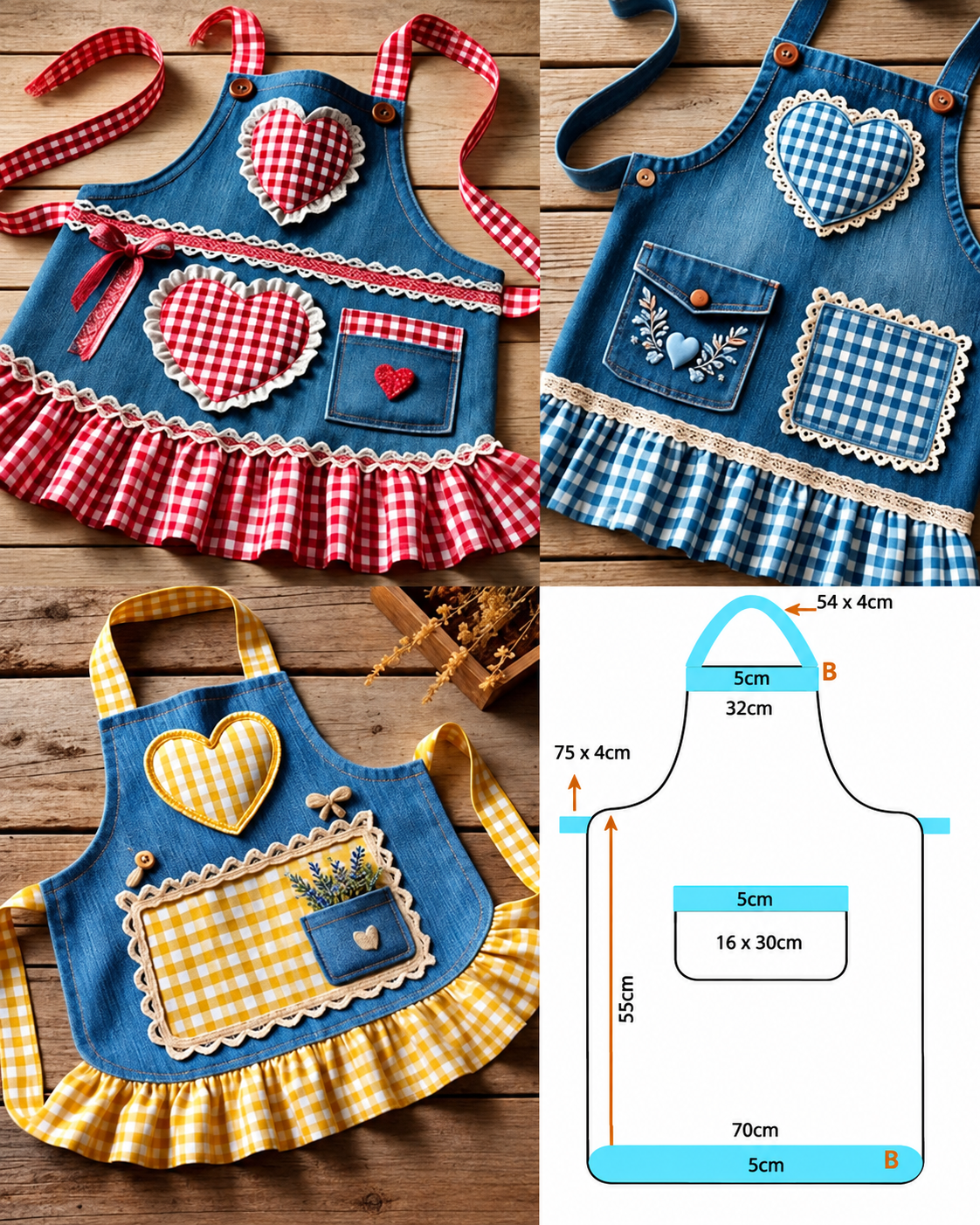
For an adult medium-size apron, begin with a main body approximately 27½ inches (70 cm) wide and 32 inches (81 cm) long. The straight lower portion can measure approximately 21½ inches (55 cm) before the curved sides begin narrowing toward the bib.
The upper bib can measure approximately 12½ inches (32 cm) wide. From the waist area, draw smooth inward curves toward the upper bib. Instead of making sharp transitions, use a French curve, dinner plate, or freehand line to create comfortable arm openings.
For the neck strap, cut a strip approximately 21 × 1½ inches (54 × 4 cm) before folding and sewing. If you prefer an adjustable neck strap, make it longer and add a button, buckle, or D-ring system.
Cut two waist ties approximately 29½ × 1½ inches (75 × 4 cm) each. These dimensions can be increased if you prefer ties that wrap around the body and fasten at the front.
For a practical front pocket, prepare a piece approximately 11¾ inches (30 cm) wide × 6¼ inches (16 cm) high. You can use denim, gingham, patchwork, or a combination of fabrics.
For the gathered lower ruffle, cut gingham strips totaling approximately 1.5 to 2 times the width of the lower apron edge. A finished ruffle depth of approximately 4–5 inches (10–13 cm) creates the full decorative appearance visible in the inspiration.
Additional materials include coordinating polyester or cotton thread, denim sewing-machine needles in size 90/14 or 100/16, pins or quilting clips, scissors, rotary cutter, cutting mat, acrylic ruler, measuring tape, fabric marker, iron, lightweight fusible interfacing, optional batting for dimensional appliqués, and decorative buttons.
Preparing the Denim Body, Straps, Pocket, and Heart Appliqués
Fold the denim in half vertically before cutting the apron body. Draw only one half of the pattern so that both sides will remain symmetrical when the fabric is unfolded. Mark the bib width, waist level, overall length, and curved arm openings carefully.
Cut the denim and unfold it. Check that the curves are symmetrical. If necessary, fold the apron again and trim tiny differences before beginning construction. Accurate cutting at this stage makes the finished Denim Apron Pattern look much more professional.
Prepare the straps by folding each gingham strip lengthwise with right sides together. Stitch along the long edge using approximately a ¼-inch (6 mm) seam allowance. Turn the strips right side out, press carefully, and topstitch close to both edges.
If turning narrow straps feels difficult, use an alternative method. Fold both long raw edges toward the center, press, fold the entire strip in half again, and topstitch. This creates sturdy straps without requiring a turning tool.
For the front pocket, fold the upper raw edge toward the wrong side by approximately ½ inch (1.3 cm) twice. Press and topstitch. Fold the remaining sides inward by approximately ¼–½ inch (6–13 mm), press, and position the pocket on the apron.
A decorative gingham pocket can be framed with lace before being attached. For a quilt-inspired appearance, layer the pocket with lightweight batting and backing fabric and add a few lines of quilting before sewing it onto the apron.
To create the dimensional heart decoration, cut two matching heart shapes from gingham fabric. Place them right sides together over a thin piece of batting, stitch around the perimeter while leaving a small turning opening, trim the curves carefully, turn right side out, and lightly stuff if desired. Close the opening with invisible stitches.
Position the heart on the upper bib or lower body and hand-sew or machine-appliqué it into place. A narrow lace ruffle can be positioned underneath the heart before attachment to create the decorative framed effect seen in the inspiration.
Sewing the Apron Body and Adding the Decorative Ruffle
Finish the curved side edges before attaching the straps. One attractive option is a narrow double-fold hem. Turn the raw edge approximately ¼ inch (6 mm) toward the wrong side, press, turn again, and stitch close to the folded edge.
For curved areas, make the first fold narrow so the fabric can follow the shape without puckering. Steam pressing helps enormously. Bias binding is another excellent option and can introduce additional gingham color around the arm openings.
Position the neck strap at the two upper bib corners. Reinforce these attachment points with a rectangular stitch pattern or small stitched X because the strap will receive repeated pulling during use.
Attach the waist ties at the sides near the natural waistline. Fold the raw ends inward before stitching so no unfinished edges remain exposed. Reinforce these points in the same way as the neck strap.
Next, prepare the gingham ruffle. Join shorter fabric strips until you have approximately 1.5–2 times the length of the apron bottom. Finish the lower edge with a narrow hem.
Sew two parallel rows of long machine basting stitches along the upper raw edge without backstitching. Leave long thread tails at both ends. Gently pull the bobbin threads to gather the fabric evenly until the ruffle matches the width of the lower apron edge.
Pin or clip the gathered ruffle to the apron with right sides together. Distribute the gathers evenly, paying particular attention to the corners. Stitch securely, finish the raw seam with a zigzag stitch or serger, then press the seam allowance upward toward the denim.
For an attractive finishing detail, sew cotton lace trim over the seam where the ruffle meets the denim. This hides the construction seam while adding the decorative farmhouse appearance characteristic of the design.
Quilting, Decorative Details, Fit Adjustments, and Professional Finishing
Once the main construction is complete, decide how elaborate you want your quilted denim apron to become. Decorative topstitching in contrasting thread can emphasize the bib, pockets, arm curves, and lower edge.
Additional heart appliqués can be positioned on the pocket or apron body. Use different gingham colors for seasonal variations. Red gingham creates a classic country-kitchen appearance, blue looks fresh and traditional, while yellow gives the apron a bright spring or summer personality.
A small utility pocket can be added over the larger decorative pocket. A finished size of approximately 4 × 5 inches (10 × 13 cm) is useful for small sewing tools, recipe notes, a thermometer, pencil, or other lightweight accessories.
If you want more protection while cooking, enlarge the lower body. If the apron is mainly decorative, the sides can be narrowed. The most important measurement is the distance from the upper bib to the waist because this determines where the apron sits on the body.
For a larger size, add approximately 1–2 inches (2.5–5 cm) to each side and lengthen the waist ties. For a petite version, reduce the overall length and slightly narrow the bib. Always make a quick paper or inexpensive-fabric test if substantially changing the dimensions.
Press every seam carefully after sewing. Denim responds particularly well to pressing, but use appropriate heat for any synthetic trim or lace. A tailor’s clapper can help flatten bulky seam intersections.
Finally, inspect all stress points. Reinforce the neck strap, waist ties, and upper corners of pockets. Trim loose threads and make sure decorative buttons are sewn securely. These finishing steps turn a simple DIY apron pattern into a durable handmade project suitable for frequent use.
Frequently Asked Questions About the Denim Apron Pattern
Is the Denim Apron Pattern suitable for beginners?
Yes. A confident beginner who can sew straight seams, curved hems, and gathered fabric should be able to complete the project successfully.
What type of denim should I use?
Lightweight to medium-weight cotton denim is ideal. Very heavy jeans denim can become difficult to sew where multiple layers overlap.
How much denim is required?
Approximately 1¼ yards (1.15 m) should be enough for most adult versions, depending on fabric width and final dimensions.
How much gingham fabric do I need?
Approximately ¾ yard (70 cm) provides enough material for the ruffle, straps, pocket accents, and appliqués in most versions.
What is the approximate finished size?
The suggested adult apron measures about 32 inches (81 cm) long and up to 27½ inches (70 cm) wide across the lower body.
What seam allowance should I use?
A ¼-inch (6 mm) seam allowance works well for decorative construction, while ⅜–½ inch (1–1.3 cm) can be used for major seams if additional strength is desired.
Can recycled jeans be used?
Yes. This is an excellent upcycled denim sewing project. Large leg sections can be opened flat and joined if necessary.
Can I use quilting cotton instead of denim?
Absolutely. Quilting cotton creates a lighter apron. Lightweight fusible interfacing can be added to the bib if more structure is desired.
How do I create the gathered ruffle?
Sew two rows of long basting stitches along the upper edge and gently pull the bobbin threads until the fabric fits the apron width.
How much fabric should I use for the ruffle?
Use approximately 1.5–2 times the finished width of the area being ruffled.
Can I omit the ruffle?
Yes. Simply finish the lower apron edge with a double-fold hem or binding.
How can I make the neck strap adjustable?
Use a longer strap with a button and buttonhole, D-rings, buckle, or slider.
Can the apron have more pockets?
Yes. Multiple pockets are especially useful for sewing, quilting, gardening, and craft-room versions.
Can batting be added?
Batting is unnecessary for the entire apron, but small amounts work beautifully behind decorative quilted appliqués or pockets.
What sewing-machine needle works best?
A 90/14 denim needle is appropriate for medium-weight denim. Use a 100/16 needle if the fabric is heavier or several layers must be crossed.
Can this pattern be made as a gift?
Yes. The customizable colors, appliqués, pockets, and decorative trims make this an excellent handmade gift for cooks, bakers, gardeners, quilters, and sewists.
Conclusion
The Denim Apron Pattern combines practical protection with the decorative appeal of quilting and traditional fabric crafts. Denim creates a strong foundation, while gingham ruffles, heart appliqués, lace trim, pockets, and colorful straps transform the basic apron into a distinctive handmade piece.
Construction begins with a symmetrical shaped apron body approximately 27½ inches (70 cm) wide and 32 inches (81 cm) long. The design is then completed with a comfortable neck strap, long waist ties, useful pockets, optional dimensional hearts, and a generously gathered lower ruffle.
One of the greatest advantages of this quilted denim apron pattern is customization. Red-and-white gingham creates a cheerful farmhouse style, blue-and-white gives the design a classic appearance, and yellow-and-white produces a bright, welcoming finish. Scraps from previous quilting projects can also be incorporated into pockets and appliqués.
PATTERN VIDEO
Whether made for cooking, sewing, quilting, gardening, crafting, or gifting, this Denim Apron Pattern provides an enjoyable way to combine useful sewing techniques with creative fabric design. Careful cutting, consistent seams, secure strap reinforcement, and thoughtful decorative details will result in an apron that is attractive, comfortable, and durable enough to be enjoyed for years.